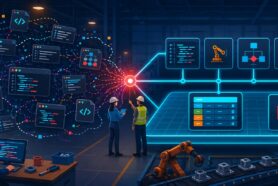
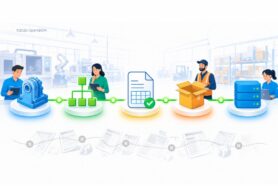
For most of my career in PLM, I’ve watched engineering teams rely on routed documents—ECO packets, PDFs, and linear approval workflows—to manage product changes. It worked for a long time. But the way we design and build products today requires something more adaptive: connected data, real-time collaboration across companies, and intelligent agents that can operate on a shared product memory.
In this article, I want to show the transition I believe the industry is making: from routed documents → to routed data → to routed intelligence.
Today’s article closes the “vision and architecture” segment of this 30-day journey. Over the past few days, I tried to explain how modern PLM must evolve beyond monolithic architectures and limited point-to-point integrations. If you missed these previous posts, here are the links:
Day 17 — Composable PLM & Digital Thread
Day 18 — ERP Near PLM & The Design-to-Order Gap
Day 19 — PLM for the Extended Enterprise
Day 20 — Multi-Tenant SaaS as the New Standard for PLM
Each of these themes—composability, ERP-near-PLM, extended enterprise, multi-tenancy—represents an architectural layer in what I see as the future of PLM.
And all of them converge into one important question:
What will engineering work actually look like over the next decade?
If the last 20 years of PLM were defined by documents, routed approvals, and workflow diagrams, the next 20 years will be shaped by something different: agentic workflows—AI agents working on top of connected product data and collaborating with humans in real time.
The tools we’ve relied on for decades—ECO packets, routed PDFs, state machines—are being outpaced by the reality of today’s engineering work: multi-company collaboration, continuous change, supply-chain risk, and data volumes that no human can track manually.
Let’s talk about what is changing, and what comes next.
The Done Era: Routed Documents and Approval Workflows
If you’ve been in engineering long enough, you know exactly how traditional workflows operate:
- ECOs and ECRs passed from person to person
- PDFs moving through inboxes
- Workflow engines deciding whether something is “in review” or “in release”
- Files checked in, checked out, and locked
- A linear chain that moves at the pace of document routing
There was nothing wrong with this model. In fact, it succeeded for a few clear reasons:
- Products were much simpler than today.
- Companies were vertically integrated—design, manufacturing, and procurement lived under the same umbrella.
- Data existed in isolated silos and could be synchronized once per day without breaking anything.
- Supply chains were stable and predictable.
- The pace of engineering change was slower.
But this is not the world we live in now.
Today, engineering processes stretch across:
- globally distributed suppliers
- contract manufacturers
- software teams
- electronics partners
- regulatory dependencies
- multiple ERP, PDM, ECAD, and cloud systems
Add the pressure of shrinking lead times, component shortages, and the need for traceability everywhere, and suddenly routed PDFs simply cannot keep up.
And the truth is simple:
Document routing is still important, but it is no longer enough.
It represents a world where data is static, where decisions wait until a file shows up in someone’s inbox, and where engineering and procurement operate on different timelines.
We need something that reflects the real behavior of modern engineering work. Something more dynamic, more connected, and more intelligent.
The Shift to Data-First Engineering
In the last four days of this series, I laid out the architecture that enables a new era of engineering work.
Let’s recap the pillars:
Composable PLM. Instead of one monolithic system dictating the entire lifecycle, we now think in terms of modular services—CAD integration, BOM, change, procurement, suppliers—that can be composed based on a company’s needs.
Digital Thread as a Graph. A product is no longer a linear data structure. It is a network—items, BOMs, alternates, revisions, suppliers, contractors—connected in ways that only a graph model can represent cleanly.
Multi-Tenant SaaS. Not hosted PLM. Not private servers. A true shared cloud fabric where data can be shared between companies without being copied or exported.
Extended Enterprise Collaboration. Because engineering rarely happens inside a single company anymore. PLM must work across OEMs, suppliers, and contract manufacturers.
ERP Near PLM. Engineering and procurement cannot be separate worlds. Part availability, cost, and supplier readiness influence design decisions long before release.
All of this leads to one foundational capability:
A shared product memory. This product memory is what agentic workflows operate on. Not documents. Not isolated change packets. But a living data model that connects the entire product lifecycle.
This is why I say:
“Agentic workflows cannot exist on top of files and routed forms. They require connected, structured, trustworthy data.”
And now we can talk about what an agentic workflow actually looks like.
Introducing Agentic Workflows — A New Operating Model for Engineering
When I talk about “agentic workflows,” I am not talking about a replacement for engineering work. I am talking about a new operating model that pairs AI agents with human engineers to accelerate change, eliminate errors, and orchestrate work across the extended enterprise.
Here’s what defines an agentic workflow:
- Agents work with engineers
- Workflows are triggered by events, not manual routing
- Agents analyze the product graph
- They validate, cross-check, and make recommendations
- They look across BOM, cost, alternates, suppliers, and lead times
- They can operate across tenants (OEM + CM + supplier)
- Humans remain the decision makers
- The system handles orchestration
This is the evolution of engineering work:
humans and agents collaborating in a shared product memory.
One way I think about it is:
“Routed documents automate administration. Agentic workflows automate understanding.”
And that “understanding” is what engineering organizations are lacking today.
Let’s look at what this looks like in practice.
How Agentic Engineering Actually Works (Real Scenarios)
The best way to explain the value of agentic workflows is through concrete scenarios. These examples come directly from patterns we already see in OpenBOM and from conversations with manufacturing companies of every size.
BOM Validation (Automatic and Collaborative)
Think about how much time engineering teams spend checking BOMs line by line. Quantities, alternates, revisions, classifications—it’s an endless manual review cycle. In an agentic workflow, this work doesn’t wait for release day. An agent continuously monitors the BOM as it evolves, spotting mismatches, missing alternates, outdated revisions, duplicate items, or components drifting into lifecycle risk. The moment something looks off, it’s flagged. The engineer simply reviews the insight and makes the call. The validation becomes continuous, not a last-minute scramble.
Procurement Readiness (Predictive)
One of the biggest sources of rework I see is discovering too late that a part is out of stock, has a 52-week lead time, suddenly doubled in price, or requires a certification no one accounted for. Traditionally, procurement hits these issues only after engineering release—when it’s already too late. With agents, these risks surface while the design is still in progress. As the BOM evolves, the agent checks availability, lead times, cost trends, and alternates in real time. The painful “release → panic → redesign” cycle simply disappears.
Extended Enterprise RFQ (Collaborative)
Now imagine sharing the same BOM with multiple contract manufacturers—each providing their own quotes, lead times, alternates, and assumptions. Normally, comparing all this is a manual and error-prone task. An agent can automatically analyze all incoming responses, comparing not just price, but readiness, feasibility, long-lead exposure, and manufacturing constraints. What used to be a difficult, occasional task becomes a continuous, informed comparison that guides better sourcing decisions.
Change Impact Analysis (Graph Reasoning)
When a single component changes, the implications ripple across assemblies, suppliers, and cost structures. An agent operating on a product graph can instantly map this change across the entire structure—identifying affected assemblies, estimating cost impact, checking procurement readiness, alerting downstream partners, and catching inconsistencies before they become problems. This is where graph intelligence shows its value: it understands relationships, not just rows in a table.
Compliance & Requirements Monitoring (Continuous)
Compliance is usually treated as a final checkpoint—something verified right before release. But an agent can monitor compliance continuously, watching for RoHS and REACH issues, country-of-origin constraints, certification requirements, or internal engineering rules. Instead of discovering compliance gaps at the end, the system surfaces them the moment they appear.
What Makes All This Possible
None of these scenarios are futuristic. They emerge naturally once you combine multi-tenant cloud, shared product memory, a graph-based digital thread, and composable services. When data is connected and continuously updated, agents can reason about it in real time—and engineering workflows transform from reactive document routing into proactive intelligence.
The Role of the Engineer: Human-in-the-Loop, Not Out-of-the-Loop
One of the questions I hear all the time is, “Will AI replace engineers?”
And I always give the same answer: absolutely not.
What we’re building at OpenBOM is not about replacing engineering expertise with automation. It’s about giving engineers the freedom to focus on what they’re actually trained to do. In agentic workflows, the system takes on the tedious, repetitive, and error-prone parts of the process—validation, cross-checking, impact analysis, and orchestration—while engineers remain firmly in control of the decisions, tradeoffs, and creativity.
The agent can catch mismatches and inconsistencies, analyze supply risks, or coordinate activities across teams, but it doesn’t design products. It doesn’t innovate. It doesn’t understand intent. That still belongs entirely to the human engineer.
The way I often describe it is simple:
engineers shouldn’t spend their days checking spreadsheets—they should spend their days engineering.
Agentic workflows make this possible. They remove the administrative weight that has grown around product development over the past decade and allow engineers to stay focused on solving problems, exploring options, and making meaningful decisions. The AI augments the process; it doesn’t replace the people who make engineering work what it is.
OpenBOM’s Roadmap Toward Agentic Workflows
Let me now connect this vision to the actual architecture of OpenBOM.
Agentic workflows are not a standalone feature. They emerge from the platform itself.
Here are the five architectural pillars that make it possible:
Graph/xBOM Product Model. A flexible representation of items, catalogs, multi-level BOMs, alternates, suppliers, revisions, and dependencies.
Multi-Tenant Cloud Platform. A shared infrastructure where companies can collaborate without data duplication.
ERP-Near-PLM Connectivity. Bringing procurement, lead times, and availability closer to engineering.
Extended Enterprise Data Sharing. OEMs, suppliers, and CMs working on the same objects with granular permissions.
Product Memory + Agents. A persistent knowledge base that agents can analyze, validate, and act upon. This is why the platform matters. You cannot “patch” agentic workflows onto a monolithic PLM system.
As I often say: “You cannot bolt agentic workflows onto a monolithic PLM. You need a network platform.” OpenBOM was built this way from the beginning.
Vision: Routed Documents → Routed Data → Routed Intelligence
To close this architectural journey, it helps to look at how engineering work has evolved over the last two decades—and where it’s going next. I tend to think of this evolution in three distinct eras.
The first era, roughly from 2005 to 2015, was the era of routed documents. Engineering teams lived inside ECO packets, PDF attachments, workflow diagrams, and state machines. All progress moved through a sequence of approvals, and PLM’s primary function was to move a document from one person to the next. It was slow but predictable, and it fit the structure of organizations at the time.
The second era began around 2015 and is still unfolding today: the era of routed data. APIs emerged, SaaS systems became practical, and multi-tenant architectures started to replace hosted servers. We learned how to build digital threads, how to represent a product as multiple BOM views, and how to collaborate across companies instead of relying on file attachments. PLM became more about connected data than controlled documents.
Now we’re entering the third era—one that will define the next decade: routed intelligence. In this era, AI agents operate directly on product memory, reasoning continuously instead of waiting for release events. Workflows span multiple companies and update in real time. Validation becomes dynamic, not episodic. Procurement and engineering feedback loops become predictive rather than reactive. The “workflow” is no longer a sequence of approvals; it is a system that understands the product and acts with context.
None of this is theoretical.
It is simply the natural outcome of the architectural principles we’ve been discussing—graph data, multi-tenancy, composable services, and shared product memory.
At OpenBOM, we’re building toward this era deliberately and systematically. The groundwork is already in place.
Conclusion: Building the Network Platform Future of PLM
This concludes the visionary and architectural part of the 30-day series. Days 22–30 will shift into practical patterns, user stories, and examples that show how teams are adopting this new direction.
If this article resonates and you want to talk about how your organization can move from document routing to agentic workflows:
→ Schedule a strategy session with the OpenBOM team.
We can map your processes and discuss how to achieve this transformation step by step.
→ Try the OpenBOM platform.
You’ll see the foundations of product memory, graph modeling, and multi-tenant collaboration in action.
→ Join the conversation about AI-powered engineering work.
The shift is happening. Companies preparing their data architecture today will benefit first.
As I often say:
“If you want to understand what engineering looks like beyond routed documents, start by giving your data a connected foundation. OpenBOM is building the network platform future of PLM.”
Contact us directly or REGISTER FOR FREE to check OpenBOM as of today.
Best, Oleg
Join our newsletter to receive a weekly portion of news, articles, and tips about OpenBOM and our community.