

An AI-ready Product Memory Platform is a data layer that continuously captures engineering decisions, BOM changes, CAD revisions, and production workflows, then structures that information so AI agents and search engines can retrieve and act on it. OpenBOM’s Product Memory Platform replaces fragmented spreadsheets and disconnected PLM tools with a unified product knowledge graph that serves engineers, procurement teams, and AI systems simultaneously.
Product knowledge is fragmented across CAD files, drawings, BOMs, spreadsheets, ERP systems, workflows, and conversations. Critical decisions are made every day, but the context behind them is lost between systems, documents, and people. The data exists. The connections often do not. And the reasoning that explains why products are what they are almost never survives at all.
OpenBOM Product Memory Platform vision is to change that. We plan to connect product information into a usable memory layer that helps engineering and manufacturing teams capture knowledge, review decisions, and synchronize changes across the lifecycle.
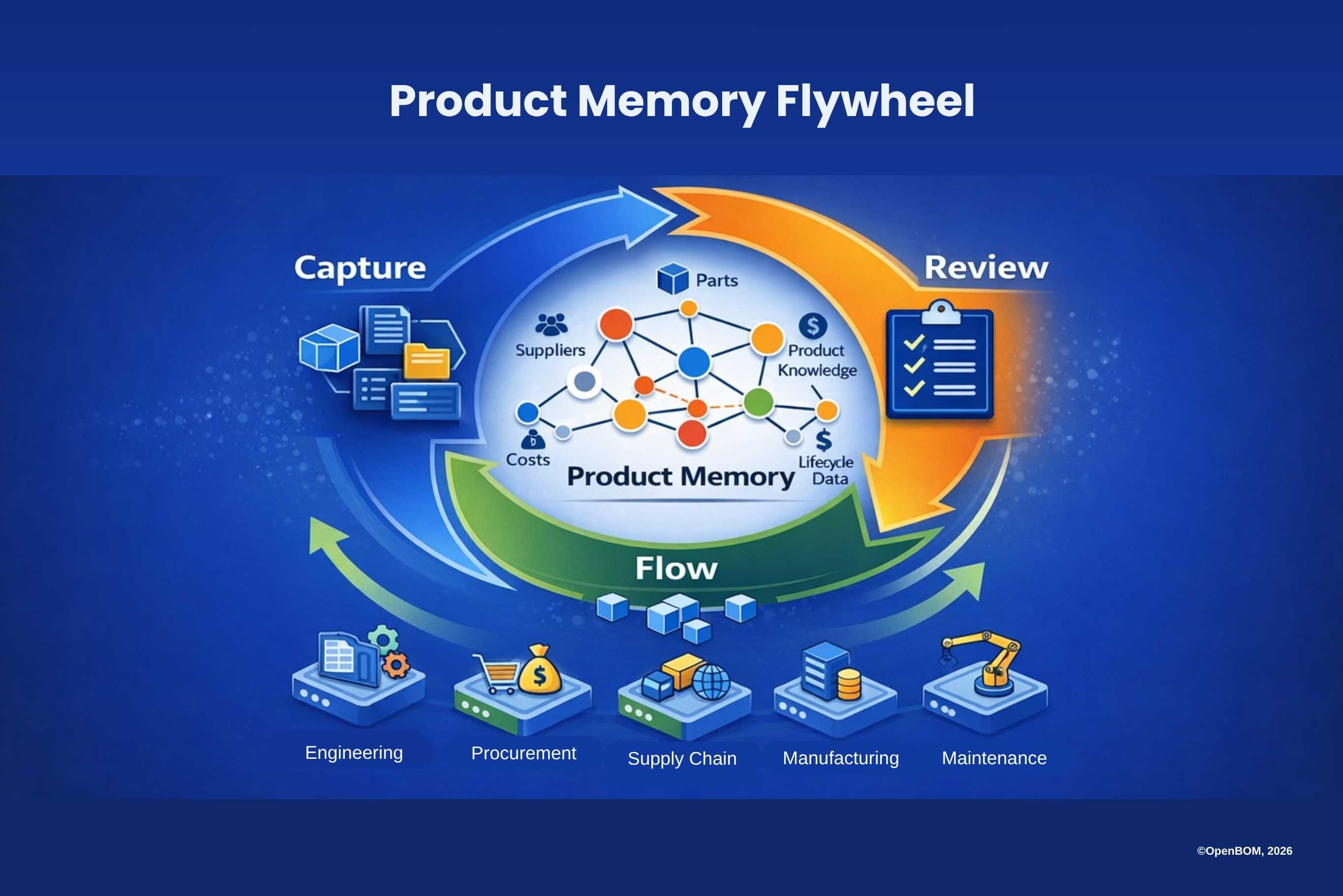
Built around the Product Memory Flywheel: Capture → Review → Flow
Why Product Knowledge Gets Lost Today
Most companies do not lack systems. They lack continuity across systems.
CAD stores geometry. ERP stores transactions. PLM stores released records and formal workflows. Drawings, notes, supplier inputs, spreadsheets, discussions, and downstream changes all contain valuable product knowledge. But these fragments are rarely connected in a way that preserves a living understanding of the product.

The result is familiar. Teams spend time reconstructing context, repeating analysis, chasing the latest version, and rediscovering what the organization already knew once. When experienced engineers leave, the data stays but the understanding goes with them. New team members work from records that tell them what was decided but not why. AI tools search and summarize, but cannot explain.
OpenBOM Product Memory Platform addresses that gap by connecting product knowledge across systems rather than assuming any one system can contain everything.
What Product Memory Actually Means
For decades, the PLM industry focused on a single promise: if you could store all your product data in one system, you would have a single source of truth. That promise delivered real value. Revision control improved. Release processes became disciplined. Files stopped getting lost.
But it never solved the deeper problem.
The real gap in product development is not a data gap. Most organizations already have more stored data than they know what to do with. It is not a connection gap either. Digital Thread addressed most of that. The gap is a memory gap. The reasoning, the context, the history of decisions that explains why the product is what it is – that layer does not exist in any system built for engineering today. It lives in people’s heads, in buried email threads, in spreadsheets that capture results without capturing the conversations that produced them.
Why is this fastener this size? Because of a housing tolerance decision made two years ago. Why does this assembly sequence exist? Because of a quality issue in the third production run. Why are the software and hardware versions coupled this way? Because of a field failure during early deployment. These are decision-to-decision relationships. They are the actual intelligence of the organization. And they are stored nowhere.
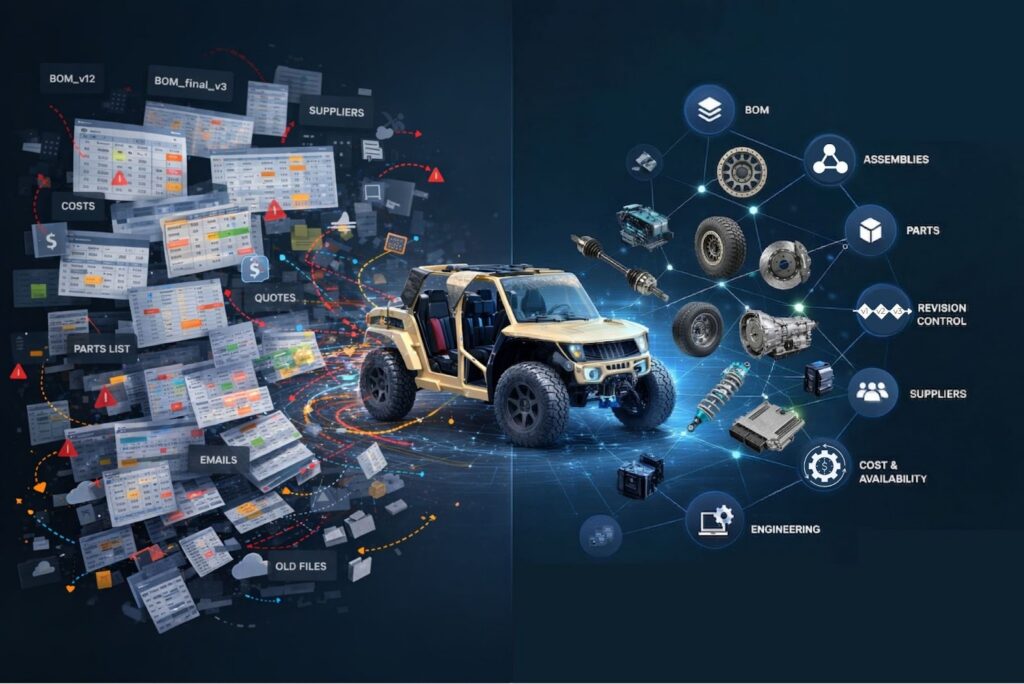
Product Memory is the proposition that context and reasoning need to be first-class citizens in how we think about product lifecycle management. Not a feature added to PLM. Not an extension of the Digital Thread. The next architectural step in a journey the industry has been on for forty years – the Product Memory Flywheel model makes this practical.
OpenBOM is building that layer.
How Product Memory Gets Built
Product Memory is not a static database. It is not one more system of record. It is built through a continuous operating cycle that connects engineering information, validates decisions, and flows knowledge into the downstream functions that need it.
That is the role of the Product Memory Flywheel.

The flywheel makes Product Memory practical. Product Memory is created when product information is continuously captured from the places where work happens, reviewed in product context, and then flowed into the lifecycle processes that depend on it. Each cycle strengthens the connected knowledge around the product. Each cycle improves future decisions.
This is why Product Memory is not simply stored information. It is an accumulating operational asset that grows more valuable through use.
Capture: AI-Powered CAD Intelligence
The flywheel begins with capture.
Product information has to enter the system from the places where engineering work actually happens. In most companies, that starts with CAD and expands into drawings, revisions, BOMs, and related engineering content. The goal is not only to store files. The goal is to capture them in product context, so they become part of a connected knowledge model rather than isolated artifacts.
One of the most persistent and painful problems in product development is that files are managed as isolated objects. They contain structure, relationships, and engineering intent. But that structure and intent is rarely captured alongside the file in any meaningful way. Teams reconstruct context by hand, repeatedly, every time someone needs to understand what a file represents and why it exists.
This is where OpenBOM is starting its first AI product: the CAD File Agent for SolidWorks. Starting with files makes the Product Memory vision practical from day one. It turns the first stage of the flywheel into something teams can use immediately – not in some future state, but in their existing CAD workflow.
Capture supports: 3D models and drawings, changes and revisions, BOMs, PDF, STEP, and related engineering content.
Review: AI-Powered BOM Validation
Once information is captured, it has to be reviewed in context.
This is where Product Memory becomes useful for decision-making. Review is not only about checking whether data exists. It is about understanding risk, validating assumptions, identifying mistakes, spotting missing information, and evaluating the impact of change before downstream execution.
Traditional systems preserve records. Product Memory must do more. It must help teams reason about what those records mean: what is incomplete, what is risky, what has changed, and what should happen next.
This is also where OpenBOM’s collaborative change management model becomes especially important. Change does not happen only at formal release. It happens continuously in the product data itself: in edits, revisions, relationship updates, BOM changes, comments, approvals, and coordinated decisions. Because OpenBOM embeds collaborative change management directly into the data environment, every meaningful change can become part of the evolving product understanding. A useful memory layer cannot depend only on final records. It has to preserve the context of change as it happens.
Review supports: risk alerts, cost estimates, validation, mistake detection, and identification of incomplete data.
Flow: AI-Powered Product Synchronization
Product Memory becomes valuable when connected knowledge flows beyond engineering.
After capture and review, product information has to move into the operational functions that depend on it: procurement, supply chain, ERP, manufacturing, and the broader lifecycle environment around the product. Product Memory is not complete until it becomes synchronized, usable, and actionable across the business.
Validated product knowledge should not stop in a file folder, a spreadsheet, or a formal approval queue. It should move into execution. It should support sourcing decisions, manufacturing readiness, ERP synchronization, service preparation, and future lifecycle decisions. AI agents and connected BOM systems depend on this movement to turn captured and reviewed information into operational value.
Flow connects: engineering, procurement, supply chain, ERP, and maintenance.
Product Memory = Connected Product Knowledge
At the center of the flywheel is Product Memory itself.
Product Memory is the connected representation of the product across the information that matters most: parts, suppliers, costs, lifecycle data, change history, and the accumulated decisions and reasoning behind them. It is not a flat record and not an isolated database entry. It is a connected, evolving knowledge structure that helps people understand the product across time, systems, and change.
The value is not only in storing information. The value is in preserving relationships, continuity, and context. It is in making it possible to understand how a product evolved, why certain decisions were made, what changed, and how those changes connect to the broader lifecycle.
This distinction matters more today than it did five years ago, because AI depends on it. An AI system that can access connected product context can reason about relationships and precedent, suggest actions based on what has been done before, and flag risks that a human navigating disconnected systems would miss. An AI system operating on isolated records, without the reasoning layer that explains those records, becomes a confident way to repeat decisions that were already considered and rejected. Product Memory is what separates useful AI from expensive autocomplete.
Product Memory connects: parts, suppliers, costs, lifecycle data, and accumulated product knowledge.
Why OpenBOM Is a Natural Platform for Product Memory
OpenBOM is well positioned to build a Product Memory Platform because the foundation already exists in the product – why Product Memory extends beyond traditional PLM becomes clear when you see how the platform connects CAD, BOMs, and collaborative change management in a single data model.
OpenBOM was built around a flexible data model with a unique collaborative change management mechanism, multi-view xBOM structures, CAD connectivity, file and design project management, and downstream business integration. Each of these capabilities matters independently. Together, they create the scaffolding that Product Memory requires.
The most important element is OpenBOM’s collaborative change management model, which is embedded directly into data management itself – not layered on top as a separate workflow process. This matters because Product Memory cannot be built from final records alone. It must capture how the product changes over time. In OpenBOM, changes happen in the context of the product data model, where edits, revisions, relationship updates, discussions, approvals, and workflow actions can all become part of the evolving product knowledge.
Instead of treating change as a separate document process, OpenBOM treats change as something connected to the data itself. Over time, this creates the conditions for a richer context graph, where product structure, files, revisions, discussions, workflow actions, and lifecycle changes are all connected as part of the same memory layer.
Product Memory is not a separate story layered on top of OpenBOM. It is the next architectural step in connecting these capabilities into a broader system of product understanding.
OpenBOM platform capabilities: flexible product data model, xBOM and multi-view product structures, CAD integrations, file and design project management, embedded collaborative change management, collaboration and workflow, procurement and ERP connectivity.
A Platform That Learns Through Use
The Product Memory Flywheel is not a closed loop.
Engineering changes feed back into the next cycle. Customer feedback and downstream lifecycle signals feed back as well. Product Memory does not reflect the product only at one moment in time. It grows as the organization designs, changes, procures, manufactures, delivers, and supports the product.
This is what makes Product Memory a strategic asset rather than a static repository. It improves through use. It becomes more valuable as more decisions, changes, and lifecycle events are connected into the same memory structure. Early organizations that build this layer will accumulate institutional knowledge that competitors cannot replicate later – because the value is not in the software, it is in the months and years of connected organizational understanding that accumulate inside it.
AI Products Are the Entry Points
AI becomes useful in engineering when it works with connected product context.
That is why OpenBOM is approaching AI through Product Memory. Instead of treating AI as a disconnected assistant layered on top of existing systems, OpenBOM is building AI products that participate directly in the flywheel – products that capture, review, and flow product knowledge as part of the work itself.
The first product, OpenBOM CAD File Agent for SolidWorks, enters through the Capture stage. It begins with one of the most fragmented parts of product development: files. Future products will expand into Review and Flow, helping teams validate BOMs, understand changes, identify missing data, estimate impact, and synchronize product knowledge across the lifecycle.
Product roadmap: Capture – CAD File Agent for SolidWorks (available for limited set of customers now) Review – BOM and change validation agents (coming) Flow – synchronization and lifecycle coordination agents (coming)
AI products are how users enter the platform. The Product Memory Flywheel is how the platform becomes smarter over time.
Frequently Asked Questions About Product Memory Platform
What is a Product Memory Platform?
A Product Memory Platform (PMP) is a data architecture that continuously captures, connects, and preserves product knowledge across the full product lifecycle – from CAD design through BOM management, supplier collaboration, and production. Unlike traditional PLM systems that act as static databases, PMP treats product data as a living, AI-consumable knowledge layer.
How is Product Memory Platform different from traditional PLM?
Traditional PLM systems are designed for document control and workflow routing. A Product Memory Platform focuses on data connectivity and context preservation. PMP automatically captures relationships between design decisions, BOM revisions, supplier communications, and engineering changes – creating a traceable product memory that PLM’s siloed architecture cannot provide.
Why do AI agents need a Product Memory Platform?
AI agents need structured, contextual product data to generate accurate BOMs, validate engineering changes, and recommend supply chain decisions. Without a Product Memory Platform, AI tools operate on isolated data sets that lack the revision history, cross-reference links, and decision context needed for reliable output. PMP provides the connected data graph that makes AI useful in manufacturing.
How do I start building Product Memory for my manufacturing team?
Start by connecting your CAD files and existing BOMs to OpenBOM’s platform. The Product Memory Platform automatically captures revision history, links engineering changes to their downstream production impact, and creates the data foundation AI tools need. Most teams see initial product memory structure within hours, not months.
Build the Next Layer of Product Systems
For decades, product systems focused on storing files, transactions, and released records. The next layer is different. It is about preserving connected product understanding across work, change, and lifecycle flow – the reasoning and context that makes data meaningful, not just the data itself.
OpenBOM Product Memory Platform is built around that idea. By combining the Product Memory Flywheel with OpenBOM’s data model, xBOM foundation, CAD connectivity, collaborative change management, workflows, and business integrations, OpenBOM is building a platform that connects product knowledge for people today and AI systems tomorrow.
Explore CAD File Agent by Register for free and start your journey. The OpenBOM team will support you all the way through the process. In case of any questions you can contact us directly via email.