Product Lifecycle Management (PLM) is evolving from a single-system approach to a network of connected services. The era of monolithic, all-in-one PLM systems is over. The future belongs to composable, cloud-native, and graph-connected platforms that can adapt, connect, and grow with the business.
At OpenBOM, we’re moving PLM beyond the outdated idea of a “single source of truth” toward a connected network of truths — where data flows dynamically across people, tools, and companies.
The End of One-Size-Fits-All PLM
For decades, PLM was built as a vertical monolith — even when small, still designed to control everything: CAD, change, configuration, documents, workflows, and more.
That architecture worked when products were simpler and owned entirely by one company. It made sense when there were fewer tools, less integration, and fewer data sources.
But the world has changed.
Today, engineering data is everywhere — CAD in the cloud, supplier data in ERP, cost models in spreadsheets, and part metadata in procurement portals. Attempting to confine all of that into a single database is no longer possible.
Traditional PLM, which once promised “a single source of truth,” now struggles in a world where truth is distributed.
Modern manufacturing doesn’t happen inside a single system — it happens across a network of systems, teams, and suppliers. PLM must evolve from being a closed vertical stack into a horizontal, open architecture that connects existing systems.
That’s what we call Composable PLM.
“Composable PLM reflects the way products are really built — through connected systems and teams, not monolithic databases.”
What “Composable” Really Means in PLM
Let’s be clear: Composable PLM is not modular PLM.
Modular PLM simply means a single platform split into functional modules — design, change, workflow, quality — all tied to the same underlying monolith. Composable PLM is something different entirely.
Composable PLM is about integrating multiple independent services — each specialized, lightweight, and interoperable — connected through open APIs and shared data semantics.
It’s about building systems the way modern products are built: from components that fit together, evolve independently, and can be replaced or extended without breaking the whole.
Think of it as:
“A PLM made of Lego bricks, not a concrete block.”
At the heart of composable PLM is the graph-based product data model — a model that connects rather than confines data.
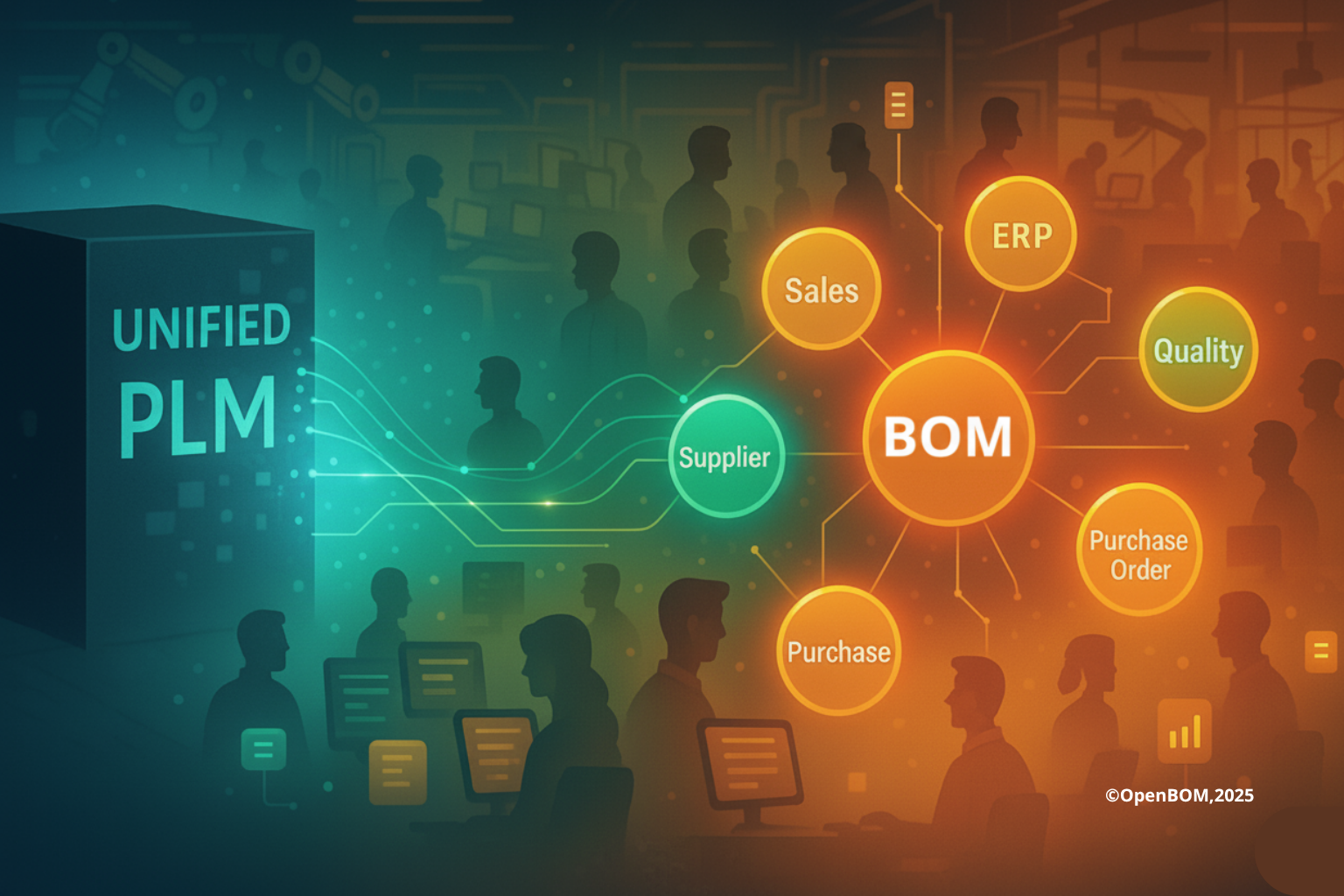
Each domain — CAD, BOM, change, procurement, ERP — provides microservices and data views connected through the product graph. The relationships between those domains form the digital thread.
In this model, PLM isn’t a single application. It’s a dynamic network of knowledge that lives across the organization.
OpenBOM’s Architectural Approach
From the very beginning, OpenBOM was built as a composable platform, not as a “lite” version of traditional PLM. Its architecture combines graph data modeling, multi-tenant SaaS, and federated connectivity, forming the foundation for a new class of PLM system.
Let’s unpack the core pillars of this approach.
Graph-Based Product Data Model (xBOM Services)
The graph data model is the foundation of OpenBOM’s composability. At the center lies the Product Knowledge Graph — a connected structure representing every part, assembly, vendor, revision, and property in context.
Engineering BOM, Manufacturing BOM, Service BOM, and Supplier BOM are all views of the same underlying graph. Each represents a specific perspective but draws from shared, connected data.
OpenBOM doesn’t replicate information between systems; it links it. This is how we achieve real-time traceability and consistency without synchronization nightmares.
API-First Design
Every OpenBOM function — from creating a BOM to connecting a CAD system or updating supplier cost — is accessible through APIs. This makes integration straightforward with tools like Autodesk Fusion, SolidWorks, Onshape, Microsoft Dynamics 365, Odoo, and more.
Composable PLM depends on this openness. The API is not an afterthought — it’s the backbone of the system.
Multi-Tenant Cloud Platform
OpenBOM is not hosted PLM; it’s built as a true multi-tenant SaaS platform. Multiple companies — OEMs, suppliers, contractors — can collaborate within shared workspaces while maintaining control over their data.
Each tenant can define what to share and how to connect, allowing secure and frictionless collaboration across company boundaries.
Federated Digital Thread
In OpenBOM, data stays where it originates but is connected by relationships, not by duplication. This creates a federated digital thread that links distributed data sources — engineering, procurement, manufacturing — into one navigable context.
Real-Time Collaboration and Simultaneous Editing
OpenBOM’s “Collaborative Workspace” capabilities enable multiple people to edit data at once — similar to how Google Sheets transformed collaboration in office tools.
When engineers, buyers, and manufacturing partners can view and update shared data simultaneously, the result is a living, dynamic source of truth that reflects how modern teams actually work.
“OpenBOM’s composable architecture is like the Internet for product data — distributed, federated, and always connected.”
Composable PLM + Digital Thread = The Network Effect
The Digital Thread has become one of the most overused buzzwords in the industry — often reduced to “a data pipeline connecting CAD to ERP.”
But the true digital thread is not a file pipeline — it’s a semantic graph that captures relationships across design, manufacturing, and supply chain systems.
In traditional PLM, the thread breaks every time data moves between tools. You can export it, import it, or synchronize it, but each step creates fragmentation.
In OpenBOM, the digital thread is continuous. It extends naturally through the graph data model that connects design, BOMs, sourcing, costs, and change records — not through file exports but through relationships.
The outcome is a living product network that provides:
- Traceability: Every item, revision, and supplier relationship is linked and visible.
- Version integrity: Changes flow across connected views without data duplication.
- Visibility: Teams across companies can access contextualized data in real time.
The graph architecture allows OpenBOM to represent both structure and behavior — tracking who changes what, when, and how.
“The digital thread is not about centralizing data; it’s about connecting knowledge.”
Real Examples of Composability in Action
OpenBOM’s composable architecture is not theoretical — it’s being used daily by customers worldwide to replace fragmented workflows with connected digital threads.
CAD + Procurement Integration
An engineering team designing in SolidWorks or Fusion 360 can create and update BOMs directly from the CAD environment. At the same time, purchasing teams access the same BOM data through OpenBOM’s catalog and vendor management features — without waiting for a file export or ERP integration. Every cost change, supplier update, or quantity modification is instantly reflected across the entire network.
Multi-Company Collaboration
An OEM can securely share a controlled view of an assembly with its supplier using OpenBOM’s multi-tenant sharing. Both teams see real-time updates, ensuring that purchasing and manufacturing always work from the latest data. No email attachments. No “final_version_v6.xlsx.”
xBOM for Different Stakeholders
Engineering BOM → Manufacturing BOM → Procurement BOM. In OpenBOM, these are not separate data silos — they’re connected views on the same product graph. Each stakeholder sees what’s relevant to them while staying synchronized with the whole.
These examples illustrate how composability translates into tangible business outcomes: faster decisions, fewer errors, and less overhead.
Why This Matters Especially for SMB and SME Teams
For large enterprises, traditional PLM complexity can be absorbed by teams of consultants, administrators, and integration experts. For SMBs and mid-size manufacturers, that model simply doesn’t work.
Smaller teams need agility, not bureaucracy. They can’t afford multi-year implementations or “custom deployments” that consume time and capital.
Composable PLM changes the equation:
- Start small. Deploy only the services you need.
- Integrate easily. Use APIs and standard data connectors to link existing tools.
- Scale naturally. Add new functions and integrations without replatforming.
- Collaborate freely. Share data securely with partners, without IT overhead.
It’s a model built for growth — not for control.
“Composable PLM gives small manufacturers the agility of startups and the control of enterprise systems — without the burden of enterprise complexity.”
OpenBOM embodies that vision. It’s a system where every SMB can access enterprise-grade collaboration, without enterprise cost or friction.
The Future: From Composable to Intelligent
Composable PLM is not the end goal — it’s the foundation for what comes next.
Once data is modeled as a graph, it becomes intelligent. You can apply graph analytics, data reasoning, and AI agents to automate and augment engineering work.
At OpenBOM, this is already emerging through initiatives like OpenBOM Agent — enabling intelligent assistants that can understand product context, validate data consistency, and automate routine workflows.
The graph data model provides the structure and context, while AI and agents bring reasoning and action. Together, they form intelligent digital threads that understand the intent behind every change, not just the data itself.
Conclusion — PLM as an Ecosystem, Not a Platform
The future of PLM will not belong to a single platform or vendor. It will be defined by ecosystems of connected, composable systems that work together through open data models and APIs.
OpenBOM’s mission is to make that ecosystem accessible — to democratize product data collaboration for every manufacturer, from startups to global supply networks.
PLM’s next evolution is not about enforcing control from the top — it’s about enabling connection from the bottom up.
“The next era of PLM will not be owned by a single platform — it will be composed by everyone connected to the digital thread.”
REGISTER FOR FREE and check how OpenBOM can help you.
Best, Oleg
Join our newsletter to receive a weekly portion of news, articles, and tips about OpenBOM and our community.