Why disconnected BOM and product data holds AI agents back — and how to fix it
AI agents in engineering are only as useful as the product context they can access. Learn why connected BOM data, CAD integrations, and a structured workspace are the real foundation for operational engineering AI.
Why AI Agents Fail Without Connected Engineering Context
Imagine you ask an AI agent to review your bill of materials before a design freeze. Simple enough request. The agent looks at the BOM — and immediately runs into a wall.
It can see part numbers. It can see quantities. But it cannot tell you whether the microcontroller on line 47 is compatible with the firmware your software team locked last Tuesday. It cannot flag that the supplier for your main structural bracket just went on allocation. It cannot warn you that the capacitor in position C12 is end-of-life, or that the PCB assembly it sits on hasn’t been updated to reflect the latest ECAD revision. It cannot connect any of this to the cost model your procurement team maintains in a spreadsheet, or to the requirement that traces back to a customer specification three levels up.
The agent is not unintelligent. It is uninformed. And in engineering, those two things look identical from the outside.
This is the real AI problem facing engineering and manufacturing organizations today — and it has almost nothing to do with which language model you choose. The gap is not capability. The gap is context. Specifically: the rich, connected, multidisciplinary operational context that a BOM decision actually requires. Mechanical structure. Electronics. Embedded software. Supply chain status. Requirements traceability. Cost targets. Change history. Supplier risk. Lifecycle state. These are not separate data problems. They are one engineering problem — and right now, most organizations have them locked in separate systems, separate files, and separate teams with no operational thread connecting them.
AI agents cannot reason across silos they cannot see. That is the problem worth solving. And solving it starts not with selecting a model, but with building the foundation that makes operational context available in the first place.
The Real Bottleneck for AI in Engineering: Product Data Fragmentation
Ask most engineering leaders what they need to get started with AI, and they will describe a model selection process. They will talk about evaluating GPT versus Gemini versus Claude. They will discuss prompt engineering, fine-tuning, and governance policies. What they will not talk about — because most have not yet confronted it directly — is whether their product data is actually in a state where an AI agent can do anything useful with it. That is the conversation that needs to happen first.
Context is not a secondary concern. It is the primary constraint. An AI agent operating on disconnected, fragmented, or incomplete product data does not produce bad answers because the model is weak. It produces bad answers because it is reasoning in the dark. The model is not the bottleneck. The context is.
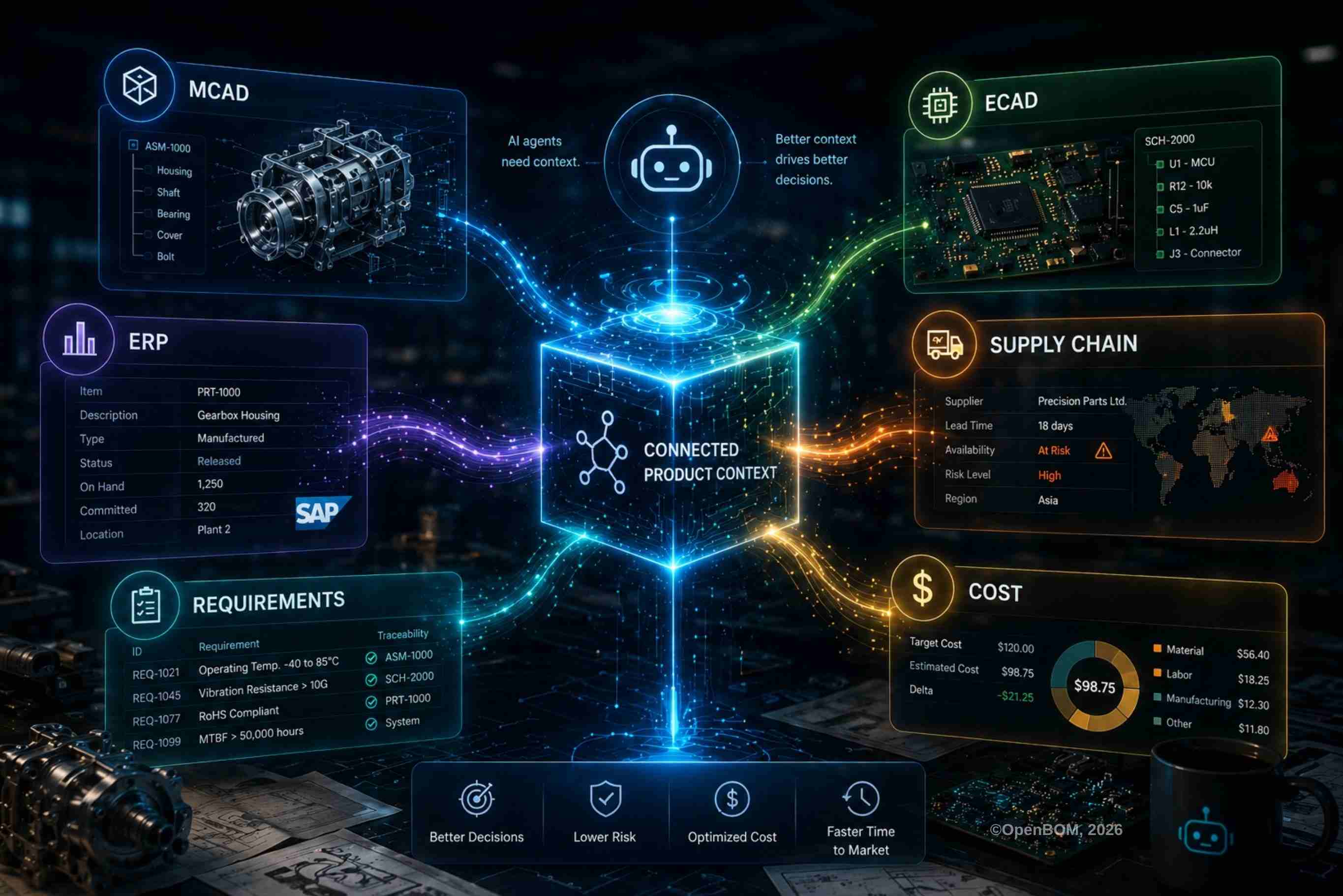
What does operational context actually mean in an engineering environment? It means more than having access to data. It means having access to connected data — information that carries its relationships intact. A part number without its assembly context is nearly meaningless. A supplier record without lifecycle state is incomplete. A requirement without traceability to the design that implements it is just text. Operational context is the web of relationships between mechanical design, electrical design, software, supply chain, manufacturing constraints, cost, compliance, and change history — all of it current, all of it connected, all of it navigable. That is what an AI agent needs to reason reliably on engineering problems.
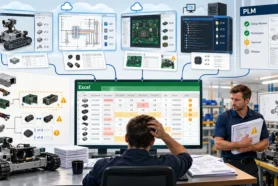
Most organizations do not have this. Not because the data does not exist — it almost always does. It exists in CAD vaults, ERP systems, ECAD tools, shared spreadsheets, email threads, and tribal knowledge sitting in the heads of experienced engineers. The problem is not data availability. The problem is data fragmentation. The information is there, but it is scattered across systems that were never designed to talk to each other — and certainly never designed with AI consumption in mind.
Why Multi-Disciplinary BOMs Break Traditional AI Approaches
This fragmentation was manageable when products were simpler. A mechanical assembly with a supplier list and a drawing package was something a PLM system could organize reasonably well. But modern products are not mechanical assemblies with a supplier list. They are mechanical systems with embedded electronics, firmware, cloud connectivity, software dependencies, regulatory requirements, and global supply chains — all of which change continuously and all of which affect each other.
A BOM review today is not the question “is this part approved?” It is: does this component have a qualified second source? Is the firmware on the controller compatible with the latest hardware revision? Does this assembly meet the new RoHS requirements for the European market? Has the lead time on this semiconductor changed since the last program review? These are cross-domain questions. They require mechanical context, electrical context, software context, supply chain context, and compliance context — simultaneously. Traditional PLM systems were built for one domain. AI agents need all of them, connected, to reason on problems that span all of them.
Why ERP and CAD Integrations Alone Don’t Create AI-Ready Product Data
Most engineering organizations, when they hear “connected product data,” immediately think of integrations. And integrations are real progress — connecting CAD to ERP, pushing BOM changes into procurement systems, synchronizing part attributes across tools. But integrations solve a data movement problem. They do not solve a context problem. And conflating the two is one of the most common and costly mistakes organizations make when preparing for AI.
Here is the distinction that matters. A traditional integration moves a record. It synchronizes an attribute. It replicates a transaction. That is useful. But an AI agent trying to assess whether that change has downstream implications needs something the integration does not provide: the relationship web around that record. Which assemblies reference this part? Which firmware version depends on it? Which requirement does it trace to? What was the engineering rationale behind the last revision? Integrations move facts. Context carries meaning.
What AI agents actually need is not a pipeline between systems — it is a workspace where the relationships between systems are preserved, navigable, and alive. Not a data lake where information is flattened and stripped of its operational structure. A shared operational environment where a part knows its assembly, an assembly knows its requirements, a requirement knows its change history, and all of it reflects the current state of the engineering program. That is the architectural shift: from moving data between silos to creating a connected context layer that spans them.
A workspace, properly constructed, is the operational memory of an engineering program. It is where integrations deposit not just records but relationships. Where changes accumulate history rather than overwriting it. Where cross-domain connections — mechanical to electrical, electrical to software, software to supply chain — are explicit and traversable, not inferred by whoever happens to know both systems. It is the layer where human collaboration and AI reasoning can operate on the same shared context, simultaneously, without either one working from an incomplete picture. Building that layer is the real infrastructure work of AI readiness. And it starts long before any agent is deployed.
How a Connected BOM Workspace Gives AI Agents the Context They Need
This is where OpenBOM’s role becomes concrete.
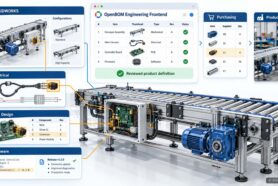
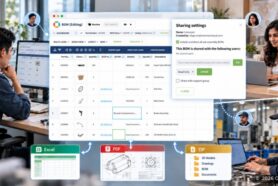
OpenBOM is designed to bring product context together from the systems where engineering work actually happens — MCAD tools like SolidWorks and Onshape, ECAD environments, ERP systems, and the spreadsheets that every engineering organization relies on whether they admit it or not. But the goal is not simply to collect that data in one place. The goal is to preserve its structure, its relationships, and its history as it comes together.
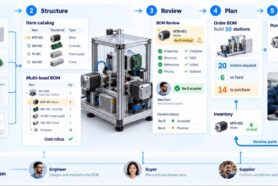
When a mechanical BOM flows into OpenBOM from a CAD assembly, it carries its hierarchy. When an electronics BOM is added, it connects to the relevant assemblies. When ERP data is pulled in, supplier status and lead times attach to the parts that depend on them. When a team member updates a specification or flags a change, that context accumulates in the workspace rather than disappearing into an email thread. The workspace becomes a living record of the product — not a snapshot of it.
This matters for human engineers working today. It matters even more for AI agents working tomorrow. An agent operating inside a properly constructed OpenBOM workspace does not see a flat list of parts. It sees an operational context graph: assemblies, components, suppliers, requirements, revisions, costs, and decisions — connected, current, and traversable. That is the difference between an agent that can answer a real engineering question and one that can only describe what it sees on a spreadsheet.
Building an AI Harness for Engineering: The Architecture Behind Operational AI
There is a term worth introducing here: AI harness.
Most companies approach AI adoption by asking which tool to buy or which model to connect. That framing leads to isolated copilots, disconnected assistants, and AI features that impress in demos but fail to deliver in production. What engineering organizations actually need is something more deliberate: a connected operational environment where AI agents can access live product context, participate in real workflows, and produce decisions that are traceable and grounded.
That is an AI harness. Not a chatbot. Not a copilot bolted onto an existing tool. A structured environment that combines integrations, workspaces, product knowledge, and workflow history into a foundation that agents can operate on safely and effectively. Without it, agents hallucinate. Decisions lack grounding. Context disappears between sessions. Reasoning breaks at domain boundaries. With it, agents become genuine collaborators — able to assess a BOM, flag a supply chain risk, trace a requirement, or identify a cross-domain conflict with the same operational awareness a senior engineer would bring.
Building an AI harness for engineering and manufacturing is precisely the vision OpenBOM is pursuing. Not by becoming an AI product, but by becoming the foundation that makes engineering AI operational. The integration layer that connects the systems where engineering work lives. The workspace layer that assembles and preserves the context those systems produce. The operational memory layer that accumulates the history, decisions, and relationships that give AI agents something real to reason on. The harness does not replace the engineer or the model — it gives both of them something solid to stand on.
AI Readiness in Engineering Starts With Product Data, Not Model Selection
The future of engineering AI will not be defined by which model a company uses. It will be defined by whether the company has built the context foundation that makes AI operational — connected product knowledge, integrated systems, collaborative workspaces, and traceable relationships across every domain that touches the product. I started to call it – Product Memory.
That foundation does not appear automatically when you connect an LLM to your CAD system. It has to be built deliberately, starting with the data architecture, the integration layer, and the workspace that holds it all together. The companies that build it now will have an AI harness ready when the agents mature. The companies that skip it will find themselves, a few years from now, exactly where they are today — with capable models and no context for them to work on.
The missing layer is not the AI. It is the foundation beneath it. Start there.
OpenBOM is a product data and BOM management platform built for engineering and manufacturing teams.
We are inviting engineering teams to collaborate and discuss how our infrastructure, integration and tools can help to build an engineering AI harness for your organization.
Contact us and schedule a meeting to discuss.
Best, Oleg
Join our newsletter to receive a weekly portion of news, articles, and tips about OpenBOM and our community.