Every manufacturer faces a critical divide between engineering design and procurement execution. You can design the most brilliant product in CAD — but without ordered components, approved suppliers, or confirmed lead times, production stops before it begins.
OpenBOM was built to close this gap — not by becoming another ERP system, but by bringing ordering, purchasing, and supplier collaboration closer to the engineering source of truth. This article explores how OpenBOM’s composable architecture and graph-based data model enable seamless collaboration across design, BOM, and procurement — connecting design intent with real-world supply decisions.
The Two Biggest Silos: Engineering and Procurement
Every manufacturing company, regardless of size or industry, operates around two major systems of work — engineering and procurement.
On one side are the engineers, living in CAD tools, defining assemblies, items, and configurations. On the other side are buyers and planners, managing parts, suppliers, prices, and purchase orders in ERP or spreadsheets. Between them lies the gap that stops companies from scaling efficiently.
In theory, the connection seems simple: engineers design, buyers purchase. In practice, it’s one of the hardest things to align. When design changes, supplier availability shifts, or cost models evolve, the coordination between these two worlds often breaks down. The results are familiar — misordered parts, duplicated records, outdated BOMs, and costly production delays.
And here’s the painful truth: you can sometimes hand-assemble a prototype without process or system discipline. But without procurement, you stop cold.
Procurement is where ideas meet reality. It’s what turns digital models into physical products.
“You can build a prototype by hand, but you can’t scale without procurement.”
This is why the design-to-order connection isn’t a nice-to-have — it’s the heartbeat of modern manufacturing.
Why Traditional CAD-to-ERP Integration Isn’t Enough
Many companies try to solve this gap through traditional CAD-to-ERP integration. A familiar process: export a BOM from CAD, import it into ERP, and hope the data stays aligned. Unfortunately, this “linear” integration rarely works well in dynamic environments.
CAD-to-ERP connectors typically transfer static snapshots of BOMs — not living relationships between design and procurement data. When engineers change a design, add a new part, or select an alternate component, ERP remains blind unless someone re-uploads or reimports.
Over time, these manual synchronizations create drift — multiple versions of BOMs, mismatched item properties, inconsistent vendor lists. Traditional integration assumes a world of perfect process and stable design. Today’s world is exactly the opposite — fast, iterative, collaborative, and distributed.
The future requires something different: ERP near PLM. “ERP near PLM” means placing procurement context next to design intent — not inside it. I found this term coined by Prof. Dr. Jorg Fischer and it resonated – making data “connected” – this is what made me excited about this term.
Instead of pushing data across systems through static exports, OpenBOM connects the two worlds through a shared data model — where relationships, not records, define truth.
OpenBOM’s Bridge Between Design and Procurement
OpenBOM’s architecture was designed to make ordering and procurement a natural extension of design, not a disconnected afterthought.
When an engineer releases a design from CAD (e.g., SolidWorks, Fusion 360, or Onshape), OpenBOM automatically generates a connected BOM enriched with vendor references, cost, and sourcing attributes. Buyers can immediately open the same BOM, review approved suppliers, and generate RFQs (Requests for Quotation), Purchase Orders (POs), and even cost roll-ups — all without re-entering data or exporting files.
The moment an engineer changes a part, the change is visible to procurement. The moment a buyer updates a supplier price, the engineering view updates the total cost. This is not synchronization — it’s collaboration.
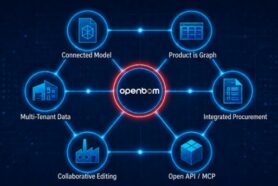
OpenBOM’s graph-based data model makes this possible. It doesn’t just store records; it represents relationships between items, assemblies, vendors, and orders. Each of these entities is connected within the same product knowledge graph, ensuring that changes propagate intelligently across the network.
Key enabling technologies:
- Graph-based xBOM model: Links items, suppliers, costs, and revisions as a single connected dataset.
- Collaborative workspaces: Engineers, buyers, and suppliers can view and update data in real time.
- Integrated ordering tools: Users can create RFQs, POs, and track order status directly within the BOM.
“In OpenBOM, the BOM isn’t just a list — it’s a living structure that connects design intent to supply reality.”
The Three Maturity Levels of Integration
Every company connects engineering and procurement differently, depending on its maturity and operational scale. OpenBOM was built to support all three levels of evolution — from startup to enterprise.
Level 1 – OpenBOM Standalone: CAD + EBOM + Order/RFQ/PO
For smaller companies, OpenBOM alone can manage the entire design-to-order workflow. Design data comes directly from CAD, producing a live Engineering BOM (EBOM) with cost and supplier details. From there, users can send RFQs or generate Purchase Orders directly within OpenBOM.
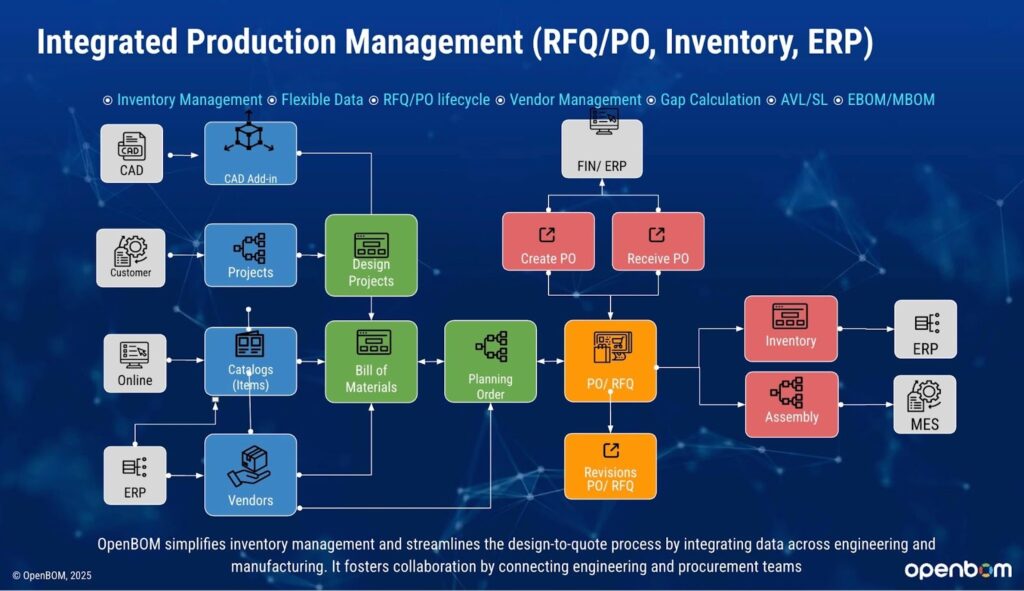
There’s no need for a separate ERP system — OpenBOM serves as both the engineering and procurement backbone. It’s ideal for startups, prototype manufacturers, and companies that prioritize speed and visibility over heavy infrastructure.
Level 2 – OpenBOM + ERP Integration
As companies grow, their processes become more formalized, and ERP adoption becomes necessary. At this stage, OpenBOM integrates with systems such as Microsoft Dynamics 365, Odoo, QuickBooks, or Xero. The xBOM model remains the core — maintaining real-time connections between engineering data and ERP’s procurement and inventory modules.
Procurement gains instant visibility into design changes, and engineering receives live cost and supplier updates. Instead of manual synchronization, the two systems act as one continuous flow.

Level 3 – OpenBOM as the Federated Digital Thread
For advanced organizations with multiple systems (e.g., PLM, ERP, MES), OpenBOM becomes the federated layer — connecting all data models into one digital thread. This is the full “ERP near PLM” vision: design data in CAD and PLM, procurement data in ERP, production data in MES — all linked through the OpenBOM graph model.
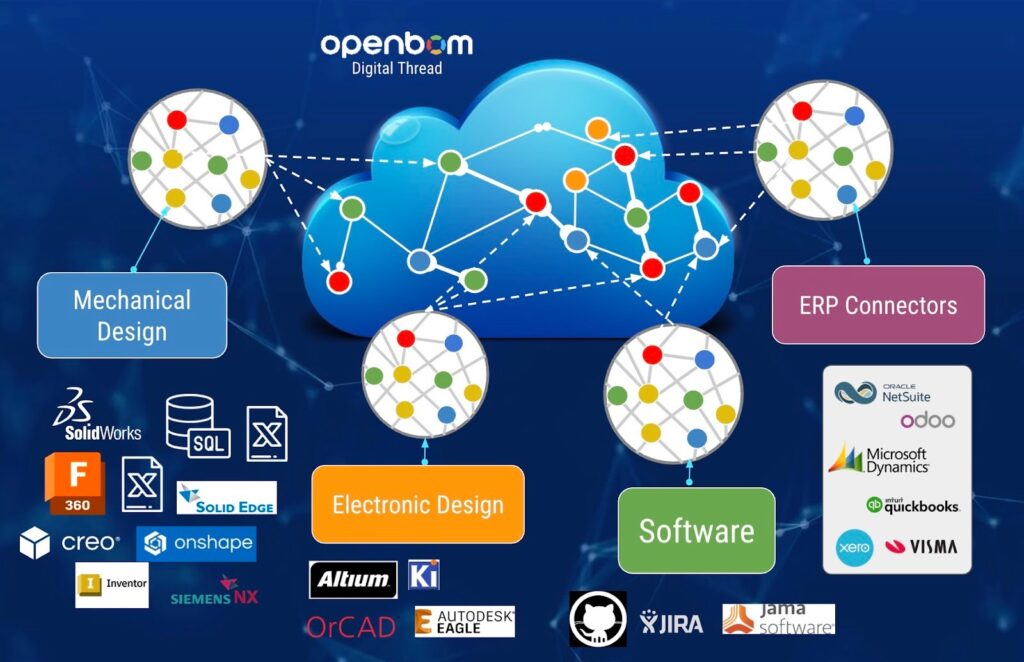
OpenBOM doesn’t replace ERP or PLM. It connects them — creating semantic interoperability across the product lifecycle.
“ERP near PLM isn’t about merging systems — it’s about connecting their data semantics.”
Connecting the Full Data Flow: Design → Engineering → Ordering → Manufacturing
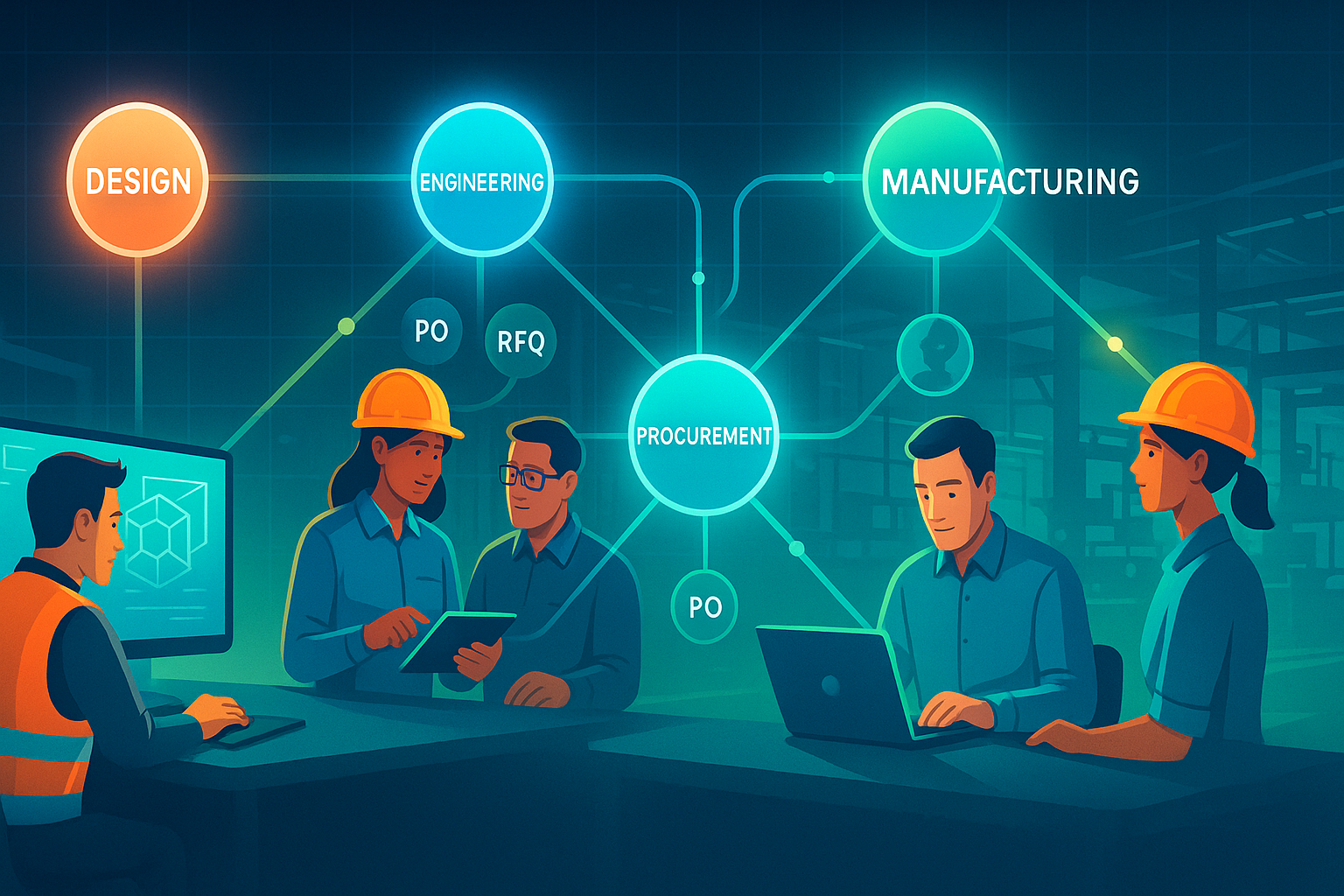
OpenBOM’s ultimate goal is to connect all key data structures representing how a product moves from concept to production. Each step — design, engineering, procurement, manufacturing — requires its own view, but all are part of one shared data graph.
- Design data defines geometry, revisions, and configuration.
- Engineering data defines items, structure, and technical attributes.
- Procurement data defines vendors, costs, lead times, and purchase history.
- Manufacturing data defines routing, production orders, and scheduling.
In OpenBOM, these are not disconnected silos — they are interconnected perspectives of the same digital product. The graph data model ensures that when one piece changes (e.g., a cost update, supplier substitution, or design revision), the impact is visible everywhere instantly.
This model unlocks new types of intelligence:
- Automated validation: Detect mismatched quantities or vendor gaps before orders go out.
- Dynamic cost roll-ups: Get real-time total cost estimation as designs evolve.
- Change traceability: Track which design change triggered which procurement action.
With the right analytics layer, this data becomes actionable knowledge — enabling companies to optimize sourcing, reduce errors, and shorten lead times.
The Strategic Impact of “ERP Near PLM”
For decades, the industry has debated where PLM ends and ERP begins. The answer is no longer about boundaries — it’s about proximity and connection.
By bringing ERP “near” PLM, OpenBOM creates a shared operational context that connects design intent with supply execution. This approach has deep strategic implications:
- Faster time-to-order: Procurement can begin planning while design is still evolving.
- Lower risk: Live connections reduce the chance of ordering obsolete or mismatched parts.
- Greater collaboration: Engineers and buyers work from a single, living dataset instead of static exports.
This is what composable, data-driven PLM looks like in action. The digital thread isn’t just a technical construct — it’s a network of trust across people, systems, and companies.
Conclusion — ERP Near PLM is the Future of the Digital Thread
The design-to-order gap is one of manufacturing’s most persistent inefficiencies. For too long, data silos and brittle integrations have made it difficult for teams to move seamlessly from CAD to BOM to order.
OpenBOM’s graph-based, composable architecture closes that gap — enabling companies of any size to connect engineering and procurement into a single, living digital thread.
By placing ERP “near” PLM rather than trying to merge them, OpenBOM allows each system to do what it does best — while keeping data, context, and relationships intact.
“The future of manufacturing isn’t ERP vs. PLM — it’s ERP near PLM, connected through data.”
REGISTER FOR FREE to learn how OpenBOM connects engineering and procurement workflows to accelerate your design-to-order process.
Best, Oleg
Join our newsletter to receive a weekly portion of news, articles, and tips about OpenBOM and our community.