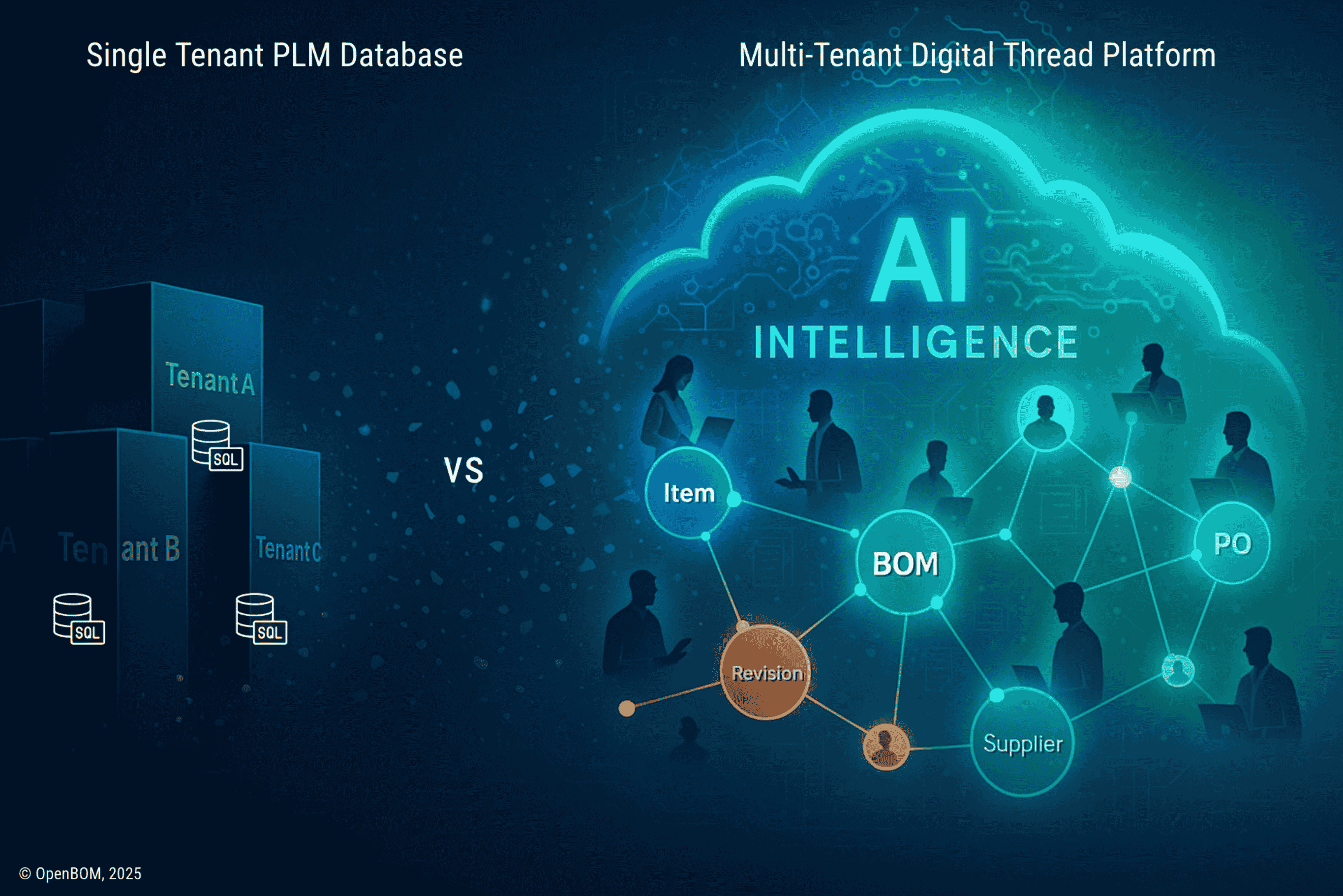
PLM is undergoing a generational architectural shift. The industry is moving beyond single-tenant and hosted systems toward true multi-tenant SaaS, where continuous delivery, cross-company collaboration, traceable data flows, and AI-native workflows are built into the platform’s DNA. Multi-tenancy is not a deployment detail—it is the foundation of a network-based PLM architecture. OpenBOM was built on this model from day one, enabling modern engineering teams and extended enterprises to work from a shared, live, federated digital thread.
Introduction — Why Multi-Tenant Matters Now
Manufacturing today is a networked activity. It involves not just one company and one set of internal processes, but an ecosystem of OEMs, suppliers, contract manufacturers, design partners, procurement teams, fabricators, assembly shops, and logistics networks. Even the smallest hardware startup may rely on a dozen distributed partners.
This networked reality breaks the assumptions of traditional PLM. Earlier in this series, we explored composable PLM (Day 17) and ERP-near-PLM (Day 18) — both focused primarily on bridging internal silos. But true digital transformation requires one more dimension: extending PLM beyond the enterprise.
To support modern supply chains, PLM must evolve from being an internal database to becoming a network-native system, capable of securely connecting multiple companies, multiple workflows, and multiple sources of truth. Only a multi-tenant SaaS architecture can deliver this.
Hosted ≠ SaaS: Understanding the Difference
Many PLM and PDM vendors claim to offer “cloud” solutions, but most provide hosted monoliths, not true multi-tenant SaaS. This distinction matters because it determines what you can and cannot do with your data.
Hosted PLM (the old model)
Hosted PLM means each customer runs a separate instance, often lifted from legacy on-prem code and placed onto a cloud VM.
This results in:
• Siloed systems: Every customer is isolated in their own database, making collaboration impossible.
• Heavy customizations: Each instance drifts over time, creating upgrade nightmares.
• High TCO: Infrastructure, maintenance, version control, and IT overhead all remain.
• Slow updates: Every upgrade is a small “project.” Many customers fall behind.
• Weak integration: Each integration must be built and maintained separately.
• No ecosystem effects: Tenants cannot share data; everything becomes an export/import exercise.
Hosted systems are easy for vendors to build, but hard for customers to operate.
Multi-tenant SaaS (the new model)
Multi-tenant SaaS means one global application fabric serves all customers with isolated logical tenants and shared services.
This model provides:
• Shared semantics: Items, BOMs, revisions, catalogs, and relationships follow consistent definitions across tenants.
• Instant upgrades: Every tenant receives improvements simultaneously — no version drift.
• Lower cost: Infrastructure is centralized and optimized; customers don’t maintain anything.
• Real-time collaboration: Users share live data, not static copies.
• Higher reliability: The platform is built for global scale.
• Built-in extensibility: Integrations are services, not custom scripts.
• Cross-company workflows: Tenants can share access, enabling actual multi-company PLM.
This isn’t a small improvement — it’s a different category of system.
For SMB/SME manufacturers, the differences are dramatic: instead of fighting with upgrades, IT tickets, customizations, and integration budgets, they get a living, continuously improving platform that simply works.
What Multi-Tenant Enables (Architecturally)
In the picture below you can see OpenBOM’s architecture stack that gives you an idea how it is different from a traditional system.
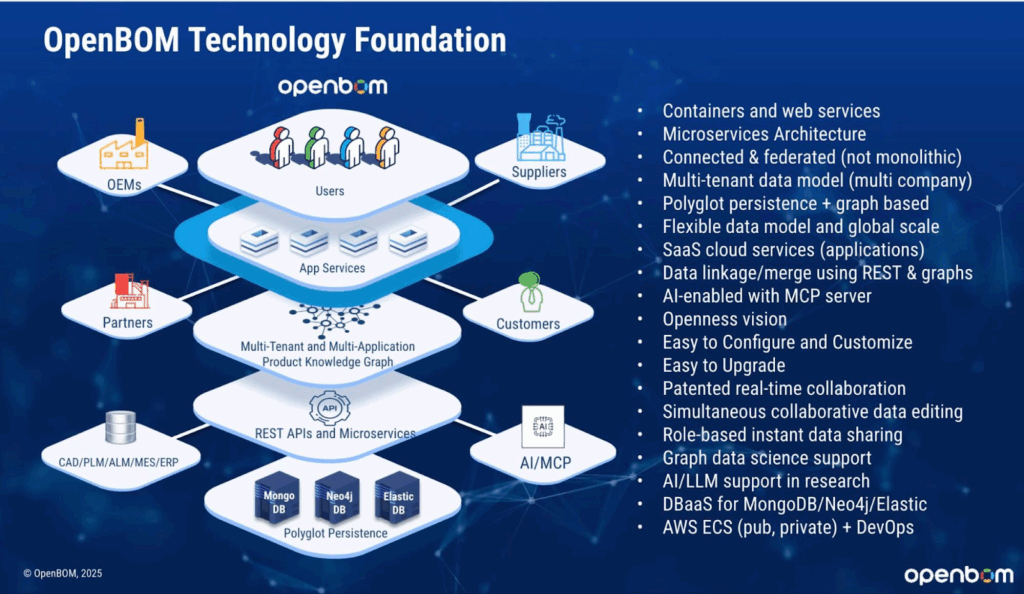
What it enables to our customers? Here are four things to explore.
Cross-Tenant Sharing of Live Data
Traditional PLM systems were built for a single enterprise. Sharing data with a supplier requires:
• exporting a file
• sending it by email
• hoping they use the right version
• collecting changes manually
• importing the updated file
• repeating endlessly
This workflow breaks the moment two companies collaborate.
With multi-tenancy, OpenBOM introduces a new model: share, don’t export.
You can safely share:
• a BOM
• a catalog
• a set of items
• an RFQ or PO
• a sourcing workspace
• a view or filtered structure
All as real-time objects. No duplication. No merge conflicts. No uncontrolled proliferation of files.
OpenBOM’s sharing behaves much like Google Docs or Sheets:
You control the permissions.
You grant access to specific people or companies.
They work with the same data in real time.
This creates a digital thread that crosses organizational boundaries — something no single-tenant PLM can deliver.
Composability: API-First and xBOM Services
Multi-tenant platforms naturally lend themselves to microservices rather than monolithic modules.
In OpenBOM:
• items are a service
• catalogs are a service
• BOMs and xBOM are services
• orders and RFQs are services
• data management and collaboration are services
• integrations run on published APIs
This is composability: assembling PLM capabilities like Lego bricks rather than living inside a rigid, vertically integrated suite.
Because OpenBOM uses a graph-based xBOM model, the same item can appear in an EBOM, MBOM, Procurement BOM, or Service BOM without duplication. Views reflect the same underlying graph.
And because it’s API-first, OpenBOM can integrate with CAD, ERP, and PLM systems without heavy customization.
This is the future of PLM — federated, not centralized.
Analytics & Traceability Across the Digital Thread
Multi-tenancy combined with a graph data model unlocks a level of traceability and analytics unavailable in hosted PLM.
In hosted systems, each customer has a different schema, different customizations, and different data organization. Analytics do not scale across instances. Even within one company, data fragmentation is common.
Multi-tenant SaaS solves this by placing all tenants on a shared semantic foundation.
This enables capabilities like:
• Multi-supplier BOM comparison
Share a BOM with three contract manufacturers and compare their bids in one place.
• Cross-company traceability
When a supplier updates a catalog or price, the OEM sees it instantly.
• Revision impact analysis
Engineers understand how a change affects procurement, suppliers, or downstream assemblies across the entire network.
• Procurement readiness analytics
Predict shortages, delays, and cost overages based on live supplier data.
• Lifecycle integrity
Every object maintains a history — even when shared across companies.
These capabilities require consistent semantics, shared services, and graph-based relationships — none of which hosted or single-tenant systems can provide.
AI Readiness: Intelligent Agents & Agentic Workflows
AI does not operate well on fragmented or inconsistent data.
AI requires:
• shared meaning
• global relationships
• consistent schemas
• real-time access
• permissioned actions
• unified APIs
Multi-tenant SaaS provides all of this.
This is why OpenBOM can introduce AI Agents that operate across engineering, procurement, and supplier ecosystems.
Examples of upcoming agentic workflows include:
• Engineering validation agents that check structures, alternates, substitutes, property completeness, and compliance.
• Procurement agents that compare vendor options, check availability, or predict sourcing risk.
• Change-validation agents that detect inconsistencies across multi-level BOM revisions.
• RFQ agents that evaluate quotes across suppliers based on cost, lead time, and risk.
• Supplier agents that push updates or notify OEMs about changes.
• Data-quality agents that maintain metadata consistency.
Agents can operate across tenants — when permissions allow — because multi-tenancy provides the security and consistency required.
Multi-tenancy is the architectural foundation for AI-native PLM.
OpenBOM’s Multi-Tenant Differentiators
OpenBOM is one of the few PLM platforms built natively as multi-tenant SaaS. It was not migrated or “cloudified.” It was designed for this world from the beginning.
Key differentiators:
Shared services, not cloned instances
All customers use a unified platform, ensuring consistent behavior and continuous improvement.
Flexible per-tenant data model
Each customer can configure items, catalogs, classifications, properties, and structures without breaking the system or other tenants.
Granular sharing model
Just like Google Docs, users can share any piece of data—BOM, item, catalog, view—with specific people or companies.
Global availability
The platform scales globally without customer involvement.
Graph/xBOM architecture
The underlying data model is built for multi-view product structures and multi-company lifecycle data.
Collaborative editing
Multiple teams can simultaneously update the same item, catalog, or BOM.
API-first platform
Every service is available via API, enabling deep connections with CAD (SolidWorks, Autodesk Fusion, Onshape), ERP (Dynamics 365, Odoo, NetSuite), and other tools.
Continuous delivery
All customers are always on the latest version.
Legacy PLM cannot replicate these capabilities without rewriting their entire architecture — something most have publicly admitted they will never do.
Extended Enterprise Examples (Real-World Use Cases)
OEM sharing a BOM with multiple contract manufacturers
An OEM sends a live BOM to three CMs. Each CM quotes directly on the shared structure. The OEM compares bids instantly without data merges or duplicated spreadsheets.
Buyer and engineer working across two companies
A supplier updates a catalog cost. The buyer at the OEM sees it instantly. The engineer reviewing alternates sees updated pricing without requesting a spreadsheet.
Supplier updates propagating instantly
If a supplier marks a part as obsolete or changes lead times, those changes flow directly into every dependent assembly.
Distributed teams collaborating on shared objects
Mechanical engineers, electrical engineers, procurement, quality, and manufacturing across different countries collaborate on a shared multi-level BOM with role-specific permissions.
These workflows are only possible with multi-tenant SaaS.
Business Impact (Why Multi-Tenant Is the New Standard)
The shift to multi-tenancy creates measurable business improvements:
Faster onboarding
Teams start in minutes — no installation, no upgrade windows, no IT.
Lower total cost of ownership
No servers, no maintenance, no versioning, no separate environments, no custom upgrades.
Fewer errors
With one shared product data source, teams stop exchanging files and stop losing track of which version is correct.
Faster supplier collaboration
Real-time sharing reduces friction, delays, and misunderstandings. RFQs and POs become faster and more accurate.
Scalability without replatforming
Companies can double or triple usage without redesigning their architecture.
Stronger ecosystem connections
Suppliers, partners, and contractors can collaborate in real time, speeding up the entire value chain.
Foundation for intelligent automation
AI agents become possible only when the underlying platform maintains consistent semantics and relationships.
These advantages align perfectly with how modern manufacturing works: distributed, fast-moving, multi-company, and increasingly automated.
The Future — AI-Native and Network-Native PLM
Multi-tenancy lays the foundation for a new kind of PLM — one that is both AI-native and network-native.
AI-native PLM requires a shared, consistent data layer.
Network-native PLM requires cross-company lifecycle relationships.
When you combine multi-tenancy + graph/xBOM + federated sharing, you create a product knowledge network, not a product database.
This network can reason, analyze, and automate decisions.
It becomes the base for product memory, agentic workflows, and a fully connected digital thread across the extended enterprise.
This is the future of PLM, and OpenBOM is building it now.
Conclusion — Multi-Tenant SaaS Is the New PLM Platform Shift
The PLM industry is entering a new era. Multi-tenant SaaS is no longer a nice-to-have or a modern deployment option—it is the architectural requirement for delivering collaboration, accuracy, analytics, and automation at scale.
Single-tenant systems, even when hosted in the cloud, cannot keep up with the demands of networked manufacturing. They cannot deliver real digital threads, AI agents, cross-company visibility, or the ecosystem collaboration that product development now requires.
OpenBOM is one of the first PLM platforms built entirely on a multi-tenant foundation, enabling companies of all sizes to work together faster, smarter, and with fewer errors.
If you want to explore how multi-tenant PLM can transform your engineering, procurement, and supply chain workflows, you can try it today.
Register for a free OpenBOM account and discover the modern Network Platform for manufacturing.
Best, Oleg
Join our newsletter to receive a weekly portion of news, articles, and tips about OpenBOM and our community.