Traditional PLM systems were built for a single company’s internal use. They worked well when engineering, manufacturing, and procurement all sat under one roof. But modern manufacturing no longer looks like that. Every product today — from medical devices to bicycles to industrial machinery — is created by a network of companies: design partners, contractors, and suppliers.
This article explores how OpenBOM extends the digital thread beyond the enterprise, creating a federated environment where multiple organizations can collaborate in real time. Building on the principles of composable PLM and graph-based data modeling, OpenBOM brings a new paradigm: PLM for the extended enterprise — where companies share data, not files.
From Composable PLM to the Extended Enterprise
In our earlier discussion — Composable PLM and Digital Thread – OpenBOM’s Approach — we explored how composable PLM connects systems and tools through an open, graph-based data model. The goal was to replace rigid, monolithic systems with flexible services that form a live, connected digital thread inside a company.
Now, it’s time to extend that vision. Beyond connecting tools within a company, manufacturers must now connect companies themselves.
Modern products are built by networks. OEMs outsource design and manufacturing, suppliers co-develop subassemblies, and contractors handle production and logistics. The digital thread doesn’t stop at the walls of a single organization. It crosses boundaries — linking teams that use different tools, processes, and even PLM systems.
And this is exactly where traditional PLM tools break. They were never built for a world in which multiple companies each have their own PLM and need to work together dynamically.
“Modern products are built by networks of companies. PLM must evolve from enterprise control to ecosystem collaboration.”
The Problem: Two Companies, Two PLMs, No Shared Truth
When two companies each use their own PLM, collaboration becomes a constant export-import routine. BOMs are sent via email, parts are shared in spreadsheets, and updates get lost in the shuffle.
Even when integrations exist, they’re mostly one-directional syncs that duplicate data between systems. The result is predictable: data drift, mismatched versions, and teams making decisions on outdated information. Syncing data isn’t collaboration — it’s replication.
This approach leads to a dangerous illusion of alignment. Each side believes they’re working on “the latest data,” but they’re not. The truth is scattered across disconnected systems and inboxes.
“You can synchronize data, but you can’t synchronize people when everyone works on copies.”
This is why OpenBOM reimagined the entire concept of multi-company collaboration. Instead of synchronization, OpenBOM enables sharing — much like Google Docs or Onshape. Share what you need, with whom you need, in real time.
OpenBOM’s Multi-Tenant Architecture: Sharing Without Copying
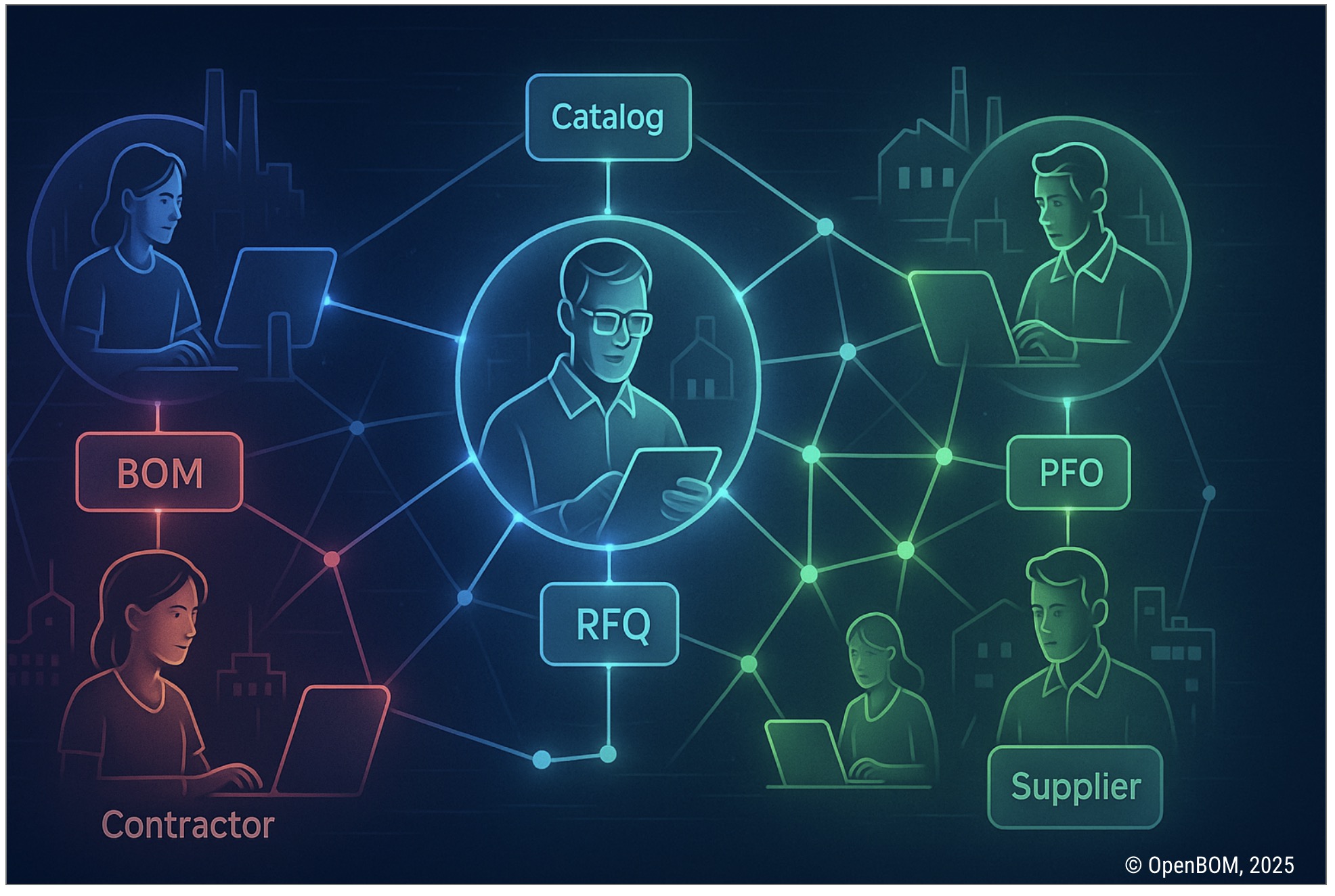
At the heart of OpenBOM’s innovation is its multi-tenant cloud architecture. Each company has its own account and owns its data, but can share specific data objects securely and directly with others.
Whether it’s a BOM, catalog, item, view, or workspace, OpenBOM enables precise sharing controls — read-only, edit, or custom view. Instead of sending exports, users simply “invite” partners to collaborate. The shared data remains live and synchronized by design.
When a supplier updates cost information or a contractor modifies a line item, those changes appear instantly for the OEM. No re-imports. No version chaos.
This mechanism scales naturally — across departments, companies, and entire supply chains. It’s the same principle that made Google Sheets transformative for business collaboration, now applied to engineering and manufacturing data.
“Don’t sync the data — share it. Work on the same truth, not on copies.”
OpenBOM’s architecture even supports the next step in collaboration: AI Agents. Soon, the same sharing mechanism will enable agents to access shared data safely, automate tasks like supplier evaluation or cost roll-ups, and assist teams across company boundaries.
Why It’s Different: A True Digital Thread Between Companies
Traditional PLM systems, even those branded as “cloud,” are typically single-tenant — each customer runs its own isolated database instance. Collaboration between two tenants means duplication or synchronization.
OpenBOM is multi-tenant by design, enabling data to be connected across tenants securely. When two companies collaborate, they don’t exchange files — they share relationships between data objects in the same graph.
Each company retains full ownership of its account, permissions, and intellectual property. Yet they can work together seamlessly on shared items or BOMs. This structure creates what can be called a “digital handshake” — a secure, federated connection where information is visible and actionable across organizations.
“In OpenBOM, the digital thread doesn’t stop at your company’s firewall — it extends to your entire supply network.”
This is not just about access. It’s about connected context — where engineering, purchasing, and supply partners all operate within one federated product network, each seeing the same data through their own lens.
Real-World Use Cases: Collaboration Across the Supply Chain
OEM and Supplier Collaboration
An OEM designing an electronic device needs to source key subassemblies from multiple suppliers. Instead of sending static BOMs or spreadsheets, the OEM shares a live BOM in OpenBOM with suppliers A and B. Each supplier views the data, adds their own cost and lead time inputs, and updates status fields directly. The OEM instantly sees both sets of updates in context, without ever managing imports or merges.
Multi-Bid Comparison
Manufacturers often request quotes from multiple contract manufacturers (CMs). With OpenBOM, they can share the same BOM view with several CMs at once. Each CM can input their offer directly — cost, lead time, MOQ, etc. — in the shared object. The OEM then compares offers in real time, instantly identifying the best supplier.
Collaborative Product Refinement
Suppliers often suggest alternate materials or manufacturing processes. With OpenBOM’s granular sharing, those proposals can be made directly in the shared BOM, keeping traceability and maintaining a single source of current data for all parties.
This level of collaboration has long been impossible in traditional PLM ecosystems, where exporting and re-importing dominate daily life. OpenBOM eliminates that friction by replacing duplication with connected participation.
The Business Impact: From Exports to Real-Time Collaboration
The “export and email” workflow has long been one of the biggest productivity drains in manufacturing. It slows down decisions, multiplies errors, and breaks accountability.
With OpenBOM, the process becomes live, federated, and traceable. Engineers, buyers, suppliers, and contract manufacturers all see the same connected data — each with the right permissions.
Key benefits:
- Eliminate duplication: Work on one shared dataset instead of dozens of disconnected files.
- Faster decisions: Instant updates from partners enable real-time negotiation and response.
- Fewer mistakes: Everyone sees the same version of truth, not outdated exports.
- Better transparency: Shared context creates accountability across the supply chain.
The switch to real-time data sharing also enables new business models. Companies can collaborate with multiple suppliers, compare options instantly, and maintain parallel sourcing strategies with minimal overhead.
“OpenBOM replaces the ‘send and forget’ culture with a ‘share and collaborate’ mindset.”
The Future of PLM: Networks, Not Silos
For decades, PLM has been framed around internal control — managing revisions, workflows, and compliance inside a single organization. But as products and supply chains become more complex, the definition of PLM must expand.
The next generation of PLM will be about networks, not silos. It will connect companies, not isolate them. It will reflect how design and manufacturing truly happen: collaboratively, asynchronously, and across boundaries.
OpenBOM’s federated, multi-tenant architecture is the foundation of this shift. It creates a secure, scalable environment where multiple companies can connect, share, and innovate together. It’s PLM built for ecosystems, not just enterprises.
“PLM for the extended enterprise isn’t about expanding control — it’s about expanding connection.”
Conclusion
The future of manufacturing depends on how effectively companies collaborate — not just internally, but across their entire network of partners and suppliers.
OpenBOM makes that collaboration possible. By transforming file-based exchanges into live data sharing, it eliminates communication delays, reduces errors, and accelerates product delivery.
It’s how modern manufacturers move from exporting files to building networks. From silos to shared threads. From isolated systems to connected intelligence.
“From continuous export to real-time connection — that’s how OpenBOM powers the extended enterprise.”
REGISTER FOR FREE to learn how OpenBOM helps you build a live digital thread across your entire manufacturing network.
Best, Oleg
Join our newsletter to receive a weekly portion of news, articles, and tips about OpenBOM and our community.