At OpenBOM, our long-term vision has been consistent: to enable engineers and manufacturing companies to make better decisions by providing structured, connected, and accessible data. The challenge we have observed for years is that while companies accumulate large volumes of data in CAD systems, spreadsheets, and enterprise software, most of it remains disconnected and difficult to use in daily decision-making.
The foundation of OpenBOM addresses this problem. We built our platform on a graph data model and graph database that makes relationships between items, assemblies, and processes explicit. In addition to this, we developed a collaborative workspace, something that feels as simple as Google Sheets, but with the rigor of PLM and the scalability required for complex manufacturing.
The next step is to build on this foundation by extending it into AI-driven workflows. Our goal is not to add another tool on top of existing processes, but to integrate AI where it can deliver value: by making product data accessible, by supporting reasoning across that data, and by enabling workflows that connect engineering with procurement, manufacturing, and operations.
This article is the third update in our “building in public” series. If you are new to this journey, you can revisit the earlier posts:
- Building in Public: OpenBOM Excel MCP
- BOM Excel MCP Update 1: The Super MVP
- BOM Excel MCP Update 2: Chat Navi
You can also read our press release announcing the Private Beta of the AI BOM Agent with MCP support for additional context.
AI Strategy and MCP
The OpenBOM AI strategy is not a departure from what we have built so far, it is a continuation. The core idea has always been that data, once structured and connected, becomes the foundation for better decision-making. AI provides us with a new way to unlock that potential.
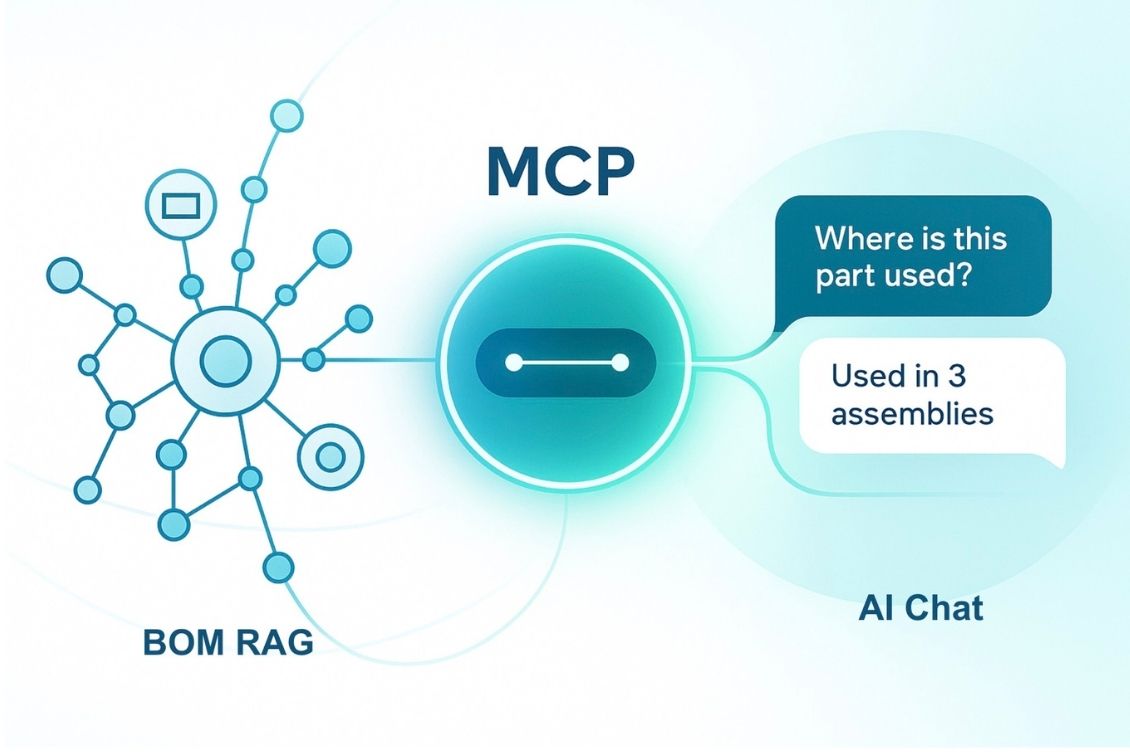
The two technologies at the center of this work are BOM RAG (Retrieval-Augmented Generation for BOMs) and MCP (Model Context Protocol). BOM RAG allows queries and reasoning to be contextualized with actual engineering and manufacturing data, ensuring answers are grounded in reality rather than generated in isolation. MCP provides a standardized way to expose structured and unstructured product data so that AI agents can use it reliably.
In phase one, our focus was on data access. We made it possible to bring information from CAD, Excel, and other formats into OpenBOM, transform it into the graph model, and make it available through MCP. This step might not sound glamorous, but it is critical. Without reliable access to accurate data, AI workflows collapse into noise. By starting here, we are building a solid base that future phases can extend with more intelligence.

Private Beta Availability
With this foundation in place, we are opening the Private Beta of the OpenBOM AI Agent with MCP support.
In practice, this means you can now import Excel BOMs or CAD data into OpenBOM and immediately make that data usable by AI. Once the data is inside OpenBOM, you can access it in two main ways. The first is through a conversational interface—a chatbot where you can ask questions in plain language. For example, you can ask “Where is this part used?” or “Show me the assemblies that include this component,” and the system will return structured results drawn directly from your data. The second way is by accessing the data directly through the MCP protocol, which allows developers to plug this data into their own workflows and tools.
Beyond simple queries, the Private Beta also supports building agentic workflows. Because the data is exposed through MCP, it can be connected to other systems using open source or low-code automation platforms such as n8n. For example, you can set up a workflow that sends BOM information to procurement or integrates directly with your ERP system. This makes the AI agent not just a tool for answering questions but a component in larger processes that span engineering and operations.
What’s Next (Phase 2 of OpenBOM AI)
Phase one is about access. Phase two is about intelligence.
Our next milestone is to introduce decision support. Once data can be reliably accessed and queried, the logical step is to provide analysis and recommendations that help engineers and manufacturers improve their work. Some of the initial applications we are exploring include detecting mistakes in BOMs, identifying gaps or inconsistencies that might lead to errors downstream, and supporting sourcing decisions by analyzing vendor and supplier data. We also plan to develop tools for cost optimization, using AI to highlight alternatives or opportunities for savings across a product structure.
The emphasis in phase two is not on replacing human decision-making but on providing tools that extend it. By surfacing potential issues, by suggesting alternatives, and by analyzing patterns that are not immediately visible, the OpenBOM AI Agent will support engineers and procurement professionals in making faster and more informed choices.
Watch the First Demo Video
The best way to understand what the OpenBOM AI Agent with MCP support can do today is to see it in action. In our first demo video, we upload an Excel BOM into OpenBOM and immediately use the chat interface to run natural language queries. Questions like “Where is this component used?” or “List all assemblies containing this part” return structured and reliable answers directly from the data.
This demonstration is important not because of the simplicity of the questions, but because it shows the principle at work: once data is ingested and structured, it becomes accessible to both humans and machines in ways that were not possible before.
Watch the demo video.
What is Now? Call to Action
The release of the Private Beta marks the first operational step toward the OpenBOM AI Agent. This stage is about proving that data can be ingested, structured, and exposed reliably through MCP, and that it can be made available in ways that are both human-friendly and machine-friendly.
We are inviting companies to participate in the Private Beta. Early adopters will not just use the system; they will help shape it. Their feedback will guide us in prioritizing capabilities, refining workflows, and defining the path toward the first public release of the OpenBOM AI Agent.
Contact our support to request an access for OpenBOM AI Agent with MCP Private Beta.
Conclusion
The combination of the OpenBOM AI Agent and MCP establishes a foundation for accessible, intelligent, and connected product data. This is a long-term project, and this release represents one step in a process that will evolve over time.
We will continue to document progress openly, sharing both the capabilities that are available now and the directions we are pursuing for the future. Our aim is to make AI a practical and valuable part of the daily work of engineers and manufacturers—not as an abstract concept, but as a set of tools grounded in data and workflows.
We invite the community to join us in this effort by testing the Private Beta, sharing feedback, and contributing to the development of a roadmap that will make AI an integral part of product lifecycle management.
Further Reading
To explore more about OpenBOM’s approach to data structure, AI’s role in PLM, and product data trends more broadly:
- From Collaborative Workspace to BOM AI Analysis (OpenBOM)
- Why PLM AI Needs Structure: From Unified Import to BOM RAG (OpenBOM)
- PLM as the Next Operational System — Goodbye Docs, Hello Collaborative Executable Artifacts (Beyond PLM)
- When CAD + PDM + PLM Platforms Shift — What Happens to the Product Data? (Beyond PLM)
Join our newsletter to receive a weekly portion of news, articles, and tips about OpenBOM and our community.