Since the very beginning of OpenBOM, our mission has been to help engineers, manufacturers, and teams organize product information and collaborate more effectively. Over the past years, we’ve been building OpenBOM step by step—releasing new features and improvements every month, guided by constant customer feedback.
Together with all our users, partners, and customers, we’ve achieved a lot. From CAD integrations to procurement workflows, from flexible BOM management to xBOM services, OpenBOM has grown into a powerful online digital thread platform for modern engineering teams and manufacturing companies.
BIG THANK YOU – We’re grateful for your support and trust. 🙏
I’m super excited to share our new milestone with you – building OpenBOM Excel MCP. Since our earlier BOM AI announcement this year, we’ve been continuously working on OpenBOM infrastructure and today we want to move to the next step – building BOM Excel MCP in public.
But today, we’re approaching a new and important milestone: starting to bring OpenBOM AI to life. And we want to build it openly with inviting feedback and earlier users to validate our ideas and become first customers.
That means we’ll share our progress, challenges, and even failures openly, and get feedback from you early. Our goal is simple: move faster, build smarter, and make sure what we deliver really helps you.

Why BOM Excel MCP?
Over the past few years, we’ve helped thousands of users and companies replace messy spreadsheets with structured product data, CAD integrations, and cloud-native collaboration. Yet, the truth remains:
Excel is the lingua franca of BOMs in many companies.
No matter how advanced your CAD, PDM or ERP solutions will be, Excel continues to be used for various tasks because of their ubiquitous performance, simple communication and availability across engineering and manufacturing teams. OpenBOM supported it by providing easy import and export capabilities at OpenBOM.
But we also see an opportunity to take OpenBOM Excel integration to the next level.
With our recent August production update, OpenBOM enhanced import capabilities with new unified and seamless Excel import. But with our multi-tenant, graph-based platform, we can go further:
- Deliver an online AI-native API access level with a unified BOM import that understands messy, inconsistent Excels.
- Introduce a BOM MCP (Model Context Protocol) API support that lets customers build agentic solutions, so BOMs data from Excel becomes intelligent, queryable, and actionable.
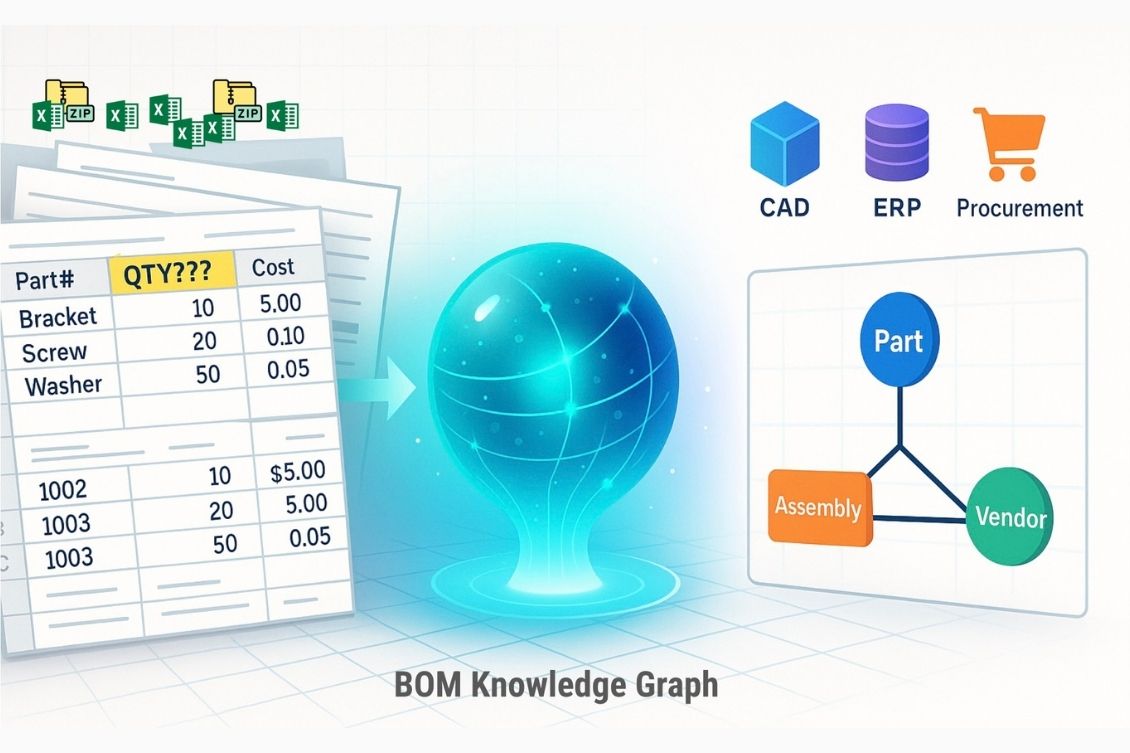
In short: we’re turning Excel chaos into structured knowledge, and making it accessible through AI-driven API workflows.
Our 4-Stage Journey
We’re breaking this down into clear stages that we’ll share as we go.
Stage 1 – Import Anything
Our first goal: seamlessly ingest any Excel BOM, no templates required. Even the messiest file with inconsistent headers should become structured data in OpenBOM.
- Excels imported to OpenBOM and turned in the structured knowledge graph
Stage 2 – Natural Language Queries
Once the BOM data is structured, you’ll be able to ask questions in plain English.
- “What’s the total cost of this assembly?”
- “Which assemblies are missing vendor data?”
- “Where is Part #123 used?”
Stage 3 – Reports & Agentic Actions
The next step is action. Agents will generate reports, cost rollups, vendor summaries, or alerts—automatically.
- Instead of exporting and reformatting data, you’ll just ask: “Generate a cost report for procurement.”
Stage 4 – Graph + Product Memory
Finally, we’ll connect all imported Excel BOMs into a graph-based product memory.
- “Show alternates of Part #123 across all projects.”
- “Highlight components impacted by a vendor cost change.”
This is the foundation for an AI-native product data future.
Conclusion: Why Build in Public?
We could build all of this behind closed doors and release it when it’s finished. But that’s not the OpenBOM way.
- We want to invite feedback early: tell us what matters most.
- We want to share the messy reality of building AI for BOMs.
- We want to engage the community: if you have a nightmare Excel BOM, let’s test it together.
Transparency builds trust, and we believe the best products are built with the people who actually use them.
Join Us
Over the coming weeks, we’ll share updates here on the OpenBOM Community, OpenBOM Blog, and on LinkedIn. Expect demos, reflections, and honest behind-the-scenes looks at how we’re building BOM AI MCP.
👉 If you’d like to participate, send us your most “chaotic” and challenging Excel BOM. We’ll run it through OpenBOM and share the results privately with you.
This is just the beginning. Excel BOMs are everywhere—and together, we can make them intelligent.
Stay tuned.
Best, Oleg
Join our newsletter to receive a weekly portion of news, articles, and tips about OpenBOM and our community.