Every product starts with an idea, but turning that idea into a shippable product requires structure, coordination, and detail. That’s where the Bill of Materials comes in.
In my experience working with hundreds of manufacturing companies, the bill of materials in supply chain management is where most operational pain lives. Teams struggle with late sourcing decisions, misaligned BOMs between engineering and production, and supply chain disruptions that could have been caught earlier.
The manufacturing BOM is the document that connects design intent to supply chain execution, and getting it right is one of the highest-leverage investments a manufacturer can make.
Among the different types of BOMs, the Manufacturing BOM (MBOM) plays a critical role in bridging the gap between the design process and the final product. It informs procurement, drives shop-floor execution, and supports precise inventory management and cost estimation.
As digital transformation reshapes modern manufacturing, the MBOM has evolved from a static parts list into a dynamic, connected data model at the heart of production planning and supply chain strategy. Let’s unpack what Manufacturing BOM really means, how it differs from other BOMs, and why it’s now a pillar of modern supply chain management.
What is a Manufacturing Bill of Materials (MBOM), and How is it Different?
An MBOM, or Manufacturing Bill of Materials, is a detailed and structured list of all components, raw materials, operations, and assemblies required to build and ship a finished product (a production recipe).
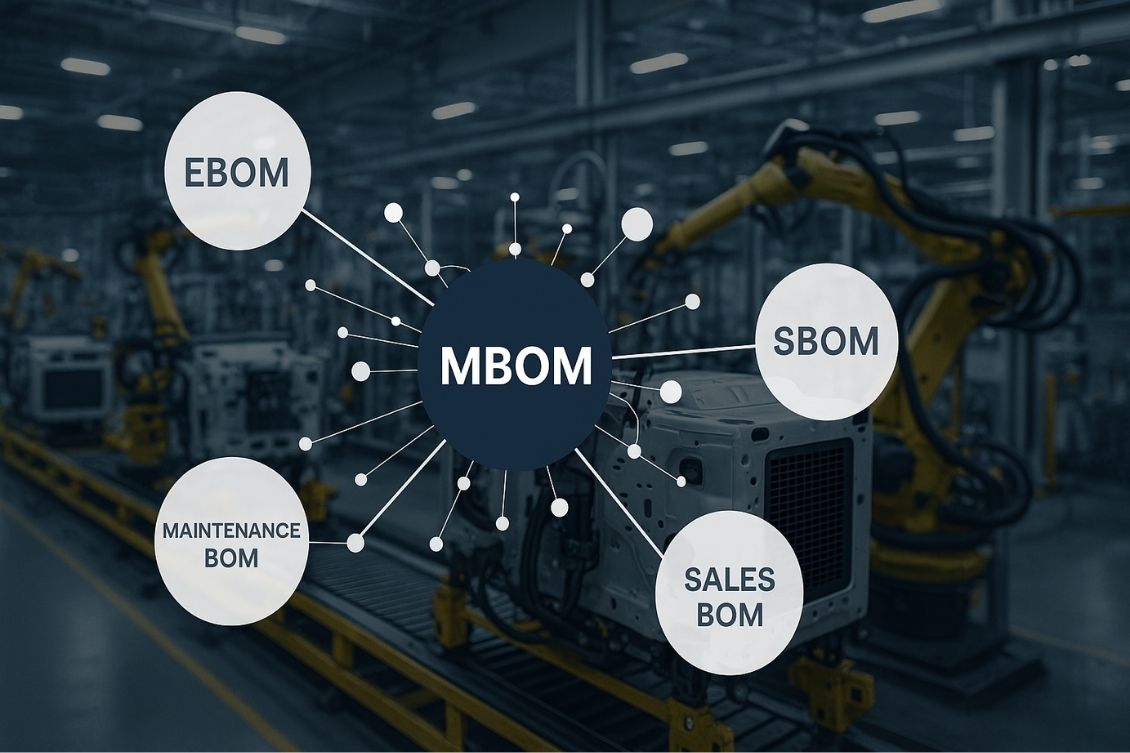
What makes the MBOM unique is that it reflects how the product is manufactured, not just how it’s designed. While an Engineering BOM (EBOM) follows the structure defined by the product’s CAD models and design’s hierarchical structure, the manufacturing BOM reorganizes that data to match the actual production process. It includes packaging, tooling, consumables, and other non-design items needed for assembly.
The manufacturing BOM is also the primary document driving supply chain management, from procurement planning and inventory control to supplier collaboration and demand forecasting. Without an accurate MBOM, every downstream system (ERP, MES, SCM) is working from incomplete information.
The MBOM is tightly connected to other integrated business systems: enterprise resource planning (ERP), manufacturing execution system (MES), and supply chain management (SCM). It informs purchasing, drives shop-floor execution, and supports precise tracking of inventory and cost estimation. In short, the manufacturing BOM is where engineering meets reality.
Manufacturing BOM: All the Components and Structure
An effective manufacturing BOM isn’t just a list of different components. It’s a structured, hierarchical model of how a finished product is built. It typically includes:
- All the parts and sub assemblies, including manufactured, purchased, and outsourced components required to create a product.
- Manufacturing process steps and operations, such as welding, painting, or firmware loading, going far beyond what a technical drawing alone can specify.
- Consumables and packaging, like adhesives, tapes, fasteners, and labels, materials required for production but often absent from the engineering BOM.
- Metadata such as supplier names, part numbers, cost, lead time, revision, and compliance requirements.
- Alternate or substitute components, where applicable.
- Routing and production sequencing, which align with the bill of process (BOP) or manufacturing workflows.
Unlike the engineering bill of materials, which follows design logic (like functional grouping), the manufacturing BOM is organized according to how the product is assembled, often based on workstations, kits, or production phases.
Here’s a simplified example of what an MBOM looks like in practice:
| Part Number | Description | Qty | UOM | Source | Lead Time |
|---|---|---|---|---|---|
| FST-0042 | M3 Hex Bolt | 8 | EA | Purchase | 3 days |
| PCB-117A | Main Control Board | 1 | EA | Manufacture | 14 days |
| CBL-009 | Power Cable Assembly | 1 | EA | Purchase | 7 days |
| PKG-003 | Retail Box | 1 | EA | Purchase | 5 days |
| ADH-01 | Thermal Adhesive Tape | 0.5 | M | Purchase | 2 days |
A real MBOM extends this with supplier names, alternate components, compliance flags, and revision history. It also specifies precise quantities and units of measure for every component, the assembly component list that production and procurement teams depend on. This level of detail is what separates a manufacturing BOM from a simple parts list.
Why Manufacturing Bill of Materials Matters: Beyond the Assembly Order List
While an oversimplified approach presents the manufacturing bill of materials as a list of components and assembly order, the bill of materials delivers far more measurable value across the entire organization:
- Production Efficiency: By reflecting the actual assembly process, the MBOM helps streamline work instructions and minimize production errors on the shop floor. Manufacturing efficiency improves when every team member, from the line worker to the quality assurance inspector, is working from the same accurate, up-to-date structure.
- Production Planning and Scheduling: The MBOM is a direct input to production planning systems. Accurate BOM data enables realistic production scheduling, capacity planning, and work order generation, reducing costly production delays caused by missing components or incorrect quantities.
- Cost Control: With accurate materials and operations listed, cost roll-ups can be calculated more reliably and earlier in the process. Accurate cost estimation at the BOM level also enables better should-cost analysis and supplier negotiation.
- Procurement Specification: The MBOM informs ERP systems on what to buy, when, and from whom, reducing inventory mismatches and late orders.
- Inventory Management: Accurate MBOM data feeds material requirements planning (MRP), helping teams calculate exactly what to order, when, and in what quantity, reducing both stockouts and excess inventory.
- Demand Forecasting: When MBOM data is connected to production schedules, procurement teams can align supplier orders with actual build plans rather than reactive purchasing.
- Compliance and Traceability: Especially in regulated industries (medical, aerospace, automotive manufacturing), the MBOM helps document what was built, when, and with which components. Regulatory compliance in industries like ISO 13485 or AS9100 depends on this traceability. Teams can also control inventory more precisely when BOM data is accurate and version-controlled.
- Supply Chain Risk Mitigation: A well-maintained MBOM makes it possible to identify sole-source components and long lead-time parts early, before they become production bottlenecks. A single missing component can halt an entire production line; BOM accuracy is the first line of defense.
- Cross-Functional Collaboration: When done right, the MBOM becomes a shared asset between engineering, manufacturing, and supply chain teams.
For a deeper look at common BOM mistakes that create downstream supply chain problems, see 10 BOM mistakes that kill product launches.
Manufacturing BOM in Supply Chain Management
The manufacturing bill of materials is not just a production document, it is the foundation of supply chain intelligence. Every component listed in the manufacturing bill of materials represents a procurement decision, a supplier relationship, an inventory position, and a lead time risk.
When bill of materials data is accurate, connected, and current, supply chain management becomes proactive. When it isn’t, teams spend their time firefighting.
Procurement and Component Sourcing
The MBOM defines what must be bought, from whom, and when. Each component in the BOM carries a procurement type, purchased, manufactured, or outsourced, that tells the ERP system how to handle it.
This data feeds MRP systems with the component information needed to generate purchase orders, plan replenishment cycles, and avoid late deliveries. When BOM data is incomplete or siloed, buyers work from assumptions, leading to inventory mismatches, duplicate orders, and missed delivery windows.
Connecting the MBOM directly to procurement workflows eliminates this gap. For more on how digital BOMs change the procurement dynamic, see how a digital BOM simplifies supplier collaboration.
Inventory Management and MRP
Material requirements planning (MRP) is only as accurate as the BOM feeding it. An MBOM with correct quantities, units of measure, and component sourcing flags allows MRP systems to calculate net requirements, plan safety stock, and schedule replenishment in line with production demand.
Errors in the MBOM, wrong quantities, outdated part numbers, missing alternates, cascade directly into inventory problems.
Supplier Collaboration and Lead Time Management
Modern supply chain management requires sharing BOM data with suppliers early and often. When contract manufacturers and vendors can see the MBOM, or a curated view of it, they can provide accurate quotes, flag availability issues, and plan capacity accordingly.
Lead time visibility at the component level is especially critical for high-mix, low-volume manufacturers where every build is different. See also: streamlining bill of materials and purchasing processes.
Supply Chain Risk Management
Supply chain disruptions often trace back to a BOM problem: a sole-source component with no approved alternate, a long lead-time part that wasn’t flagged until design was finalized, or a supplier change that wasn’t propagated through the MBOM.
Phase 3 MBOM management (covered below) addresses this directly, building supply chain risk awareness into the product data model itself rather than treating it as a downstream procurement problem.
Want to connect your MBOM directly to procurement and supplier workflows? Register for free and explore how OpenBOM bridges BOM data and supply chain execution.

Process and Best Practices: From Engineering BOMs to Supply Chain Intelligence
Over the years, the way companies approach the manufacturing bill of materials has evolved dramatically. What started as a simple bill of materials parts list has become a dynamic model that connects design, production, and supply chain.
Let’s explore three common approaches to MBOM and one key trend that’s transforming all of them.
MBOM Phase 1: The Single BOM Era (ERP-Centric Approach)
Let’s start with the most traditional model, the one that’s been in use for more than 20 years. In this approach, the MBOM is the only BOM. It lives in the ERP or MRP system and serves as the master source for everything manufacturing needs.
Back in the day, CAD tools were mostly used to produce 2D drawings and technical drawings. Once those drawings were finalized and released, manufacturing or ERP teams would manually create the BOM from them.
It was often a painstaking process, transcribing parts, quantities, and notes from engineering documentation into the ERP system. The MBOM was flat, static, and often built with little to no input from engineering. There was no connection between the manufacturing process and the product data used to plan it.
Characteristics:
- MBOM is authored and maintained manually in ERP.
- Design and manufacturing teams operate in separate silos.
- Drawing releases trigger BOM creation, no data until design is “done.”
- No structured hand-off from CAD to manufacturing.
Use Case Fit:
- Companies with simple products or limited product variation.
- Organizations heavily invested in legacy ERP systems.
- Environments where product changes are infrequent and tightly controlled.
Challenges:
- Late discovery of manufacturability or sourcing issues.
- No traceability between design revisions and BOM structure.
- Manual data entry errors are common and can disrupt the entire production process.
- Production delays caused by missing or incorrect BOM data are frequent.
- BOM change processes are slow and costly.
From a supply chain perspective, the single BOM era offered almost no visibility. Procurement teams received BOM data late, had no way to flag component availability issues during design, and relied on manual processes to translate engineering data into purchase orders.
MBOM Phase 2: The Restructured EBOM (PLM-Centric View)
As product lifecycle management (PLM) and product data management (PDM) systems became more prevalent, companies began to see the value of building MBOMs from structured engineering data. In this model, the Engineering BOM (EBOM) is the starting point, and the MBOM is derived by reorganizing or enriching it to match manufacturing needs.
This approach allows manufacturing engineers to reshape the product structure to reflect how the final product is actually built, reordering operations, introducing phantom assemblies and sub assemblies, or grouping components by production steps. The MBOM becomes a more accurate representation of the manufacturing process, including assembly sequences and production flows.
Characteristics:
- PLM/PDM holds the EBOM; MBOM is created by transformation or restructuring.
- Manufacturing input is added for routing, tooling, and operations.
- Tighter integration between engineering and manufacturing teams.
- BOM revisions are managed via formal PLM workflows.
Use Case Fit:
- Mid-sized to large organizations with cross-functional product teams.
- Companies that require traceability between design and production structures.
- Environments with frequent design changes or multiple variants.
Challenges:
- PLM systems may not integrate easily with ERP or MES.
- Restructuring can be time-consuming and prone to errors if not automated.
- Engineering teams may resist releasing design data early enough.
- BOM alignment between EBOM and MBOM can drift over time.
One underappreciated benefit of the PLM-driven MBOM is improved traceability across engineering change management. When a design change triggers a formal BOM revision workflow, supply chain teams get visibility into what changed and can proactively reassess sourcing. For more on managing this process, see revision control in multi-level BOMs.
MBOM Phase 3: Foundation of Production and Supply Chain Optimization (Data-Centric Model)
This is the most modern and forward-looking approach. Here, the MBOM is not just a transformation of design data, it’s a rich, structured model that connects all the dots: from CAD to suppliers, from cost estimates to production workflows.
The manufacturing bill of materials is created early in the product development cycle and evolves continuously. It includes supplier-specific components, cost roll-ups, lead times, sourcing alternatives, and availability constraints. This allows companies to assess manufacturing feasibility, cost, and supply risk in real time, well before design is finalized.
Characteristics:
- MBOM is built as a flexible, multi-view structure with links to design, sourcing, and production systems.
- Supports alternate parts, make/buy decisions, and supplier-specific configurations.
- Sub-assemblies are modeled with full traceability, enabling granular visibility into every step of the manufacturing process.
- Captures all materials required for each sub assembly, including consumables, packaging, and production-specific items not found in the engineering BOM.
- Includes metadata like cost, lead time, scrap rates, and compliance flags.
- Functions as a digital thread element, connecting MBOM data across PLM, ERP, MES, and supply chain systems, enabling real-time traceability from design intent through manufacturing process to field service.
Use Case Fit:
- Companies working with complex products or high-mix, low-volume production.
- Organizations with distributed teams, contract manufacturers, or multi-site operations.
- Environments that need agility in response to supply chain or design changes.
Challenges:
- Requires strong integration between PLM, ERP, MES, and sourcing tools.
- Demands flexible, often graph-based data models and not just hierarchical structures.
- Cultural shifts are needed to support cross-functional ownership of BOMs.
- Investment in modern platforms and scalable data infrastructure is essential.
Early MBOM Visibility
Regardless of which approach a company takes, there’s a clear and universal trend emerging: waiting until the design is finalized to create an MBOM is no longer acceptable.
Modern manufacturing requires early and incremental visibility into manufacturing data. This means creating and refining the MBOM in parallel with design, so that potential issues related to cost, sourcing, and manufacturability are identified long before they become expensive problems.
With early MBOM visibility:
- Engineers can get feedback on part availability and cost implications while still designing.
- Buyers can flag long lead-time components before they affect delivery.
- Manufacturing teams can provide input on assembly constraints during early prototyping.
Early MBOM visibility is also a supply chain risk management tool. When long lead-time components and sole-source parts are identified during the design phase, not after design freeze, procurement teams have time to qualify alternates, place early orders, or influence design decisions.
This is how a BOM helps you launch products faster: not by moving faster in production, but by removing supply chain surprises before they happen.
This trend is reshaping not only how BOMs are built, but also how organizations collaborate. The MBOM becomes a living product model, one that grows, adapts, and ultimately drives better decisions from concept to production.
Integration: MBOM Meets Digital Systems
The MBOM doesn’t live in a vacuum. It’s part of a broader digital ecosystem that includes PLM, ERP, MES, and SCM platforms. To be truly effective, the MBOM must be deeply integrated with these systems. The tighter the integration, the greater the impact on operational efficiency, cost control, and supply chain agility.
The MBOM typically connects to:
- PLM systems to receive design intent, EBOMs, and engineering change data.
- ERP systems to support procurement, inventory planning, cost rollups, and materials management.
- MES systems to deliver shop-floor instructions and manage routing and production steps.
- BOP (Bill of Process) to align materials with the actual manufacturing process, including steps, tools, and work centers, ensuring the MBOM and the manufacturing process stay in sync as both evolve.
However, the critical point is that the MBOM can reside in different systems, depending on your company’s IT architecture, process ownership, and legacy system landscape.
- In engineering-driven organizations, the MBOM often originates or resides in the PLM system, where the EBOM-to-MBOM transformation occurs, and engineering maintains control over the product structure.
- In manufacturing- or supply chain–driven organizations, the MBOM may be created or maintained in the ERP system, where procurement, planning, and production teams take ownership.
- In some cases, companies implement hybrid approaches, with MBOM data synchronized or federated between PLM and ERP systems, or even maintained in a specialized MBOM system that bridges both domains.
API-based integration is increasingly the standard for connecting MBOM data across systems. Rather than manual exports and re-entry, a process prone to version drift and data errors, modern platforms use open APIs to automate data flow between CAD, PLM, ERP, and MES.
This is a core driver of digital transformation in manufacturing: moving from siloed, document-based workflows to a connected, data-driven manufacturing environment where manufacturing efficiency gains compound across every function.
This connected architecture is what makes the digital thread a reality: MBOM data flows from design intent through manufacturing execution to field service, creating end-to-end traceability across the product lifecycle management process.
A key principle remains: the MBOM must be dynamic, version-controlled, queryable, and extensible. Static spreadsheets or document-based BOMs can’t support today’s pace of change or manufacturing complexity.
Modern architectures, especially those leveraging graph-based or composable data models, enable a more fluid, real-time MBOM that reflects actual product configurations, supports alternates and substitutes, and can respond quickly to disruptions in design or supply.
Ultimately, integration is not just about syncing data. It’s about aligning ownership, processes, and responsibilities across systems to ensure a consistent, actionable view of how your product gets built.
MBOM in OpenBOM
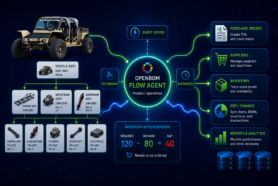
As companies look to modernize their MBOM strategy, tools like OpenBOM provide a significant advantage. OpenBOM goes beyond traditional BOM software by offering a flexible xBOM model that supports multiple BOM views, including EBOM, MBOM, and service BOMs, all connected through a single data infrastructure.
With OpenBOM, manufacturers don’t need to force-fit their BOMs into rigid templates or workflows. Instead, they can create and evolve a dedicated MBOM structure that reflects exactly how their products are built and sourced. This MBOM can be linked to specific inventory items, engineering data, supplier information, manufacturing sequences, or even cost breakdowns, creating a rich, connected product model.
For supply chain teams specifically, OpenBOM’s purchasing BOM view connects component-level data directly to vendor records, approved manufacturer parts, cost rollups, and lead time information. This means procurement doesn’t need to chase engineering for the latest BOM, the data is live, version-controlled, and always current. Learn more about item and BOM management in OpenBOM.
OpenBOM’s item lifecycle and change tracking capabilities ensure that all revisions, updates, and modifications are captured, so teams always know what changed, when, and why. This traceability is critical for compliance, auditability, and quality control, especially in regulated industries.
And perhaps one of the most unique advantages? The OpenBOM Graph Navigator. It allows teams to explore complex product structures visually, navigating through interconnected parts, sub assemblies, vendors, and configurations in an intuitive, graphical format. It’s not just about seeing the data, it’s about understanding how all parts relate and everything fits together.
Whether you’re creating an MBOM from scratch or restructuring your EBOM for manufacturing, OpenBOM provides the tools and flexibility to do it right and evolve it over time as your processes mature.
Conclusion: Building the Future of MBOM
The MBOM is no longer just a downstream artifact. It’s a strategic structure that helps teams deliver high-quality products, fast and at scale, and a cornerstone of modern supply chain intelligence.
Whether your organization still relies on legacy ERP-driven BOMs or is moving toward an integrated, AI-ready product data model, the direction is clear: early collaboration, flexible data structures, and supply chain awareness are becoming the norm.
To succeed, teams must treat the MBOM as a living model, not just an output from design. Build it early. Keep it connected. Let it evolve.
And with platforms like OpenBOM, you have the infrastructure to do exactly that, organize, trace, and navigate your MBOM with confidence, from design intent all the way to supply chain execution.
Interested in discussing how OpenBOM can help you organize your manufacturing BOM planning process? Talk to us.
REGISTER FOR FREE and check how OpenBOM can help.
Best, Oleg
FAQ
What is a Manufacturing BOM?
A manufacturing bill of materials (MBOM) is a detailed and structured list of all components, raw materials, operations, and assemblies required to build and ship a finished product. Unlike a standard bill of materials, the manufacturing bill of materials is organized around production processes rather than design hierarchy, capturing exactly what is needed on the shop floor to build the final product.
What are the Types of BOMs?
The most common are engineering and manufacturing BOMs. There are also single-level BOM, multi-level BOM, assembly BOM, production BOM, sales BOM (also called a sales bill of materials), procurement BOM, configurable BOM, modular BOM, indented BOM, phantom BOM, and abstract BOM. Each serves a different stage of the product lifecycle.
What are the Benefits of MBOMs?
Implementing an MBOM allows companies to improve production efficiency, inventory management, collaboration between multiple departments, cost and quality control, and reduce the number of errors and mismatches.
What is the difference between an eBOM and an mBOM?
An engineering BOM (eBOM) reflects design intent from CAD/PLM, organized by design hierarchy, it captures how the product was designed. A manufacturing BOM (mBOM) reorganizes components for actual production: assembly sequence, shop-floor operations, packaging, and tooling. The eBOM is owned by engineering; the mBOM is owned by manufacturing and supply chain teams.
How does a manufacturing BOM support supply chain management?
The MBOM defines every component that must be procured, including quantities, units of measure, sourcing type, and lead times. This data feeds MRP systems to calculate what to order and when, drives procurement scheduling, enables inventory planning, and supports supplier collaboration. Without an accurate MBOM, supply chain management operates on incomplete information.
When should you create a manufacturing BOM?
Best practice is to start MBOM creation in parallel with design, not after design is finalized. Early MBOM visibility gives procurement teams time to flag long lead-time parts, identify sole-source risks, and feed cost and availability data back to engineers while changes are still inexpensive to make.
What is BOM restructuring?
BOM restructuring is the process of transforming an engineering BOM into a manufacturing BOM by reorganizing the product structure to match actual production processes. This includes adding phantom assemblies, grouping components by production workstation or kit, incorporating shop-floor items like tooling and consumables, and defining make/buy decisions. It is one of the most error-prone steps in product development when done manually.
How do you integrate MBOM data with ERP and MES systems?
MBOMs feed ERP systems for procurement, inventory planning, and cost management; MES systems for shop-floor instructions and routing; and PLM systems for design traceability and engineering change management. Modern approaches use API-based integration for automated, real-time data flow, eliminating the manual re-entry that causes version drift and data errors between systems.
Join our newsletter to receive a weekly portion of news, articles, and tips about OpenBOM and our community.