From BOM management to a connected operational layer across engineering, procurement, inventory, and business systems.
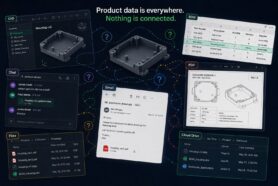
Every manufacturing company eventually runs into the same structural problem. Engineering owns the definition of the product. It owns the BOM, the revisions, the suppliers, and the sourcing decisions. ERP and financial systems own the execution. They own purchasing, inventory, accounting, and the transactions that keep the business running. Between those two worlds sits a wide band of manual work that nobody designed on purpose. It is the band of spreadsheets, exports, imports, email threads, and reconciliation that quietly absorbs hours every week and breaks the moment a revision changes.
I have spent a long time watching companies try to close that gap, and the usual instinct is to treat it as a synchronization problem. Move the data from here to there on a schedule, and the problem is supposed to go away. It does not. The reason it does not is that the gap is not really about moving data. It is about product operations, the connective layer where engineering intent turns into purchasing, inventory, and supplier action. OpenBOM Flow Agent is built for that layer.
Many Companies Don’t Start From ERP
A lot of growing companies are not in a position to stand up a full ERP on day one, and they should not pretend otherwise. They begin with CAD, spreadsheets, supplier lists, and procurement plans maintained by hand. The hand-maintained version works until the product gets complex enough that it quietly stops scaling, and by then the cost of the disconnection is already being paid in errors and rework.
Two situations make this especially clear. The first is early engineering and prototype planning, where a team is still defining the product but already needs to order long-lead parts, track what has arrived, and plan a first build. The second is a growing company that depends on contract manufacturing, or a small company that runs lean by design. Neither is a candidate for a heavyweight ERP rollout, and yet both have an immediate need to run production operation planning, the procurement, supply chain coordination, and purchasing that turn a design into something that can actually be built. That work does not wait politely for an ERP to be in place.
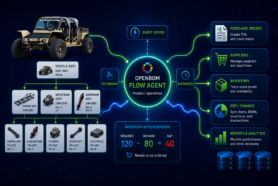
This is where OpenBOM’s operation planning and inventory management helps. This is not a “typical” PLM checkbox, but OpenBOM does it – vendors and supplier records, inventory, purchasing, procurement planning, and order-specific functions in one collaborative place, with inventory, RFQ, and purchase order support built in. A team can run real procurement planning before it has committed to an ERP at all. The outcome that matters most in both cases is a gap calculation. Take an Order BOM, compare required quantities against accurate on-hand inventory and the size of the order being planned, and read directly what needs to be ordered, before production starts. Here is a typical product operation flow described in the picture below.
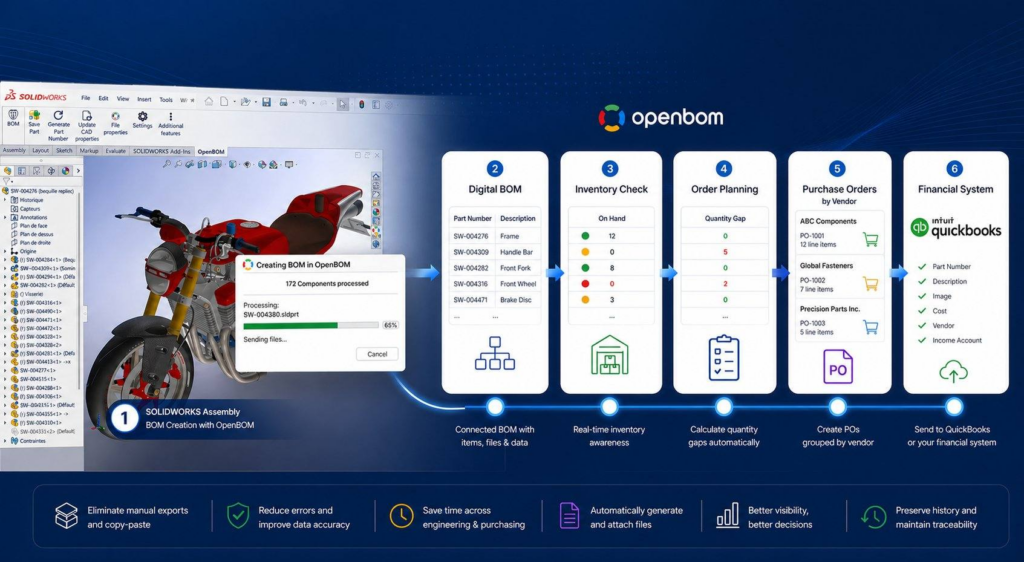
Nobody has to rebuild that process in a separate spreadsheet that is out of date the moment it is saved. The spreadsheet was never the problem. The disconnection was. OpenBOM closes this process in a fully automated and integrated way for prototype development, contract manufacturing and small engineering and manufacturing teams.
OpenBOM Is a Bridge, Not a Replacement for ERP
ERP systems are very good at transactions. Engineering systems are very good at product definition. Neither was designed to be the other, and the long-running mistake in this industry has been asking one to absorb the other. OpenBOM was built to connect them rather than compete with them.
Today that connection ships out of the box for a growing set of business applications – check OpenBOM Integration page. It covers financial systems such as QuickBooks and Xero, ERP platforms such as NetSuite, Odoo, and Microsoft Dynamics 365, and custom applications reached through REST APIs. The synchronization runs in both directions and covers items, BOMs, inventory, suppliers, and purchase-related records. The practical effect is that a company can adopt an ERP at its own pace, when it is actually ready, without tearing up the engineering workflow to get there. The product data foundation stays consistent on the engineering side no matter what changes downstream.
Integration Is Not One Pattern, It Is Three
Traditional integration tends to assume a single rhythm. Data moves on a nightly schedule, or through a one-time import, or through a custom script that somebody wrote and that nobody now wants to touch. Real operations do not run on a single rhythm, and Flow Agent is built around three patterns that coexist.
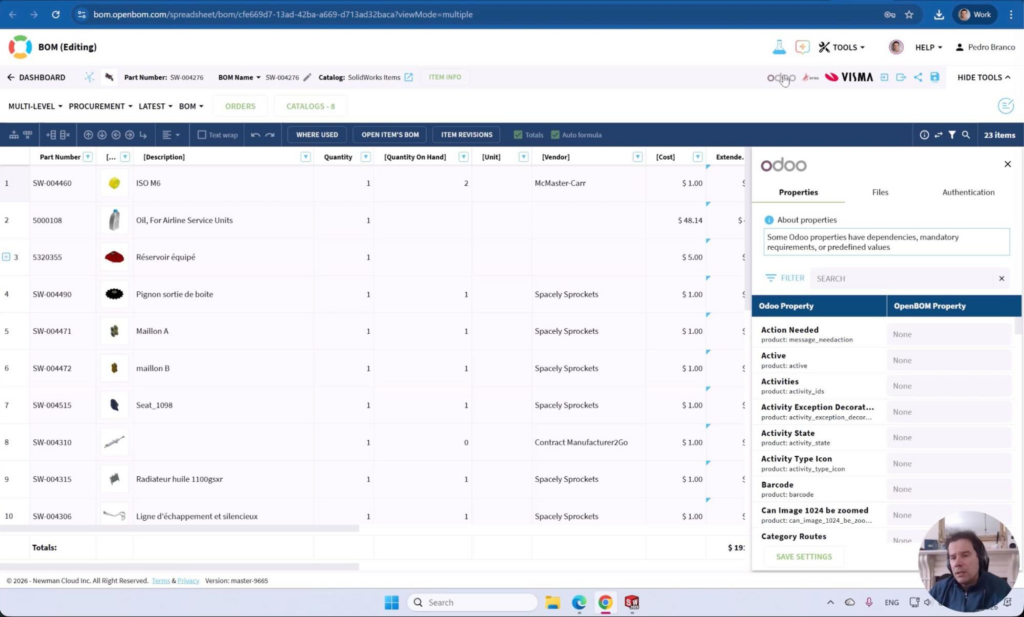
The first is on demand, and it is the one most teams reach for first. Someone has a released BOM and needs it in the ERP now. In a push-style integration, the engineering or operations team configures the connection once, maps OpenBOM properties to the ERP fields, decides whether to carry thumbnails, drawings, and documents along, and sends the structure with a single action. This is how the Odoo integration works in practice. A BOM captured from SolidWorks lands in Odoo as a complete manufacturing structure, files and all, without anyone re-keying it. The same on-demand logic also runs from the other direction. In an embedded integration such as NetSuite, an ERP user opens an item record, sees the related OpenBOM BOM from inside NetSuite, reviews it, configures how part numbers, revisions, and item types should map, and pulls it in when they are ready. The trigger in both cases is a person deciding the moment is right, and the detail that matters is that what moves is the correct structure, the manufacturing BOM with operational data attached, not a raw CAD export.
The second is automated, where routine work runs on its own schedule without anyone babysitting it. This is the pattern that keeps the operational picture from drifting. Vendors, costs, lead times, and item types change constantly, and the expensive failures in this industry almost always trace back to a stale value that someone re-entered by hand, a wrong part number, a wrong quantity, a cost that surfaces three steps later in purchasing or inventory and is painful to unwind. A scheduled inventory synchronization, a nightly supplier update, or a cost rollup that simply runs on its own removes the re-entry and the drift at the same time.
The third is event driven, and this is the one that changes how the whole system behaves. Flow Agent can react to a business event as it happens rather than waiting for a person or a clock. A revision is released, an engineering change order is approved, a manufacturing BOM is restructured from its engineering parent, an inventory level crosses a threshold, and the corresponding exchange fires automatically. Consider the moment a team finishes turning an engineering BOM into the manufacturing BOM that ERP actually needs. In a manual world, someone has to remember to push that new structure downstream, and the gap between approved and in ERP is exactly where things go wrong. An event-driven exchange closes that gap by making the release itself the trigger. That last pattern removes the manual coordination that usually keeps two systems limping along in rough alignment, always one human step behind reality.
Check for all these use cases in the following article – How to rethink CAD to ERP integration.
Beyond Data Sync – OpenBOM Was Designed to Be Embedded, Not to Stand Alone
There is a quieter architectural decision underneath all of this. OpenBOM components were designed to be embedded rather than to force every company into a single standalone application. The same capabilities can live inside a PDM system, a PLM platform, an ERP application, a supplier portal, or a custom internal tool.

For an organization that already has working systems, this matters more than it first appears. It means OpenBOM functionality can become part of the environment people already use every day, while the product data underneath stays consistent across all of them. The goal is not to add one more place to log in. It is to let product and operational data move through the tools a company already trusts.
Any ERP With an API Should Be Able to Participate
The next step on the roadmap is the one I am most interested in. Building an ERP integration has always been expensive in a specific way. It means researching the API, mapping the data, reading the documentation, implementing the workflow, then testing and deploying it. The Flow Agent Plugin framework, which is coming, is designed to compress that work. By drawing on API specifications, documentation, and integration templates, Flow Agent will help generate integration workflows tailored to a company’s actual requirements rather than starting from an empty file every time.
MCP support is on the same path. It gives AI agents a standard way to reach OpenBOM data and operations, which is what turns integration from a wiring exercise into something an agent can reason about and assemble. The principle behind both is simple. Any ERP system with an API should be able to participate in a connected product operations environment, without a six-month project to get there.
From Product Data to Product Operations
The future of manufacturing software is not a tighter collection of isolated systems. It is a connected operational environment where engineering, procurement, inventory, suppliers, and business systems share the same product foundation and act on it together. OpenBOM’s flexible data model, its inventory and purchasing capabilities, its out-of-the-box integrations, its embedded architecture, and the Flow Agent framework are all parts of the same idea. Product information does not stop at the engineering BOM. It flows into the operational decisions that depend on it, and increasingly it does so in a way that is configurable, intelligent, and closer to autonomous.
There is a longer arc here as well. Once the operational layer carries not just the transactions but the reasoning behind them, the sourcing decision, the change, the trade-off that led to a substitution, it starts to hold product memory and not only product data.
The reason this matters is visible the first time an integration moves data that is structurally perfect and factually wrong. A mechanical BOM and an electrical BOM can both export cleanly, both import without an error, and still combine into a structure with a missing component, a doubled assembly, and a quantity that does not match. The finance system accepts all of it because the data is valid, and nobody notices until someone tries to build from it two days later. The mistake never lived in either file. It lived in the gap between them, in a consolidation that no system owned. Integration that only synchronizes records cannot catch that, because by the time the data has moved, the context that would have flagged the conflict has already been left behind.
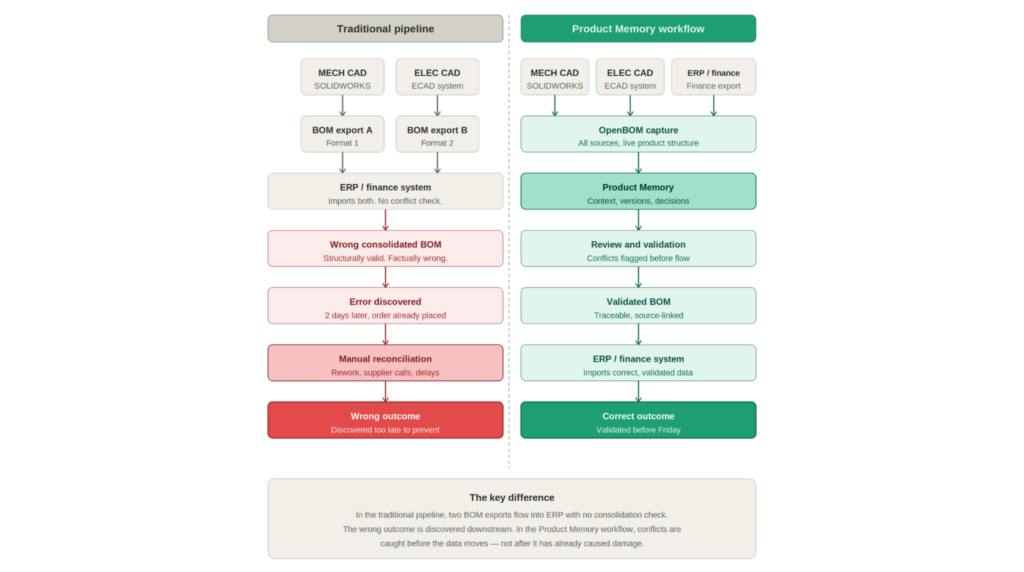
An integration context layer changes where that check happens. When product information is captured into a shared workspace that carries its relationships, its versions, and the decisions behind it, the conflict between those two BOMs is surfaced before anything flows to ERP, not after. The shared parts are matched, the mismatches are flagged, the late addition is caught, and the people who understand the discrepancy are still available to resolve it. What flows downstream is then a validated structure with its reasoning attached, every component linked to its source and every decision recorded in place. The job of Flow Agent in that world is not to move a spreadsheet that looks correct. It is to move product information that is correct, with the memory of how it got that way traveling alongside it.
The next move is to stop thinking about integration as a set of pipes and start thinking about it as a set of tasks. Validate this consolidation. Reconcile these two structures. Release this manufacturing BOM to ERP once the conflicts are cleared. Reorder against this shortage. Each of those is a task with a goal, a context, and a condition for being finished, and each is the kind of work an agent can be asked to carry out rather than a script that someone has to keep alive. The three patterns described earlier, on demand, automated, and event driven, are really three ways of deciding when a task should run. A standard interface such as MCP gives an agent a reliable way to read the context layer and act on it, which is what turns “sync the BOM” from a wiring problem into an instruction. Integration stops being plumbing and becomes work that can be delegated.
For now, the point is narrower and concrete. We are at the beginning of OpenBOM Flow Agent development using the integrations we ship today. But we go beyond that – to treat the space between engineering and ERP as something to be operated, not just synchronized. The longer ambition is larger. When integration runs on a context layer and is expressed as tasks, the connection between systems stops being a fragile handoff and becomes the place where product knowledge is preserved, validated, and acted on. That is what product operations becomes once it carries memory and not only data.
REGISTER FOR FREE to check OpenBOM for a 14 day trial.
Best, Oleg
FAQ
Can OpenBOM handle inventory and purchasing without an ERP?
Yes. OpenBOM’s data model holds product structures, suppliers, inventory, purchasing, and Order BOMs together, which lets teams run inventory gap analysis and procurement planning directly from product data before any ERP is in place.
Does OpenBOM replace an ERP system?
No. OpenBOM connects engineering product definition to ERP execution rather than replacing the ERP. It lets companies run procurement and inventory planning before they adopt a full ERP, and integrate with one at their own pace afterward.
Which ERP and financial systems does OpenBOM integrate with?
OpenBOM offers out-of-the-box bidirectional integration with financial systems including QuickBooks and Xero, and ERP platforms including NetSuite, Odoo, and Microsoft Dynamics 365, with additional systems reachable through REST APIs. MCP support and a Flow Agent Plugin framework for generating new integrations are on the roadmap.
What does OpenBOM Flow Agent do?
Flow Agent organizes the exchange of product and operational data between OpenBOM and business systems. It supports on-demand operations, automated scheduled jobs, and event-driven workflows that react to events such as a revision release or an approved engineering change order.
What is event-driven integration in Flow Agent?
Event-driven integration fires a data exchange automatically in response to a business event, such as a revision release, an engineering change order approval, or an inventory level crossing a threshold, rather than waiting for a scheduled job or a manual export.
Join our newsletter to receive a weekly portion of news, articles, and tips about OpenBOM and our community.