We are proud to share that OpenBOM has been included in the Gartner® Magic Quadrant™ for PLM Software in Discrete Manufacturing Industries.
For a company built on the idea that product data should be connected, open, and usable from the first day, this is a meaningful milestone. We believe it reflects something larger than any single vendor. The PLM market is changing, and the companies driving that change are no longer only the largest manufacturers running multi-year enterprise deployments.
Enterprise PLM Was Never Designed for the Companies That Need It Most
For most of its history, PLM has been synonymous with scale. Long implementation cycles, heavy customization, dedicated administrators, and IT budgets only large organizations could justify. That model has served big manufacturers well, and it continues to.
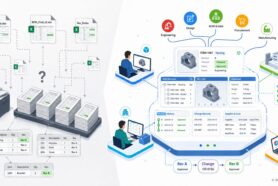
But the growing engineering teams and small and midsize manufacturers who design and build complex products every day were left to improvise. They manage the same realities the enterprise does, including CAD data, items, revisions, multiview BOMs, suppliers, RFQs, purchasing, and change, without the staff or the budget to stand up a traditional PLM system. So the work lands where it always has: in spreadsheets, shared drives, email threads, and a handful of disconnected business tools.
OpenBOM was created with the vision to close that gap. Not by shrinking enterprise PLM down to size, but by rethinking what a modern, cloud-native product data platform should be.
Product Data Breaks the Moment It Leaves the CAD File
Consider a thirty-person SOLIDWORKS shop preparing a release. The design is finished, the assembly is clean, and then the real work begins. Someone exports a BOM to a spreadsheet. Someone else retypes part numbers into the ERP. A supplier receives an outdated revision because the latest one lived in a folder nobody checked. Two engineers create the same part under two different numbers. None of this is a CAD problem. It is what happens when product data has nowhere connected to live once it leaves the design file.
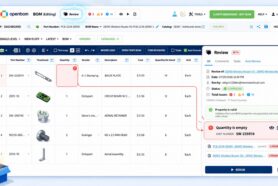
This is the problem OpenBOM was built to solve. As a cloud-native, multi-tenant SaaS platform, OpenBOM brings PDM, BOM management, change, procurement, and digital thread into one connected environment. Engineering teams manage CAD files, design projects, revisions, and released documentation, while items, BOMs, vendors, and purchasing data stay linked to the same source of truth. The point is not the length of the capability list. The point is that the spreadsheet handoff, the retyped part number, and the stale revision stop happening, because the data was connected in the first place.
Open and Connected Beats Monolithic and Closed
Manufacturing environments are not uniform, and no single system will ever run all of them. Companies use different CAD tools, different ERP systems, and different procurement and quality applications, often by deliberate choice.
OpenBOM is built for that reality. The platform is CAD-agnostic, with integrations across widely used mechanical, electrical, and cloud CAD tools, and it connects to ERP, procurement, manufacturing, and quality systems through REST APIs and webhooks. Our strategy has never been to replace every specialized system a manufacturer already trusts. It is to provide the connected product data foundation those systems can compose around, so a single source of product information flows across engineering, procurement, suppliers, and operations.
For a smaller manufacturer, that openness is the difference between adopting a platform in days and committing to a project that takes a year.
The Market Is Moving From Storing Product Data to Understanding It
What makes this milestone meaningful to us is less the listing itself and more what it signals about where the category is heading.
For years, PLM was treated as a system of record: a place to store data and control who could touch it. That is necessary, but it is no longer sufficient. The questions manufacturers actually need answered live in the relationships between the data. Why was this change made? What did it affect downstream? Which supplier decision drove this cost? A system that only stores outcomes cannot answer them.
This is the work OpenBOM has been investing in through our graph-based Product Memory architecture and agentic AI. Product Memory captures the relationships, dependencies, history, and decisions behind product data, not just the data itself, so manufacturers can turn information into knowledge they can act on. We have argued for some time that the next phase of PLM belongs to the intelligence layer rather than the storage layer. Seeing the market move in that direction reinforces the path we have chosen.
A Milestone That Belongs to Our Customers
Inclusion in the Gartner Magic Quadrant for PLM Software in Discrete Manufacturing Industries is not something a company earns alone. It rests on the manufacturers who trusted OpenBOM to modernize their product data, their BOMs, their PDM workflows, and their procurement, and on the partners who help connect OpenBOM to the wider engineering and manufacturing ecosystem.
“We are proud that OpenBOM has been included in the Gartner Magic Quadrant for PLM Software in Discrete Manufacturing Industries,” said Oleg Shilovitsky, CEO and co-founder of OpenBOM. “Small and midsize manufacturers need a modern alternative to spreadsheets, disconnected tools, and heavy enterprise deployments. OpenBOM was built to make structured product data, connected BOMs, PDM, procurement, and digital thread accessible from day one. As we continue to invest in Product Memory and agentic AI, our goal is to help manufacturers turn product data into knowledge they can act on.”
We see this as a beginning. We will keep investing in cloud-native PLM and PDM, multiview BOMs, digital thread, open integrations, Product Memory, and AI agents, with the same purpose we started with: helping manufacturers turn fragmented product information into connected, actionable product knowledge.
You can purchase Gartner Research via this link
Link to OpenBOM press release.
Attribution: Gartner®, Magic Quadrant™ for PLM Software in Discrete Manufacturing Industries, Sudip Pattanayak, Marc Halpern, Brady Barnes, Rajan Saini, 9 June 2026.
Disclaimer:
GARTNER is a registered trademark and service mark and MAGIC QUADRANT is a registered trademark of Gartner, Inc. and/or its affiliates in the U.S. and internationally and are used herein with permission. All rights reserved. Gartner does not endorse any vendor, product or service depicted in its research publications and does not advise technology users to select only those vendors with the highest ratings or other designation. Gartner research publications consist of the opinions of Gartner’s research organization and should not be construed as statements of fact. Gartner disclaims all warranties, expressed or implied, with respect to this research, including any warranties of merchantability or fitness for a particular purpose.
Gartner does not endorse any company, vendor, product or service depicted in its publications, and does not advise technology users to select only those vendors with the highest ratings or other designation. Gartner publications consist of the opinions of Gartner’s business and technology insights organization and should not be construed as statements of fact. Gartner disclaims all warranties, expressed or implied, with respect to this publication, including any warranties of merchantability or fitness for a particular purpose.
Join our newsletter to receive a weekly portion of news, articles, and tips about OpenBOM and our community.