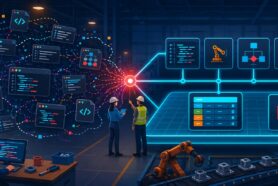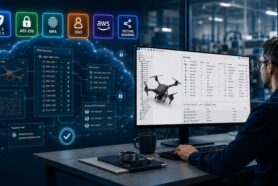
I’m heading to SharePLM Summit 2026 in Jerez de la Frontera, Spain. This is a new conference in my calendar, and quite a unique one — unlike other major PLM vendor forums, it focuses on the human side of PLM. This year it has a heavy focus on the intersection of humans and AI, which makes the timing feel right. The last year gave us a rollercoaster of ideas and progress in AI, and now it is time to analyze where we are and what comes next.
I will participate in a panel discussion and join Helena Gutierrez and Martin Eigner in a workshop exploring how AI is reshaping the way engineering teams work. At its core, SharePLM is about people, transformation, and the changing nature of work.
To say AI is impacting the way we work would be an understatement. Almost every technology conversation these days starts and ends with AI.
This is not the first time we have seen a major technology shift reshape business and engineering practices. The internet changed how we access information. Cloud software changed how we collaborate, deploy systems, and scale business processes. Mobile changed how we interact with applications, people, and data from anywhere.
Each of these waves started as a technology change. But the real transformation happened later, when people changed their habits, companies redesigned workflows, and new business models emerged.
I think AI will follow the same pattern, but probably faster and with a deeper impact on the structure of work itself.
The most interesting question is not whether AI will be used in PLM, engineering, or manufacturing. It already is. The more important question is how AI will change the way people work, how decisions are made, and how companies organize product knowledge.
This is the topic I’m bringing with me to SharePLM Summit.
AI Is Not Just Another Tool
When new technologies arrive, we often try to fit them into existing processes. We take the old workflow and add a new button, a new dashboard, or a new assistant. This is natural because companies don’t change overnight.
But AI is different because it challenges the workflow itself.
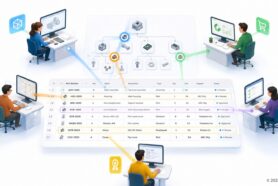
In traditional PLM and PDM processes, a lot of work is based on searching, collecting, checking, routing, formatting, comparing, approving, and moving information between people and systems. Engineers export BOMs to Excel. Manufacturing teams ask for clarification. Procurement teams search for supplier and cost information. People review documents, compare revisions, check what changed, and try to reconstruct why a decision was made.
AI has the potential to change many of these steps.
Some work can be automated. Some work can be assisted. Some work can be delegated to AI agents. But some decisions must remain human because they require judgment, accountability, risk evaluation, customer understanding, regulatory awareness, and business experience.
This is where the conversation becomes interesting. AI does not remove the need for people. It changes the role people play in the process.
The Human and AI Intersection
At SharePLM Summit, I expect many conversations to focus on this intersection between humans and AI.
Where is AI already changing how engineers work today? Where is it still overhyped? How is AI changing the professional identity of engineers? What skills are becoming less valuable, and which ones are becoming critical? What will collaboration look like when part of the team consists of AI agents? And what needs to change for AI in engineering to be adopted at scale?
These questions are not theoretical anymore.
For many years, PLM conversations were mostly focused on systems, processes, governance, and data models. These topics are still important. But AI brings another dimension. It forces us to think about how people interact with knowledge.
A human engineer does not only need data. A human engineer needs context.
Why was this component selected? Why was this supplier approved? Why did we accept this deviation? Why was the ECO approved? What was discussed before the decision was made? What alternatives were rejected? What constraints existed at that moment?
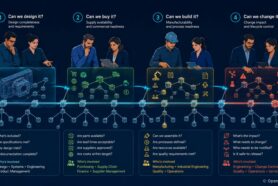
Most of this knowledge does not live in one system. It is scattered across CAD files, BOMs, PLM systems, ERP systems, spreadsheets, emails, Slack messages, supplier communications, documents, meetings, and people’s memories.
If AI is going to help, it needs more than access to files and APIs. It needs context.
This is one of the most important questions for the future of PLM and manufacturing: how do we capture, organize, and make available the product context that allows AI to reason and people to trust the result?
Five Observations I’m Bringing to SharePLM Summit
These are the five observations I expect to put on the table in Jerez.
1. General-Purpose AI Is Not a Junior Assistant
Large language models trained on broad internet-scale data bring something very unusual. They have access to an enormous body of public knowledge and reasoning patterns. In some ways, it feels like working with a companion that has read all the books, articles, manuals, and public conversations available online and can analyze them quickly.
This is why I don’t think we should treat AI as a junior assistant that simply follows instructions.
At the same time, we should not confuse broad public knowledge with company-specific product understanding. A general-purpose model may understand engineering principles, manufacturing concepts, and PLM terminology. But it does not automatically understand your product, your company, your suppliers, your part history, your ECO process, your customer commitments, or the reasons behind your past decisions.
This distinction is critical.
AI can be extremely powerful, but without your company’s product context, it is still operating from the outside. It can reason about general information, but it cannot fully reason about your specific situation unless that context is available.
This is where product development and manufacturing are very different from general knowledge work. The answer is rarely just “what is the best practice?” The real question is usually, “what is the best decision in this specific product, with this supplier, this revision, this customer, this cost target, this manufacturing constraint, and this history?” That answer requires context.
2. When AI Looks Stupid, Context Is Often Missing
Many people try AI, get a poor answer, and conclude that AI is not useful. Sometimes the model is wrong. Sometimes it hallucinates. Sometimes it gives generic answers. These problems are real.
But in many practical situations, the issue is different. The AI was not given enough context.
The task was vague. The product structure was missing. The revision history was not available. The supplier constraints were not included. The cost target was not defined. The reason for the previous decision was not captured. The system was asked to produce an answer without understanding the situation.
This is very similar to asking a smart person to solve a problem after giving them only half the information. The person may still answer, but the answer will be incomplete or misleading.
AI changes the importance of task definition. It requires us to be more precise about what we ask, what context is needed, and what outcome we expect. We cannot simply continue with the same fragmented processes and expect AI to magically reconstruct the full picture.
The quality of AI output will depend on the quality of the context we provide. This also changes the skills engineers and product teams need. Asking AI a good question is not just prompting. It is the ability to define the problem, provide the right constraints, expose the assumptions, and verify the answer. In many ways, this is already what good engineers do when working with people. AI makes this skill even more important.
3. Capturing Context Will Become a Core Workflow
Today, product data is scattered between many applications and sources. CAD systems manage geometry and files. PDM manages revisions and file relationships. PLM manages items, changes, and processes. ERP manages purchasing, inventory, costing, and operations. Teams still use spreadsheets, emails, documents, chat messages, and meetings to fill the gaps.
Humans are surprisingly good at navigating this mess. We ask colleagues. We remember what happened. We search emails. We copy data into spreadsheets. We connect dots manually.
AI will force us to rethink this.
If we want AI models and agents to help with engineering and manufacturing work, capturing and organizing context will need to become a core workflow — not an afterthought. This does not mean replacing all existing systems. It means creating a layer that can connect information, relationships, decisions, changes, history, and intent across systems.
This is where I see the importance of product memory.
Product memory is not just a database. It is a way to preserve the working context of the product: what was decided, why it was decided, who participated, what alternatives existed, what changed, and how information flows between engineering, manufacturing, procurement, support, and customers.
Without this context, AI will remain a clever assistant disconnected from the real product work. With this context, AI can become a meaningful participant in the workflow.
The future of AI in engineering will not be defined only by better models. Companies will gain real advantage by organizing their product context in a way that AI can use and people can trust.
4. The Balance Between Human Work and Machine Work Will Change
Product development and manufacturing have always been a combination of human-driven activity and structured processes. Engineers make design decisions. Manufacturing planners prepare processes. Procurement teams select suppliers. Quality teams review compliance. Managers approve changes. Systems record some of this activity, but people often carry the real context.
AI will change the balance.
Some tasks will be automated: searching for information, summarizing changes, comparing BOMs, identifying inconsistencies, extracting data from files, checking completeness, preparing reports. Some tasks will be delegated to AI agents: monitoring product data, detecting anomalies, recommending substitutions, preparing ECO drafts, identifying missing information. And some decisions will remain human — those that involve business risk, customer impact, safety, compliance, supplier strategy, cost trade-offs, and accountability.
The important point is not to decide whether AI or humans are better. The real question is how to design the interaction between them.
AI can process more information faster. Humans bring judgment, responsibility, experience, intuition, ethics, and accountability. The future workflow must combine both.
This is especially important in engineering and manufacturing because decisions have consequences. A wrong component, an unclear requirement, a missed supplier constraint, or an incorrect revision can create real operational and business problems. AI can help us see more, compare faster, and identify patterns. But humans still need to own the final judgment in many critical situations.
5. AI-Powered Workflows Are Different from Human-Powered Workflows
This is probably the most important observation, and the one I think will generate the most debate at SharePLM.
Human-powered workflows were built around human limitations and human communication patterns. We created meetings, documents, approvals, emails, dashboards, exports, and manual coordination because this is how people were able to move work forward.
AI-powered workflows will not look exactly the same.
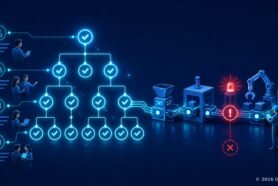
They will require continuous context capture. They will require structured and connected product data. They will require traceability so people can understand where an answer came from. They will require feedback loops so AI can learn from corrections. They will require new forms of human-in-the-loop review, and clear governance about what AI can act on and what requires human approval.
Simply adding an AI assistant to an old workflow will not be enough.
The real opportunity is to rethink the workflow itself. What should be done by people? What should be done by AI? What context must be captured automatically? What decisions require human approval? What information needs to flow between systems without waiting for someone to export a spreadsheet?
This is the design space that I think will define the next phase of PLM.
A Provocative Thought: Who Becomes the Luddite in the AI Era?
Every industrial revolution creates resistance. But in the AI era, the new Luddites may not only be people who refuse to use AI. They may also be people who use AI superficially — measuring prompts, tokens, and chatbot activity instead of better decisions and better workflows. Some will decorate old processes with AI without changing anything underneath. Others will expect AI to work without providing the product context it needs to reason well. The real divide will not be between people who use AI and people who don’t. It will be between those who use AI to preserve old workflows and those who use it to rethink how work is done. I plan to expand this thought separately on Beyond PLM, because I think it deserves its own article.
What Defines the Engineer in the Age of AI?
One of the questions I’m most interested to explore at SharePLM is how AI changes the professional identity of an engineer.
For many years, engineering work has included a large amount of manual effort: searching for data, comparing versions, preparing documents, checking completeness, creating reports, and moving information between systems. Some of this work required deep experience, but much of it was repetitive and fragmented.
AI will change this balance.
If AI can search, summarize, compare, generate, and suggest, then the engineer’s value will be less defined by manual execution and more by judgment. Engineers will need to become better at defining problems, framing tasks, understanding constraints, validating results, making trade-offs, and taking responsibility for decisions.
This does not make engineers less important. In my view, it makes engineering judgment more important than ever.
AI can produce options, but someone must understand whether those options make sense. AI can identify a supplier substitution, but someone must understand the risk. AI can summarize an ECO, but someone must decide whether the change is acceptable. AI can compare BOMs, but someone must understand the implications for manufacturing, cost, service, and customers.
Engineering will become less about manually producing every artifact and more about orchestrating knowledge, decisions, constraints, and outcomes. The best engineers will know how to combine domain expertise with AI assistance — when to delegate, when to question, when to validate, and when to decide.
Will AI Make PLM Obsolete or Create a PLM Renaissance?
A question I expect to come up repeatedly in Jerez is whether AI will make traditional PLM systems obsolete.
My answer is: AI will make some traditional PLM experiences obsolete, but it will make the need for PLM even stronger.
AI will challenge PLM systems that are closed, rigid, document-centric, and disconnected from the real flow of engineering and manufacturing work. If PLM is only an approval system, a vault, or a database people fill in at the end of the process, AI will expose its limitations very quickly.
But AI also creates a renaissance opportunity for PLM. Because AI needs product context. It needs trusted structures, relationships, revisions, changes, configurations, suppliers, requirements, costs, manufacturing plans, and decision history. These are exactly the areas where PLM was always supposed to help.
The difference is that PLM cannot remain only a system of record. It needs to become part of a broader product memory architecture — a context layer that connects information across systems and makes product knowledge available for both people and AI agents.
PLM systems that remain isolated and difficult to use will struggle. PLM architectures that can connect, organize, expose, and preserve product context will become more important. The digital thread also needs to evolve — not just as a traceability diagram between systems, but as a living context network that supports reasoning, decisions, and collaboration between people and AI.
This is where I see the next real PLM opportunity.
What Needs to Change for AI Adoption at Scale?
The most practical question is adoption.
AI tools will not be adopted at scale if they only provide generic answers. Engineers and manufacturing teams need answers grounded in their product, their data, their processes, and their constraints. They need to know where an answer came from. They need to see the traceability behind a recommendation.
This means AI must be embedded into workflows, not added as a disconnected chatbot. It needs access to product structures, CAD files, BOMs, revisions, changes, supplier data, cost information, and decision history. It needs to work inside the places where engineering and manufacturing decisions are actually made.
Adoption will also require new skills. Engineers will need to learn how to define tasks for AI, provide the right context, evaluate results, and work alongside AI agents as a normal part of the team.
I see five practical requirements for AI adoption at scale in engineering and manufacturing.
First, companies need trusted product context. AI must work with connected, current, permission-aware product information. Second, AI recommendations need traceability. People must be able to understand why a recommendation was made and what information was used. Third, workflows need human-in-the-loop mechanisms. AI can suggest, prepare, compare, monitor, and detect issues, but critical decisions need clear ownership. Fourth, AI needs to be integrated into real work — connected to CAD, BOM, PLM, ERP, procurement, change management, and collaboration workflows, not living in a separate chat window. Fifth, people need new habits and skills. The best results will come from teams that know how to define tasks, provide context, verify output, and treat AI agents as part of the working environment.
The companies that succeed with AI will not be the ones that simply buy AI tools. They will be the ones that redesign workflows, capture context, build trust, and teach people how to work differently.
Conclusion and See You in Jerez?
AI is creating a new moment for PLM — one that exposes how fragmented product information really is, challenges the professional identity of engineers, and forces us to rethink how humans, systems, and AI agents collaborate around product decisions.
The future of PLM will not be only about systems of record. It will be about systems that can preserve context, support reasoning, and help people make better decisions.
SharePLM Summit is exactly the right place to have this conversation. If you are attending, I would love to connect and continue the discussion in person. And if you are not, I will share what we learn from Jerez here on the OpenBOM blog.
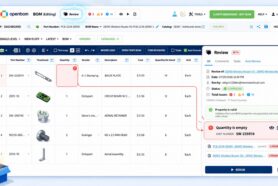
At OpenBOM we explore AI adoption with the introduction of CAD File Agent and working towards two more agents – BOM Review and Flow agents later this year.
Contact us to discuss more. Also register for free to check OpenBOM in your environment.
Best, Oleg
Join our newsletter to receive a weekly portion of news, articles, and tips about OpenBOM and our community.