The manufacturing companies are not what they used to be. In fact, there often isn’t a single company anymore. The company that designs a product might be in California. The machine shop fabricating critical components could be in Michigan. The electronics assembly happens in Taiwan. The final integration takes place at a contract manufacturer in Mexico. And somewhere in between, there are a dozen suppliers providing everything from fasteners to specialized sensors, each operating independently, with their own tools, processes, and constraints.)
Why Sharing Product Data Across Companies Is Still Hard and How To Deal With It
This is the reality of modern manufacturing. Products aren’t built by companies anymore, not really. They’re built by networks of companies, each contributing their expertise, capacity, and specialized capabilities. The org chart might show clean boundaries, but the actual work of bringing a product to life sprawls across time zones, legal entities, and continents. Engineering happens everywhere. Manufacturing happens everywhere. The people who need to understand your product are scattered across this entire network —and depend on accurate, timely product information.)
And yet, most product data management systems were designed for a different era, one where “your team” meant people who worked in the same building, or at least for the same company. These systems treat external collaboration as an edge case, something to be managed through exports and exceptions rather than as the fundamental reality of how products get made.
For most manufacturing teams today, sharing product data with suppliers and contractors is far harder than it should be. Not because the data is sensitive. Not because the tools don’t exist. But because access itself has a price tag.
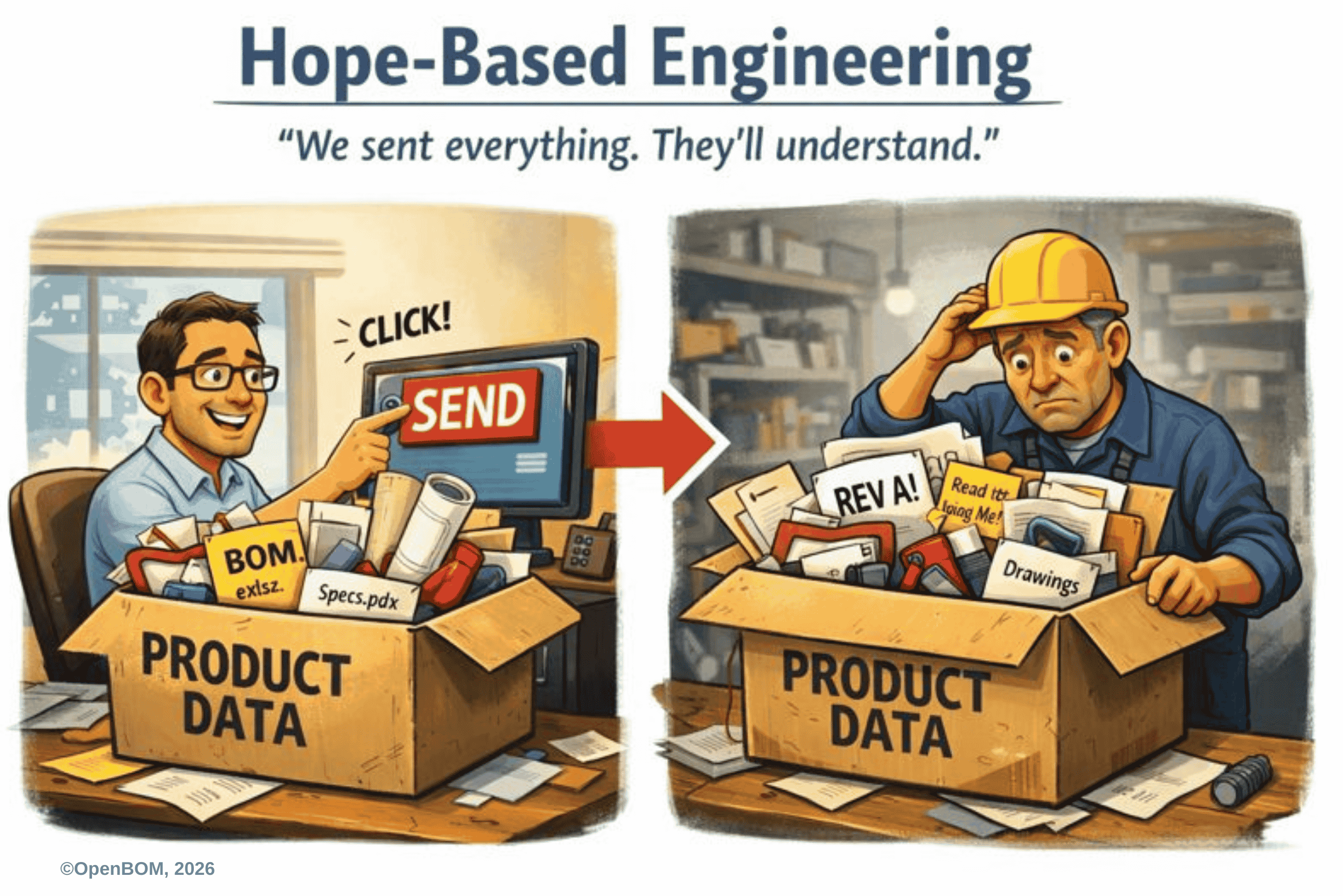
Picture this: a supplier asks for the latest BOM. A contract engineer needs to review a drawing. A manufacturing partner wants to double-check a revision before production. What happens next? Engineers start exporting PDFs, zipping files, emailing spreadsheets, or uploading “temporary” copies to shared folders, all because giving someone direct access is either too expensive, too complicated, or both.
This behavior has become so normalized that many teams don’t even question it anymore. It’s just “how things work.” But with the new OpenBOM subscription, this changes in a fundamental way. All read-only seats are now free and unlimited. That single decision removes a major friction point in how product data flows outside your organization, and it quietly changes how collaboration with suppliers and contractors can work.
The Real Problem: Sharing Data Is Treated Like a Licensing Decision
In many PLM, PDM, and ERP systems, access is tightly coupled to licenses. Every new user, whether internal or external, comes with cost, procurement approvals, and administrative overhead. As a result, companies make tradeoffs that become invisible over time. Suppliers don’t get system access, only exports. Contractors work from copied files. Manufacturing partners rely on emailed snapshots. Engineers become the bottleneck for information flow.
The irony is that these external partners are not trying to change your data. They just want to see it. They want to know what exactly should be built, which revision is approved, what files and drawings and specs are current, and how parts relate to the overall product. When access is expensive, teams compensate with static artifacts. And static artifacts are where mistakes begin.
What Changes When Access Is No Longer the Bottleneck
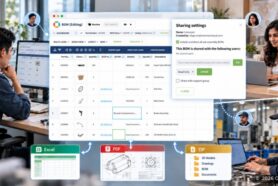
The new OpenBOM subscription removes the cost barrier entirely for view-only access. That means you can invite suppliers, contractors, and partners without buying extra seats. They can view live BOMs, CAD files, drawings, and attachments. They always see the current revision, and they don’t edit, overwrite, or disrupt your data.
This is not about “giving everyone access to everything.” It’s about allowing data to be seen without friction. Once that barrier is removed, a different set of collaboration patterns becomes possible. Let’s look at where this matters most.
When Manufacturing Partners Don’t Have to Guess
Manufacturing partners are often the first to suffer from poor data sharing. They typically receive a BOM in Excel, a drawing in PDF, a STEP file via email, and clarifications spread across message threads(a pattern widely recognized as a root cause of manufacturing errors and delays, as discussed in The Importance of Manufacturers Sharing Data with Their Contract Manufacturer). Each of these artifacts might be correct individually, but together they rarely represent a single, consistent product definition.
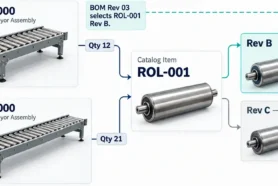
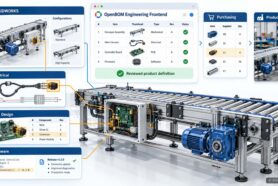
With OpenBOM read-only access, manufacturing partners can view the exact BOM structure used internally, access associated CAD files and drawings directly from items, see approved revisions and change history, and download attachments without waiting on engineering. Instead of asking “Is this the latest version?”, they can verify it themselves.
This reduces back-and-forth, prevents misinterpretation, and shortens the gap between design and production. For CNC shops, sheet metal manufacturers, electronics manufacturers, and EMS providers, this clarity makes a measurable difference in how quickly they can move from quote to production.
Contract Engineers: One Source of Truth, Not Many Copies
Contract engineers often work in parallel with internal teams. They are trusted partners, but the collaboration model is usually fragile. The typical pattern involves sending design packages by email, granting access to shared folders, syncing files manually, and working from local copies. The result is predictable: version drift (a problem that becomes especially costly during early development stages, when design decisions are still fluid, as explored in How to Share Data with Your Supplier During Development).
With free read-only seats in OpenBOM, contract engineers can review the live product structure, understand how parts are used across assemblies, access drawings and derivative files and specifications in context, and provide feedback based on current data rather than snapshots. Importantly, this preserves control. Contractors don’t need edit rights to understand the design. They don’t need to “own” the data to collaborate effectively. This model shifts collaboration from file exchange to shared understanding.
How Limited Visibility Increases Risk on Both Sides
Suppliers often quote based on incomplete or outdated information. Missing alternates, unclear quantities, ambiguous specifications—all of these create risk on both sides. When suppliers have read-only access to OpenBOM, they can see exact part numbers and quantities, review specifications and compliance documents, understand context like whether something is a prototype versus production run, and whether components are optional versus required. With this visibility, they can ask better questions or sometimes fewer questions altogether.
Better visibility leads to better quotes. Better quotes lead to fewer surprises when orders are placed. This is especially important when lead times are tight and supply chains are under pressure. Clarity reduces risk long before procurement begins.
Service Providers and Installers: Beyond Manufacturing
Not all external partners are involved in manufacturing. Installers, integrators, and service providers often need product data long after production is complete. Yet they are frequently handed static documentation and expected to figure things out on site.
With OpenBOM read-only access, these teams can navigate the product structure visually, access service-relevant BOM views, find documentation without calling engineering, and understand configurations tied to delivered systems. This reduces installation errors, speeds up service operations, and lowers support overhead for engineering teams.
Why Read-Only Matters More Than It Sounds
“Read-only” may sound limiting, but it’s precisely what makes this model work. Read-only access means no accidental edits, no conflicting changes, no data ownership ambiguity, and no risk of external users “breaking” the system. At the same time, it provides something static files never can: context.
Seeing a BOM is not just seeing a list. It’s understanding relationships, structure, usage, and intent. That context is what external partners need, and it’s what static exports fail to deliver. When someone can navigate through assemblies, see where a part is used, check which revision was approved, and access related documentation all in one place, they’re working from understanding rather than assumption.
Control Is Still in Your Hands
Opening access does not mean opening everything. In OpenBOM, you decide who gets access, what data they can see, and when access starts and ends. Your data stays in OpenBOM rather than getting copied into dozens of uncontrolled locations. Instead of spreading files everywhere, you invite people to see the source. This is actually a safer model, not a riskier one.
A Broader Shift: Products Are Built by Networks, Not Companies
Modern products are rarely built by a single organization. They are created by networks of manufacturers, suppliers, contractors, and service providers working together. Yet many systems are still designed as if everything happens inside one company boundary.
Free read-only access changes that assumption. It acknowledges that collaboration extends beyond your payroll, that data must flow across organizational boundaries, and that cost should not determine who gets clarity. When sharing data is easy, teams collaborate earlier, communicate better, and make fewer assumptions about what the other party knows or needs.
Conclusion
For years, the default way to share product data beyond company boundaries has been the same: export, email, explain, repeat. That process didn’t exist because it worked well—it existed because access was expensive.
When visibility is easy and controlled, teams stop working around the system and start working together. Manufacturing partners don’t guess. Suppliers don’t quote blind. Engineers don’t become human routers for information.
The shift is subtle, but powerful: collaboration improves not because people work harder, but because they finally see the same thing.
The new OpenBOM subscription with free read-only seats removes that hidden tax on collaboration. For teams rethinking how they collaborate across the supply chain, modern tools now make this model possible without adding cost or complexity.
Want to learn more about new OpeBOM subscription, check it here and contact our sales team to learn more.
Best, Oleg
Join our newsletter to receive a weekly portion of news, articles, and tips about OpenBOM and our community.