Looking back at 2025, it’s hard to ignore how loud the conversation around AI became.
Every platform rushed to position itself as AI-native. New copilots appeared almost weekly. Product announcements promised intelligence, autonomy, and transformation. The language evolved quickly – faster than the underlying work of engineering and manufacturing ever could.
What stood out to me wasn’t that AI was overhyped. It was that, in many cases, it was layered on top of foundations that were still shaky.
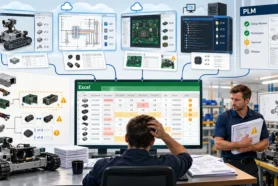
Throughout 2025, I spent time with OpenBOM customers to capture the detailed nature of the work. Here is what I learned. Engineers were still validating BOMs manually before release. Operations teams were still exporting data to spreadsheets “just to be safe.” Procurement teams were still reconciling multiple versions of the same structure before committing to an order. The aha-moment was the desire to introduce AI to the core product data loop – fixing burning problems of today’ s work order. How to find an AI to fix a problem – that was a core message I’ve heard again and again.
That observation gave me confidence to start with product data, capturing decision processes and helping customers to create a structured decision process.
OpenBOM did not start with AI. It started with product data which is structured, connected, and open. It started with the belief that integration matters more than isolation, that data should move seamlessly across tools and teams, and that openness is a prerequisite for scale, not a nice-to-have. Over the past year, many customers confirmed something important to us: when product data is consistent, connected, and accessible, everything else becomes possible, including AI.
But only then.
What customers asked for in 2025 was not smarter systems making decisions on their behalf. They asked for fewer reasons to stop and double-check. Fewer handoffs that required explanation. Fewer situations where progress depended on someone locking themselves away with a spreadsheet to make sense of the data. They wanted systems that respected how work actually unfolds—incrementally, collaboratively, and often under imperfect conditions.
That’s why I’m framing 2026 around intentions rather than predictions or roadmaps.
These intentions are not marketing statements. They are a reflection of what we learned by working closely with customers, listening to where friction appeared, and focusing our effort on strengthening the fundamentals rather than chasing labels.
One idea that has stayed with me for years comes from the Don’t Make Me Think book. While it’s often cited in the context of usability, the idea applies far beyond interfaces. When the core of a system works, people can focus on their work instead of the system supporting it. When it doesn’t, no amount of intelligence layered on top can compensate.
The five intentions below reflect how we think OpenBOM should evolve in 2026—grounded in customer reality, not industry noise.
Intention 1: Treat Customer Decisions as First-Class Product Data
Most product decisions are made by people long before they become system-approved.
Engineers choose alternates when parts are unavailable. Operations accept tradeoffs to keep schedules moving. Procurement weighs cost against risk when supply chains shift. These decisions happen in conversations, messages, tasks, and moments of judgment, not inside final approval workflows.
In 2026, OpenBOM’s intention is to help customers capture their decision process and provide tools that improve decision quality, rather than replace human judgment with workflows or automation.
This is not about adding a structured mechanism to capture tasks and decisions. It is about removing responsibility to remember the decisions from people. It’s about acknowledging where responsibility already lives. Systems that pretend to be decision-makers often end up distorting how work actually happens. Systems that respect judgment can support it, preserve it, and make it easier to stand behind later.
Intention 2: Remove Everyday Friction Before Adding Intelligence
Before intelligence can help, friction has to be removed.
Throughout 2025, we saw the same patterns repeat across companies of different sizes and industries. Customers created “safety rituals” around product data: exporting to spreadsheets, manually reconciling structures, double-checking quantities and suppliers before every handoff. Not because they wanted to, but because trust in the data wasn’t strong enough yet.
In 2026, before adding more intelligence, OpenBOM’s intention is to remove unnecessary effort from everyday product data work by eliminating the safety checks, manual reconciliations, and workarounds that customers rely on today just to move forward with confidence.
Intelligence layered on top of broken loops doesn’t remove effort. It often adds another layer of uncertainty. Our focus is on making the fundamentals strong enough that intelligence becomes an enhancement, not a crutch.
Intention 3: Preserve What Customers Do, Not Just the Outcome
Most systems are very good at recording outcomes (eg. Document approval). They are far less effective at preserving how those outcomes came to be.
Yet the most valuable product knowledge is created along the way. Decisions are revisited. Structures evolve. Constraints change. Tradeoffs are made under pressure. When only the final state is preserved, that context disappears—and the same lessons have to be relearned again and again.
In 2026, OpenBOM’s intention is to preserve what customers actually do while building products (e.g. the steps they take, the decisions they revisit, and the paths they follow) and not just the final outcome a system records or approves.
This is not about documentation for its own sake. It’s about allowing product data to reflect the real work that happened, not just where it ended. Preserving history and process creates continuity and continuity is what makes learning reusable.
Intention 4: Enable Collaborative Work for Humans and AI
Product work is inherently collaborative.
Engineering, manufacturing, procurement, and suppliers do not work in neat sequences. They work in parallel. They adjust to each other. They move forward together, even when information is incomplete or changing.
Many systems still assume isolation first: lock the file, finish your part, then hand it off. That model breaks down in collaborative environments—and it breaks even more once new kinds of contributors enter the picture.
In 2026, OpenBOM’s intention is to enable collaborative work for humans and AI in a shared product workspace—allowing multiple contributors to work on the same product data in parallel, without artificial locking, forced isolation, or loss of context.
This is not about replacing people with automation. It’s about creating a workspace where collaboration doesn’t require waiting, freezing, or working around the system. If humans can collaborate effectively in a shared context, other contributors can participate meaningfully as well.
Intention 5: Make the Core Product Loop Reliable Enough That Customers Don’t Have to Think About It
When the core product loop works, it stops demanding attention.
Customers shouldn’t have to constantly ask whether the data is correct, whether the structure is aligned, or whether something was lost in translation between systems. Those questions are signals that the fundamentals need work.
In 2026, OpenBOM’s intention is to make the core product loop reliable enough that customers don’t have to think about it, so they can focus on their work instead of managing the system supporting it.
This principle guided many of our decisions in 2025. We paid close attention to the moments where customers had to stop, hesitate, or double-check—and treated those moments as indicators of where the core loop needed strengthening. Reliability, in this sense, is not a feature. It’s a responsibility.
Conclusion: Why Intentions, Not Roadmap
These five intentions are not promises of what OpenBOM will become overnight. They are commitments to how we will think about our work in 2026. We will come with features, subscriptions, fixes, and other things too.
Intention list reflects a simple belief that has been reinforced again and again through conversations with customers: the hardest part of product development is not the software. It is the judgment, adaptation, and responsibility that people carry every day as they move work forward under uncertainty. Customers already do that work. Systems should respect it.
Our responsibility is to build product data infrastructure that reduces unnecessary effort, preserves the work that actually happens, and supports collaboration without getting in the way. Not by adding noise, but by strengthening the fundamentals. Not by replacing human judgment, but by making it easier to trust and reuse.
If we do this well, OpenBOM will not demand attention. It will quietly support better decisions, smoother collaboration, and more confident progress across teams and systems.
And that is exactly the kind of system we want to build in 2026.
Talk to us – in 2026, will continue to be open, collaborative, and listening to any feedback and opinion coming from you.
Happy New Year!
Best, Oleg
Join our newsletter to receive a weekly portion of news, articles, and tips about OpenBOM and our community.