When manufacturing companies evaluate product lifecycle management software, they often begin by comparing functions. Does the system support change management? Can it manage product configurations? Does it integrate with CAD and ERP? Can a specific process be supported?
These are important questions, but they can lead to the wrong conclusion. The system with the longest list of capabilities is not automatically the best system for every company or every stage of product development.
This article is the second in our series on selecting the right engineering platform. In the first article, How to Know When OpenBOM Is the Right Engineering Platform for Your Business, we mapped the full engineering software landscape — enterprise PLM, cloud-native PLM, CAD-centric PDM, spreadsheets, and ERP — and explained how to match the category to the problem. Here we take a closer look at the first of those categories: enterprise PLM platforms, and how they compare to OpenBOM.
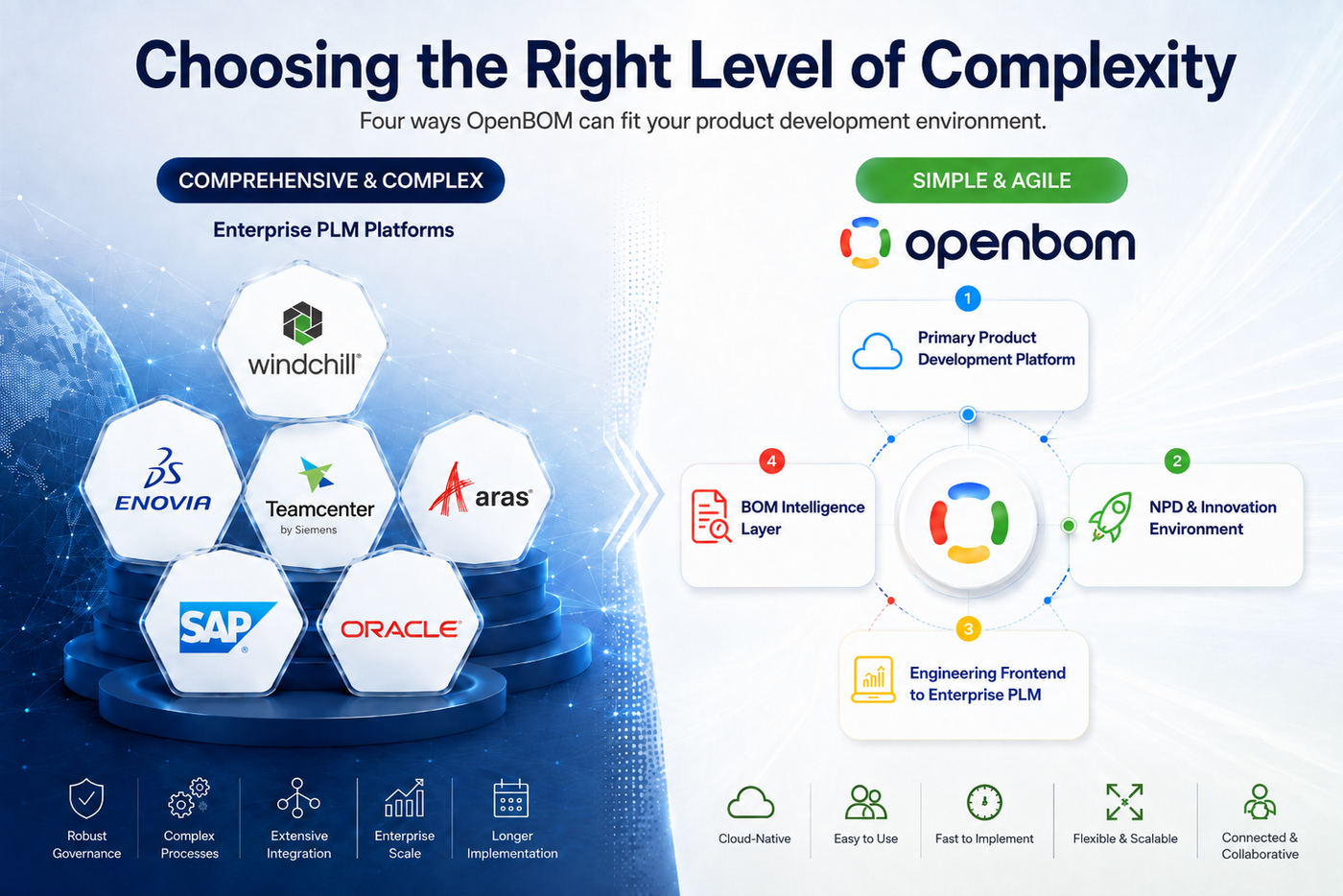
Siemens Teamcenter, PTC Windchill, Dassault Systèmes ENOVIA, Aras, SAP, and Oracle are powerful enterprise PLM platforms. They are designed to support complex products, formal processes, global organizations, and extensive governance requirements. OpenBOM approaches the problem differently. It focuses on creating a connected, cloud-native environment for design, engineering, BOM management, procurement, inventory, and supplier collaboration.
The practical question is not simply which system has more functionality. It is this:
What level of product lifecycle complexity does the organization actually need, and what is the simplest platform capable of supporting it?
The answer can also change by use case. OpenBOM can be the primary product development platform, a focused environment for new product development and innovation, an engineering frontend to enterprise PLM, or a complementary BOM intelligence layer alongside an existing enterprise system.
Enterprise PLM and OpenBOM Start From Different Assumptions
Enterprise PLM platforms were developed for large manufacturers managing complex products, long lifecycles, regulated processes, and global operations. Their objective is to provide control and standardization across a broad range of product lifecycle activities.
OpenBOM was designed around a different set of assumptions:
- Product teams are increasingly distributed, but need to collaborate in real time
- Companies often use multiple mechanical and electronic design systems.
- Engineers, procurement teams, suppliers, and operations need to work with the same product information.
- Implementation speed and ease of adoption matter.
- Product development can begin with a focused process and expand incrementally.
- Companies want to minimize infrastructure and specialized PLM administration.
This is more than a difference in features. It is a difference in architecture, deployment model, operational focus, and the amount of organizational change expected from the customer.
What Enterprise PLM Does Well
Teamcenter, Windchill, and ENOVIA provide substantial advantages when a company genuinely needs enterprise-level scope, process depth, and an enterprise digital thread.
Enterprise PLM platforms can support sophisticated engineering change processes, configuration and variant management, requirements and systems engineering, manufacturing process planning, quality and compliance, service lifecycle management, portfolio management, and other specialized processes.
They can also establish an enterprise digital thread that connects information and maintains traceability across requirements, design, engineering BOMs, manufacturing planning, quality, supply chain, delivered products, and service. Instead of treating each lifecycle stage as an isolated system or document repository, the digital thread preserves the relationships between product information, decisions, changes, and configurations across the enterprise. This connected context is especially valuable for complex products, regulated industries, global organizations, and products that remain in operation for many years.
They also provide deep connections to the engineering environments offered by the same vendors:
| Enterprise PLM platform | Closely aligned design ecosystem |
|---|---|
| Siemens Teamcenter Siemens Digital Industries Software | NX and the broader Siemens portfolio |
| PTC Windchill PTC | Creo and the broader PTC portfolio |
| Dassault Systèmes ENOVIA Dassault Systèmes | CATIA and 3DEXPERIENCE applications |
For a manufacturer standardized on one of these ecosystems, the depth of integration can be a significant advantage.
Enterprise PLM and digital-thread strategies are not limited to CAD-vendor platforms. Aras, Oracle, and SAP approach the market from different architectural and enterprise-system positions:
Scroll right on mobile to see all columns.
| Enterprise platform | Complex process strengths | Enterprise digital-thread position |
|---|---|---|
| Aras Innovator Adaptability | Adaptable data models and workflows for change, configuration, requirements, quality, manufacturing, and service processes | A flexible, vendor-neutral digital-thread platform designed to connect product information and relationships across heterogeneous systems and lifecycle domains |
| Oracle Fusion Cloud PLM Unified cloud suite | Product development, item and BOM management, change control, quality, innovation, and configuration modeling within Oracle Fusion Cloud SCM | A connected enterprise product record linking engineering with supply chain, manufacturing, quality, sourcing, and other Oracle business processes |
| SAP PLM and SAP Integrated Product Development Business backbone | Product development, engineering control, project collaboration, compliance, product costing, and integration with manufacturing and business processes | A design-to-operate digital thread that connects product development with SAP ERP, supply chain, manufacturing, compliance, and operational data |
These platforms reinforce an important enterprise PLM advantage: the ability to coordinate complex processes while connecting product information across organizational and system boundaries. Their strengths differ. Aras emphasizes adaptability and openness across heterogeneous environments. Oracle emphasizes a unified cloud suite and the connection between product development and supply-chain execution. SAP emphasizes the connection between engineering, enterprise operations, manufacturing, and the broader business backbone.
It is worth noting that Oracle and SAP approach PLM from the enterprise business system side. In our landscape article, we discussed SAP and Oracle primarily in the context of ERP. Their PLM offerings extend that same enterprise backbone upstream into product development — which is precisely the source of their digital-thread strength on the operational side, and a different starting point than the CAD-vendor platforms.
The major enterprise PLM vendors also bring large professional services organizations, global implementation partners, industry experience, and the capacity to support multi-year transformation programs. This delivery capacity matters when an implementation includes thousands of users, multiple business units, extensive legacy data, complex integrations, and highly regulated processes.
The Cost of Enterprise PLM Depth
The strengths of enterprise PLM are also the source of its primary challenges.
Broad process support creates extensive configuration options, complex data models, and significant implementation decisions. Before users receive value, a company may need process consulting, data migration, system configuration, integration development, validation, training, and organizational change management.
Enterprise PLM vendors now offer various cloud, hosted, and SaaS options. However, many of these platforms originated in traditional on-premises architectures. Moving the software to a hosted environment does not necessarily remove the need for configuration, administration, customization, upgrade planning, and specialized expertise.
The total cost is therefore much larger than software licenses. It can include infrastructure, implementation services, integration, customization, migration, administration, support, training, and future upgrades.
This investment can be justified for an organization that needs the full depth of the platform. It becomes harder to justify when a company mainly needs to replace spreadsheets and shared folders, manage CAD files and revisions, control BOMs, and connect engineering with procurement.
OpenBOM for New Product Development, Prototyping and Innovation
New product development is a fast process. Product structures change rapidly. Design information is incomplete. Components are evaluated and replaced. Suppliers are still being selected. Cost, availability, and lead-time information can force engineering changes. To run enterprise processes at this stage can be too expensive and too slow. Many companies use Excels to run these processes these days because of that.
At this stage, the challenge is not only controlling released product data. It is connecting the work taking place across:
- Mechanical and electronic product design
- Integration with MCAD, ECAD, PCB and software engineering
- BOM development
- Supplier selection
- Cost estimation
- RFQs and purchasing
- Prototype builds
- Inventory
- Production preparation
OpenBOM creates a closed loop between design, engineering, and procurement. CAD data can be captured as structured product information, organized into BOMs, enriched with manufacturer, supplier, cost, and availability data, and used to support sourcing and purchasing activities.
The results of procurement decisions can then return to engineering. A component may be too expensive, unavailable, approaching end of life, or subject to an unacceptable lead time. Engineering can evaluate alternatives and update the design and BOM before the problem reaches production.
This closed loop is particularly important during new product introduction because engineering and procurement cannot operate as isolated processes. Supplier and component decisions influence the design, while design changes influence cost, sourcing, inventory, and production readiness.
For innovation groups, startups, contract manufacturers, engineering service organizations, newly acquired business units, and companies moving from prototypes to production, this focused operational model can be a better fit than a large enterprise implementation.
A Cloud-Native, Multi-CAD Approach
OpenBOM was designed as a multi-tenant cloud service. Customers do not need to install and maintain a traditional PLM infrastructure for routine deployments. Teams can begin with a focused problem and expand as their processes mature.
Typical starting points include:
- Managing CAD files, versions, and revisions
- Creating and maintaining engineering BOMs
- Controlling items and part numbers
- Managing lifecycle and changes
- Connecting engineering data with suppliers and procurement
- Supporting RFQs, ordering, and inventory activities
- Integrating engineering information with ERP
OpenBOM also follows a multi-CAD strategy, with integrations across mechanical and electronic design systems as well as ERP and other business applications. This is useful for companies that use several MCAD and ECAD tools or collaborate with contractors and suppliers working in different design environments.
The tradeoff is important to acknowledge. Teamcenter, Windchill, and ENOVIA can provide greater integration depth inside their vendors’ respective design ecosystems. OpenBOM provides broader multi-CAD connectivity and a simpler deployment model, but it does not claim that every integration is deeper than the connection between an enterprise PLM platform and its vendor’s own CAD applications.
OpenBOM as an Engineering Frontend to Enterprise PLM
Many enterprise PLM implementations are designed primarily around formal product control, release processes, configuration management, and enterprise governance. Engineers, however, spend much of their time closer to CAD tools, files, work-in-process product structures, and rapidly changing BOMs.
This creates an opportunity to position OpenBOM as an engineering frontend to enterprise PLM.
In this role, OpenBOM provides the working environment between a broad range of MCAD and ECAD systems and the enterprise PLM backbone, including those that don’t have their own CAD such as Aras, Oracle PLM, SAP. OpenBOM’s CAD integrations capture design files, metadata, derivatives, and product structures. Its cloud PDM functions support file organization, versions, revisions, collaboration, and the connection between design information and structured BOM data.
The operating model can be summarized as follows:
- Engineers continue working in their preferred CAD systems.
- OpenBOM captures and organizes design files, metadata, and product structures.
- Teams review and enrich BOMs with items, suppliers, costs, and other business information.
- PDM functions manage work-in-process design information and revisions.
- Validated product information is transferred to enterprise PLM for formal release, configuration control, and downstream enterprise processes.
This approach can be particularly useful when a company has a heterogeneous CAD environment, distributed engineering teams, suppliers that cannot easily participate in the enterprise PLM environment, or business units that need a simpler engineering workspace.
The purpose is not to replace the enterprise PLM backbone. OpenBOM becomes the engineer-facing layer that simplifies CAD connectivity, PDM, BOM collaboration, and data preparation, while Teamcenter, Windchill, or ENOVIA continues to provide enterprise governance and process depth.
The exact connection depends on the customer’s systems, data model, and governance requirements. It may require API-based integration, data mapping, workflow design, and implementation services. The architectural value is the separation of responsibilities: OpenBOM supports the fast-moving engineering workspace, while enterprise PLM controls the formal enterprise record.
Where OpenBOM Has Limitations
OpenBOM’s simplicity is an advantage when a company needs faster adoption and lower administrative overhead. It can become a limitation when an organization requires highly specialized, deeply customized, or industry-specific enterprise processes.
OpenBOM may not provide the same process depth as established enterprise PLM platforms for advanced systems engineering, highly sophisticated product configuration, manufacturing process planning, complex program management, or some regulatory frameworks.
There is also an organizational difference. OpenBOM can support enterprise customers, but its implementation organization and partner ecosystem are smaller than those of Siemens, PTC, Aras, SAP, Oracle, and Dassault Systèmes. Companies planning a multi-country transformation involving thousands of users should evaluate not only product capabilities, but also implementation capacity, industry expertise, partner availability, and long-term service requirements.
This does not make one model inherently better than the other. It clarifies the tradeoff – one we will return to in the conclusion, and one that every company should evaluate against its own product complexity, process maturity, and capacity for change.
BOM Review Agent: Improving Product Data Without Replacing PLM
The comparison does not have to result in an either-or decision.
Many companies already use Teamcenter, Windchill, ENOVIA, Aras, SAP, or Oracle or another enterprise system. Their immediate problem may not be selecting a new system of record. Instead, they may need to improve the quality of their BOM data, understand the impact of a proposed change, or prepare legacy information for migration.
The OpenBOM BOM Review Agent can provide a complementary review and collaboration layer around existing product data.
Improving BOM Quality
BOM quality problems are often distributed across spreadsheets, CAD structures, PLM records, supplier information, and ERP data. A traditional validation rule can identify a known error, but teams also need help organizing the review, recognizing unusual conditions, explaining findings, and determining what requires human attention.
The BOM Review Agent can help identify and investigate issues such as:
- Missing or incomplete attributes
- Duplicate or inconsistent part information
- Quantity and unit-of-measure problems
- Manufacturer and supplier gaps
- Cost anomalies
- Structural inconsistencies
- Missing documentation
- Potential readiness problems before release
AI should not replace deterministic validation or engineering judgment. The stronger model combines deterministic checks, probabilistic analysis, and human review. The agent brings relevant information together, highlights potential problems, and supports a collaborative decision process.
Supporting Change Impact Analysis
A component change can affect assemblies, drawings, suppliers, costs, inventory, and purchasing commitments. The information required to understand that impact is frequently distributed across multiple systems.
The BOM Review Agent can help teams investigate questions such as:
- Where is the affected component used?
- Which assemblies and products could be affected?
- Are there relevant supplier or inventory dependencies?
- Could the change affect cost or lead time?
- Which documents and related records should be reviewed?
- What information is missing before the change is approved?
The agent does not make the engineering decision. It assembles context, identifies dependencies, and helps people make a better-informed decision.
Preparing Data for Migration
PLM migration programs often focus first on moving data. But transferring inconsistent, duplicated, or incomplete information into a new platform preserves old problems inside a new system.
BOM Review can become an important first stage of migration. It can help teams analyze legacy BOMs and spreadsheets, identify duplicates and inconsistencies, find missing attributes and relationships, compare structures, classify exceptions, and determine which records require human review.
Migration should not begin by copying every legacy problem into the target system. Reviewing and improving product data before migration reduces risk and provides a better foundation for the new environment.
Four Roles for OpenBOM
The choice between OpenBOM and enterprise PLM is not limited to direct replacement. OpenBOM can play four different roles.
1. The Primary Product Development Platform
OpenBOM can serve as the primary system for companies that need cloud PDM, PLM, BOM management, procurement, inventory, supplier collaboration, and ERP integration without the cost and complexity of a large enterprise PLM program.
2. An NPD and Innovation Environment
A large company may already operate enterprise PLM but need a faster environment for innovation teams, new ventures, prototypes, suppliers, or acquired businesses. OpenBOM can support the iterative design-to-procurement process, with validated information transferred into the enterprise environment when formal release and governance are required.
3. An Engineering Frontend to Enterprise PLM
OpenBOM can connect a broad range of CAD systems, provide cloud PDM functions, and organize work-in-process product data before it enters the enterprise PLM environment. This gives engineers a simpler workspace while preserving Teamcenter, Windchill, or ENOVIA as the backbone for formal governance, configuration control, and enterprise processes.
4. A Complementary BOM Intelligence Layer
The BOM Review Agent can complement an existing PLM environment by improving BOM quality, supporting change impact analysis, and preparing engineering data for migration. This allows a company to address an urgent data or decision problem without beginning with a system replacement.
A Practical Comparison
Scroll right on mobile to see both columns.
| Dimension | OpenBOM | Enterprise PLM |
|---|---|---|
| Primary objective | Connected product development and faster adoption | Enterprise control, standardization, and process depth |
| Architecture | Cloud-native, multi-tenant | Cloud, hosted, and traditional enterprise deployment models |
| Initial deployment | Focused and incremental | Often requires broader planning and configuration |
| Process scope | PDM, PLM, BOM, procurement, inventory, and collaboration | Broad enterprise and product lifecycle process coverage |
| CAD strategy | Multi-CAD and MCAD/ECAD connectivity | Deepest alignment with the vendor’s own design ecosystem |
| Role in a combined architecture | Engineering frontend for CAD, PDM, and BOM preparation | Enterprise backbone for formal governance and lifecycle processes |
| NPD model | Closed loop across design, engineering, and procurement | Available within a broader enterprise process framework |
| Administration | Lower administrative requirements | Often requires specialized administration and consulting |
| Implementation ecosystem | Smaller vendor and partner organization | Large global services and partner ecosystem |
| Best fit | SMB and mid-market manufacturers, NPD teams, and focused enterprise deployments | Large, complex, global, or highly regulated transformations |
| Primary tradeoff | Less depth for some advanced enterprise processes | Greater cost, complexity, and implementation overhead |
How to Decide
A company should consider enterprise PLM when it manages exceptionally complex configurable products, requires extensive industry-specific processes, needs global standardization across thousands of users, or is deeply committed to the broader Siemens, PTC, Aras, SAP, Oracle, or Dassault Systèmes ecosystem. It must also have the budget, expertise, and organizational capacity to support a major transformation program.
A company should consider OpenBOM when spreadsheets, shared folders, and disconnected CAD data are the current alternatives; when it needs results in weeks, not years; when it operates in a multi-CAD environment; or when it wants to connect engineering BOMs with suppliers, purchasing, and inventory without building a large PLM administration function.
A company that already operates enterprise PLM should also consider whether engineers need a simpler frontend for CAD connectivity, cloud PDM, work-in-process data, and BOM preparation. OpenBOM can support this engineering layer while the enterprise platform remains responsible for formal release and governance.
For companies that already have enterprise PLM, the more relevant starting point may be the BOM Review Agent. BOM quality, change impact analysis, and migration preparation are focused problems that can create value without replacing the system of record.
Conclusion
Enterprise PLM platforms provide the process depth, control, and delivery capacity required by some of the world’s most complex manufacturing organizations. But not every manufacturer, business unit, or product development team needs the full scope of an enterprise transformation platform.
OpenBOM provides a different balance. Its cloud-native architecture and connected design, engineering, and procurement model can help teams move faster from concept to sourcing and production. For new product development and innovation, this closed loop can be more valuable than a broad collection of enterprise capabilities that takes substantial time and resources to implement.
OpenBOM can also deliver value without replacing an existing PLM platform. It can operate as an engineering frontend that connects multiple CAD systems, provides cloud PDM functions, and prepares product information for formal enterprise processes. Teamcenter, Windchill, or ENOVIA can remain the enterprise backbone and system of record.
The BOM Review Agent adds another complementary role by improving BOM quality, supporting change impact analysis, and preparing product data for migration.
The objective should not be to select the system with the greatest theoretical scope. It should be to select the approach that matches the company’s product complexity, process maturity, immediate business problem, and capacity for change.
Enterprise PLM optimizes for maximum process depth and organizational scale. OpenBOM optimizes for connected product development, broad CAD connectivity, a simpler engineering and PDM experience, faster adoption, and lower complexity. In many organizations, these approaches can coexist as different layers of the same product information architecture.
In upcoming articles in this series, we will go deeper with head-to-head comparisons, including OpenBOM vs. Teamcenter and OpenBOM vs. Windchill. If you have not read it yet, start with the first article: How to Know When OpenBOM Is the Right Engineering Platform for Your Business.
If you have questions about how OpenBOM fits your environment, please contact us. Meantime, REGISTER FOR FREE and check how OpenBOM can help you.
Best, Oleg
FAQ
Can OpenBOM replace Teamcenter, Windchill, or ENOVIA?
For some companies, yes; for others, that is the wrong question. OpenBOM can serve as the primary product development platform when a company needs cloud PDM, BOM management, change management, procurement, and inventory without the cost and complexity of an enterprise PLM program. But for large, global, highly regulated organizations that depend on deep configuration management, systems engineering, and enterprise governance, replacement is rarely the goal. In those environments, OpenBOM more often operates alongside enterprise PLM as an engineering frontend or a BOM intelligence layer.
Can OpenBOM work alongside an existing enterprise PLM system?
Yes. OpenBOM can operate as an engineering frontend that connects multiple MCAD and ECAD systems, provides cloud PDM for work-in-process files and revisions, and prepares enriched BOM data before formal release into Teamcenter, Windchill, or ENOVIA. It can also serve innovation teams, suppliers, or acquired business units that need a simpler cloud workspace, while the enterprise platform remains the system of record. The specific connection depends on the data model and governance requirements and may require API-based integration.
What is an engineering frontend to enterprise PLM?
An engineering frontend is a working layer between CAD systems and the enterprise PLM backbone. Engineers continue working in their preferred design tools while the frontend captures files, metadata, and product structures, manages work-in-process versions and revisions, and supports BOM enrichment with suppliers, costs, and business information. Validated product information is then transferred to the enterprise platform for formal release and configuration control. This separates the fast-moving engineering workspace from the formal enterprise record.
What is an enterprise digital thread?
An enterprise digital thread connects product information and maintains traceability across requirements, design, engineering BOMs, manufacturing planning, quality, supply chain, delivered products, and service. Instead of treating each lifecycle stage as an isolated system, it preserves the relationships between product data, decisions, changes, and configurations. It is one of the strongest arguments for enterprise PLM in complex, regulated, long-lifecycle products — and one of the capabilities that justifies enterprise implementation cost when a company genuinely needs it.
Do I need enterprise PLM for a 100-person manufacturing company?
Usually not. Enterprise PLM is designed for thousands of users, global process standardization, and multi-year transformation programs. At 100 people, the deciding factors are typically time to value, administrative overhead, and the ability to connect engineering with procurement and manufacturing. A cloud-native platform is usually the better starting point — unless the company builds exceptionally complex configurable products or operates under industry-specific regulatory frameworks that require enterprise process depth.
What are the risks of choosing enterprise PLM when you don’t need it?
The primary risks are cost, time, and organizational burden. Enterprise implementations can require process consulting, data migration, customization, integration development, validation, training, and specialized administration before users receive value. If the company’s actual problem is spreadsheet chaos, disconnected CAD data, or the engineering-to-procurement handoff, an enterprise program can consume years and budget solving problems the organization does not have — while the original pain remains.
Join our newsletter to receive a weekly portion of news, articles, and tips about OpenBOM and our community.