

Are quantities right? Is every property populated? Any duplicate part numbers? A structural loop hiding three levels down? Is every vendor and cost defined?
Most teams still answer these with an Excel export, an email thread in three different colors, and a meeting. The review happens and the moment the meeting ends, the reasoning behind every fix disappears with it

A check flags an issue. The team discusses it in comments attached to the exact line. A task gets assigned to whoever owns the fix. The BOM is updated, the checks run again, and the issue is confirmed resolved — all inside one workspace, not scattered across chat and email
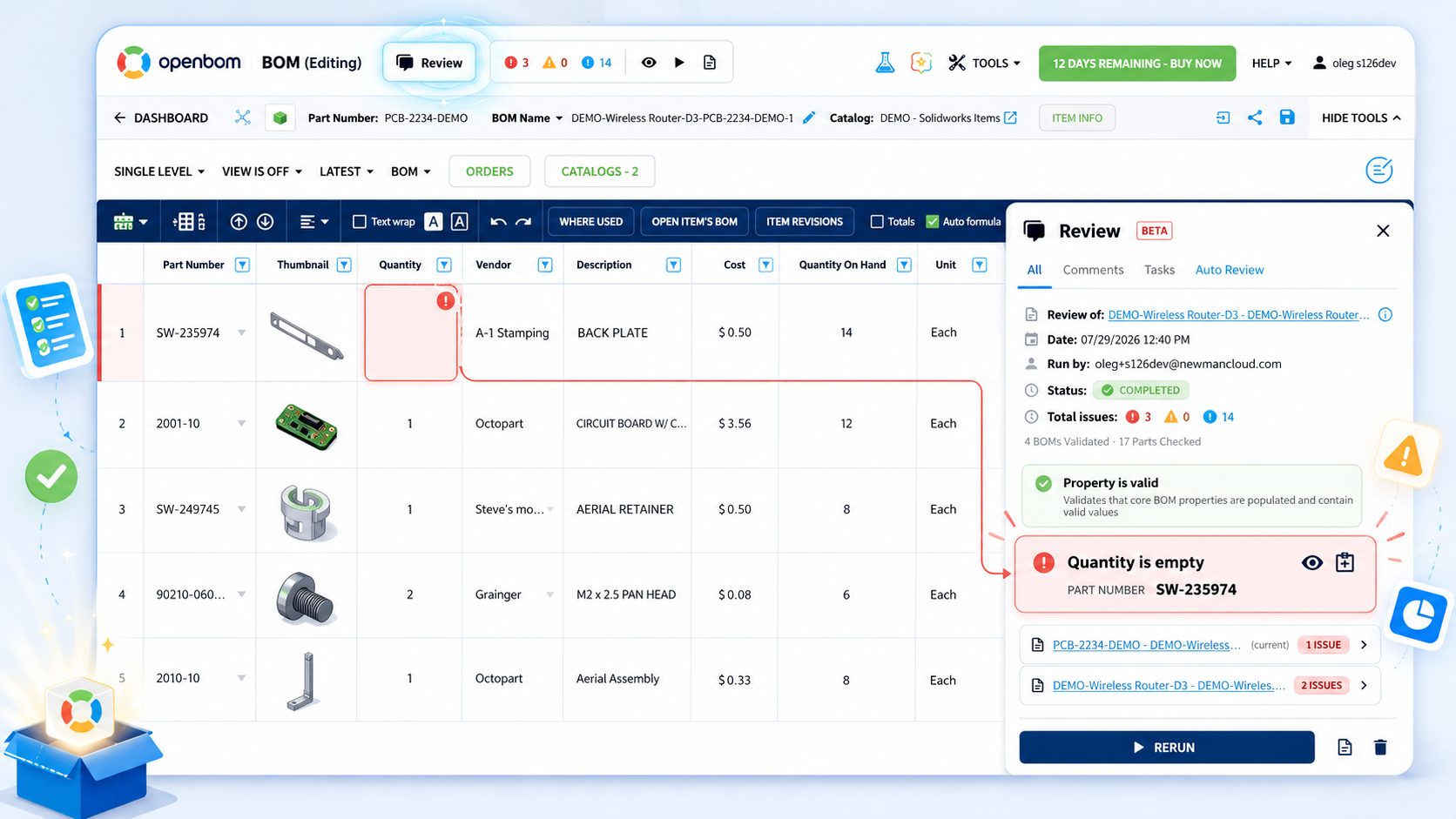
The checks that catch the expensive mistakes.
-
Part Number
Catches malformed or non-conforming identifiers
-
Quantity
Confirms quantities match reference designators
-
Property
Flags empty descriptions, costs, supplier fields
-
Structure
Detects loops and circular references
-
AI BOM Health
Analyze BOM using AI algorithms
Every review becomes part of your product's memory.
BOM Review is the missing middle of Capture → Review → Flow. Traditional systems record the outcome — approved, released. BOM Review keeps the reasoning too: what was found, who decided what, and why — a record that keeps paying off long after release.

Don't take our word for it — run it against your own BOM
Upload a spreadsheet, and BOM Review checks it the way your best reviewer would: missing approved sources, incomplete part records, prototype assemblies without test documents, options that shouldn't coexist. You get the findings in minutes, not after a review meeting. Free for two weeks. No credit card. Your own data.