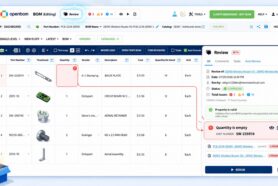
A bill of materials is where product definition begins. Creating a bill of materials is a collaborative effort that typically involves input from multiple departments, including manufacturing teams, design, engineering, and purchasing. It BOM outlines the raw materials, parts, and all components needed to build a finished product. But in real manufacturing, defining what a product needs is only the first step. The next challenge is purchasing those materials in the way suppliers actually sell them. Effective project management is essential for organizing and coordinating the procurement and production process.
That is where unit measure becomes critical.
Engineering may specify 350 screws in the BOM. A supplier may sell sugar only in boxes of 200 screws. Purchasing cannot order exactly 350 screws, so it must buy 2 boxes. The same thing happens with many other materials and components – cables, pipes, consumables like paint and others. This is the real packaging issue in procurement: not customer-facing packaging components, but supplier pack sizes and purchasing quantities.
This article is a practical guide for teams that need to define units of measure for each item, manage UOM across engineering, inventory, and purchasing, avoid procurement mistakes caused by unit mismatches, and connect those calculations to ERP, MRP, and purchasing workflows. That is the point where good BOM management improves the manufacturing process, reduces production delays, and supports better cost control across the product lifecycle. The original article focused on this exact operational problem—BOM quantities versus purchasing pack sizes—and on using item data plus formulas to calculate order quantities correctly.
Introduction to BOM
A Bill of Materials (BOM) is the foundation of any successful manufacturing process. It provides a comprehensive list of all raw materials, components, and sub-assemblies required to produce a finished product. Acting as a blueprint for the entire production process, the BOM ensures that every necessary component is identified and available when needed. This level of detail is crucial for maintaining quality control, minimizing excess inventory, and preventing production delays.
By leveraging a well-structured BOM, manufacturers can streamline operations, reduce costs, and enhance product quality throughout the product development lifecycle. Ultimately, a BOM is more than just a list—it is a strategic tool that supports efficient manufacturing and consistent delivery of high-quality finished products.
Types of BOMs
Understanding the different types of BOMs is essential for effective BOM management and smooth manufacturing operations. The Engineering BOM (EBOM) is developed during the design phase and details the components and materials needed to realize the product as envisioned by engineering. The Manufacturing BOM (MBOM) is tailored for the production process, incorporating not only the components but also assembly instructions and packaging materials necessary for manufacturing.
The Assembly BOM serves as a simplified version, focusing on guiding the assembly process with clear instructions and a concise list of components. Each type of BOM plays a unique role in ensuring that the right components are used at the right stage, supporting efficient production and accurate assembly.
Components of a BOM
A well-structured bill of materials consists of several key elements that enable precise production planning and cost control. The hierarchical structure, or BOM level, organizes the product from the finished product at the top down to individual sub-assemblies and components. Each component is identified by a unique part number and part name, with a detailed description to clarify its role.
The quantity specifies how many units are needed, while the unit cost and unit measure provide the basis for accurate calculation of total costs and inventory requirements. Keeping BOM data up to date is vital for effective inventory management, ensuring that production planning is based on reliable information and that all components are available when needed.

Why unit measure matters in BOMs and purchasing
A bill of materials BOM is a comprehensive list of the parts, materials, and assemblies needed to build a product. It may be a single level BOM for a simple item or a multi level BOM for products with a deeper hierarchical structure. A multi level bill, also known as a multi-level BOM, displays complex relationships between parent and child components, sub-assemblies, and assemblies through indentation or hierarchy, while a single-level BOM only highlights components that directly make up the end product. In contrast, multi-level BOMs illustrate the parent-child relationships between different production levels. In both cases, the BOM defines the quantity required to build the product as designed.
But the procurement process does not always work in the same unit as the design.
A design team may define:
- 24 screws
- 1.8 meters of cable
- 100 ml of paint
A supplier may sell:
- 1 box of 100 screws
- 1 spool of 10 meters
- 1 box of 1kg of pain
If those units are not connected with explicit rules, the business runs into trouble. Purchasing can order too much or too little. Inventory records stop reflecting reality. Production planners misread what is available. The result can be excess inventory, shortages, rework, and late deliveries. In short, a unit mismatch becomes a planning problem, a purchasing problem, and eventually a production problem.
That is why unit measure is not a formatting detail. It is core data that affects production planning, inventory management, associated costs, and the full production process.
What unit of measure means in a bill of materials
Unit of measure defines how a material or component is quantified. Common units include each, piece, box, pack, roll, reel, pallet, kilogram, liter, and meter.
In a detailed BOM, unit measure affects:
- how a material is consumed in the product
- how it is stocked in inventory
- how it is bought from a supplier
- how cost is calculated
- how purchasing documents are prepared
- how an erp system or MRP calculation interprets demand
A well-maintained BOM is not just a detailed description of all the components in a product. A detailed BOM should list all components needed, including parts, sub-components, and raw materials, to ensure manufacturing accuracy and efficiency. It must also connect those components to practical purchasing logic. For complex products, this becomes even more important because lower-level demand can roll up across many assemblies, sub components, and shared materials.
Engineering UOM vs purchasing UOM vs inventory UOM
The same material can have three valid unit definitions.
The engineering BOM defines how the design consumes the material. It tells you what the product needs according to product specifications.
The manufacturing BOM or manufacturing bill supports how the product is built during the manufacturing process and manufacturing operations. Manufacturing teams are key contributors to the BOM creation process, working collaboratively with design, engineering, and purchasing departments to ensure accurate and efficient production.
Purchasing uses the unit in which the supplier actually sells the item. Inventory may track the same item in yet another unit.
For example:
- Screws may be used as “each,” purchased by the box, and stocked as each or box.
- Cable may be consumed by the meter, purchased by the spool, and stocked by the roll.
- Paint may be used in kilograms, purchased by the box, and tracked in inventory by kilograms until consumption.
All of these are valid. The problem comes when the relationship between them is not defined.
Without explicit conversion factors, procurement teams end up calculating manually. That makes errors more likely, weakens version control, and creates disconnects between engineering, purchasing, and inventory. A well structured BOM should therefore support a clear distinction between engineering usage quantity and purchasing quantity.
How to define unit of measure for each item
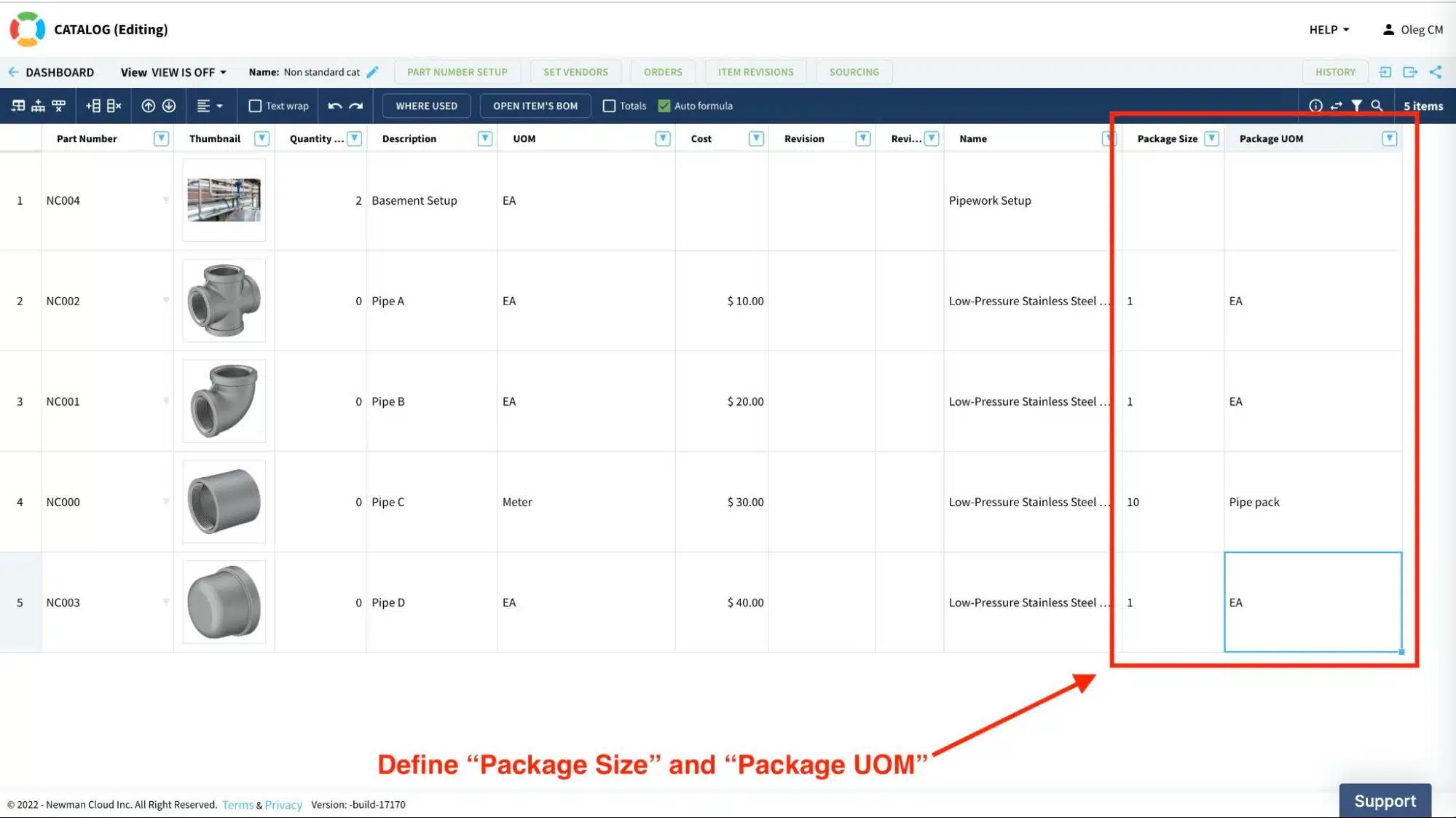
To make BOM-driven purchasing work, every purchased item should have a complete UOM definition. Many teams define the usage quantity in the BOM but fail to define how that same item is purchased and stocked.
For each purchased item, it is good practice to define:
- Engineering or usage UOM: how the item is consumed in the product
- Purchasing UOM: how the supplier sells the item
- Inventory UOM: how the item is counted in stock
- Supplier pack size: how much is in one box, bag, reel, spool, or pallet
- Conversion factor: the rule linking usage quantity to purchasing quantity
- Rounding rule: whether purchasing always rounds up to a full pack
- Minimum order quantity, when relevant
- Lead times for supply planning
This item-level definition is what makes BOM data usable in the real world. A screw may be simple, but the same rule applies to chemicals, bulk ingredients, sheet material, and electrical materials. Once that information is structured clearly, purchasing no longer needs to guess, inventory becomes more reliable, and production plans become easier to trust.
How to structure purchasing pack-size data in BOMs and item records
The clearest rule is this: the BOM should store the quantity required, while the item record or catalog should store the purchasing logic.
In the BOM line
Store:
- item number
- description
- quantity
- usage unit
- relevant BOM notes
In the item or catalog record
Store:
- purchasing unit of measure
- supplier pack size
- conversion factor
- rounding rule
- approved supplier
- unit costs
- minimum order quantity
- lead times
This separation keeps the BOM focused on product definition while still supporting purchasing calculations.
For example:
BOM line
Screw: 120 required
Item record
- Purchasing UOM: box
- Pack size: 50 screws per box
- Rounding rule: round up
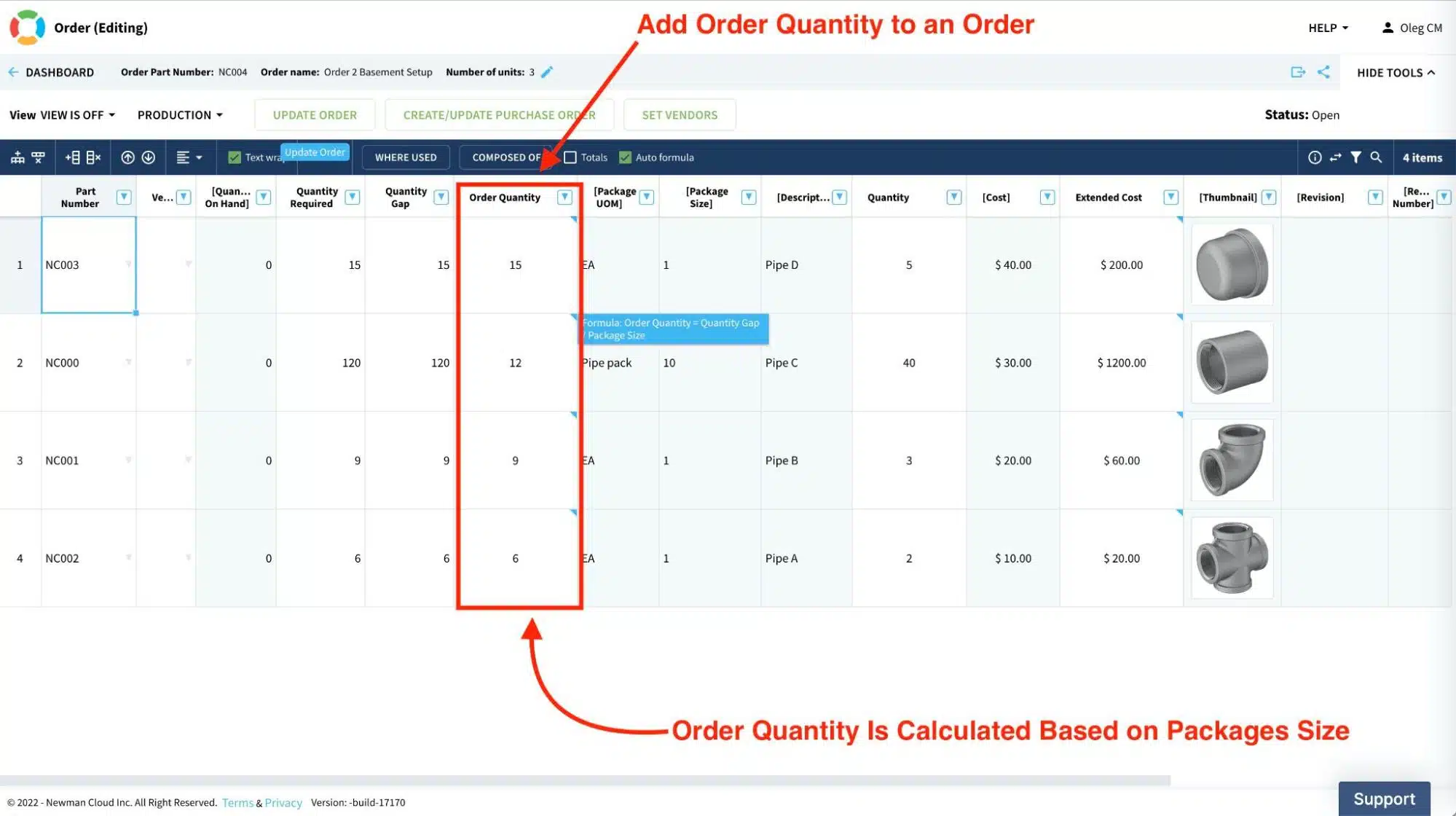
- Formula: quantity required / pack size
Result
- 120 required
- 50 screws per box
- 2.2 boxes
- purchase 3 boxes
That is far better than exporting to spreadsheets for one-off calculations. It is also how teams keep an up to date BOM connected to changing supplier data. This article is not really about a packaging BOM in the sense of a shipment list of customer-facing packaging materials. It is about supplier pack sizes used in procurement calculations.
How unit conversion works in BOM-driven purchasing
The conversion logic is simple:
Purchase quantity = quantity required / pack size, rounded up
Examples:
- 120 screws / 50 per box = 2.2 → buy 3 boxes
- 18 meters of cable / 10 meters per spool = 1.8 → buy 2 spools
In real manufacturing, companies often add more factors:
- scrap allowance
- safety stock
- minimum order quantity
- supplier-specific pack size
- alternate vendors
- contingency plans for critical supply items
These details matter because they affect production costs, inventory balance, and procurement timing. When quantities are scaled up, the business impact becomes even larger. That is why formula-based conversion is much more reliable than manual recalculation.
How ERP, MRP, purchasing, and procurement use UOM data
UOM data becomes most valuable when connected to planning systems.
In enterprise resource planning, the BOM is used to determine the material demand for a production order. MRP logic multiplies that demand across forecast or build quantity. But procurement cannot always order the exact engineering quantity. It must convert that requirement into supplier purchasing units.
A connected workflow looks like this:
- The BOM defines the required quantity.
- Planning multiplies it across the build quantity.
- The item record provides purchasing UOM, pack size, and conversion logic.
- The system calculates purchasing quantity for RFQs and purchase orders.
- Purchasing reviews supplier options, cost, and lead times.
- Inventory receives and tracks the item in the correct stocking unit.
This connection between BOM and order calculations was also the practical focus of the original OpenBOM article: item catalog data holds packaging size and UOM, and formulas in orders convert required quantity into order quantity.
When that logic is missing, companies rely on manual workarounds. Those workarounds create bad purchase quantities, poor receiving records, and broken synchronization between engineering and purchasing. Over time, that leads to production disruptions, inaccurate stock, and weaker control over the same product across its product life cycle.
Single-level and multi-level BOM calculations
A single level BOM is often enough for simple purchasing lists. It works well when a product has few parts and no meaningful hierarchy.
A multi level BOM is more important when the product includes assemblies, reused parts, and lower-level purchased items. A multi level bill, also known as a multi-level BOM, displays complex relationships between parent and child components, sub-assemblies, and assemblies through hierarchy or indentation.
A multi level BOM shows how demand rolls up through the structure, from finished product to sub assembly, down to child components and purchased materials.
For example:
- Finished Product
- Assembly A
- Bracket
- Screw
- Assembly B
- Cable
- Screw
- Assembly A
In this case, purchasing demand for screws comes from more than one branch of the hierarchy. This is where multi level BOM logic helps teams understand total demand across numerous components and sub components. It is especially useful for complex products, for outsourced builds with contract manufacturers, and for environments that need a modular BOM or deeper assembly BOM visibility.
Lead Times and Production Planning
Lead times are a critical factor in the production process, directly impacting the ability to maintain efficient production schedules and avoid costly production delays. By accurately tracking lead times for each component and sub-assembly within a multi level BOM, manufacturers can develop contingency plans and ensure that all necessary components arrive on time.
The hierarchical structure of a multi level BOM shows how lead times for sub assemblies and components affect the overall production timeline. Effective management of lead times helps reduce inventory requirements, supports consistent product quality, and enables proactive production planning, ensuring that the manufacturing process runs smoothly from start to finish.
Finished Product and BOM
The finished product is the culmination of the entire manufacturing process, and the BOM is instrumental in ensuring it meets all required specifications. By outlining all the components required—including packaging materials and associated costs—a well-structured BOM enables manufacturers to maintain high standards of quality control and cost effectiveness.
Effective BOM management ensures that every component is accounted for, supporting process manufacturing and helping to identify potential issues before they impact the final product. By utilizing a comprehensive BOM, manufacturers can optimize the production process, reduce waste, and manage the product lifecycle more efficiently, resulting in a finished product that consistently meets customer expectations and business goals.
Common mistakes and best practices
The most common mistakes are familiar:
- inconsistent unit naming
- missing conversion factors
- supplier pack sizes not documented
- spreadsheet overrides outside the BOM system
- outdated pack-size data
- poor version control
- no backup sourcing or contingency plans
The fix is equally clear:
- standardize unit measure definitions
- store pack-size data in item records
- use formulas for purchase quantity
- connect engineering, purchasing, and inventory to the same data source
- review changes regularly
- keep a detailed BOM current
- use the BOM as part of broader materials management
These practices improve quality control, support quality assurance, reduce waste, and help maintain product quality and product consistency across the product development lifecycle.
Conclusion
The real issue in purchasing is not customer-facing packaging. It is the difference between what the BOM requires and how suppliers sell materials.
A product may need 6 kg of sugar, but purchasing may need to buy 2 boxes of 5 kg each. That simple example explains why unit measure matters so much. The BOM defines what the product needs. Purchasing rules define what must actually be ordered. Inventory logic defines how that material is tracked. When those three views are connected, companies gain better cost control, stronger inventory management, more reliable planning, and fewer production delays.
A good bill of materials should do more than list necessary components. It should support the calculations that turn engineering demand into practical procurement decisions. That is how teams improve purchasing accuracy, support the final product, and create a more resilient process from design through manufacturing.
Best, Oleg
Join our newsletter to receive a weekly portion of news, articles, and tips about OpenBOM and our community.