A recent LinkedIn comment from Scott Morris captured something many manufacturing companies are quietly struggling with but rarely say out loud.
Customers are leaning heavily on JDM and ODM partners to get products to market faster. Collaboration is happening earlier, more often, and across more company boundaries than ever before. Yet the systems meant to support this collaboration are falling behind. Partners are hard to onboard. Every day, work turns into a configuration exercise. Ad-hoc collaboration quickly escapes into email, spreadsheets, and shared folders because that is where progress can actually happen.
This is not a failure of intent or discipline. It is a signal that the collaboration model has changed faster than the systems supporting it.
Across industries, even traditional OEMs now rely on JDM and ODM methodologies to scale engineering capacity and compress timelines. Design responsibility is distributed. Iteration is constant. Decisions are provisional and often reversed before they stabilize. Collaboration is no longer a controlled event at the edge of the process. it has become an integral part of the process itself.
Traditional PLM systems struggle in this environment. Not because they lack power or flexibility, but because they assume a world where collaboration is structured, onboarding is deliberate, and expertise is always available to shape the system around the process. When simplicity requires deep experience, collaboration slows down. When onboarding requires specialists, partners become reluctant participants rather than active contributors.
The result is a widening gap between how teams need to work and what their systems comfortably allow.
What customers are really asking for is not another round of configuration or more process enforcement. They are asking for a stronger collaboration foundation, one that can keep up with ad-hoc, real-world partner collaboration without sacrificing traceability, control, or product definition. They want systems that support how decisions are actually made, not just how they are recorded afterward.
That tension, between modern JDM and ODM collaboration and the limits of traditional PLM assumptions, is where this story begins.
As a result, collaboration quietly escapes the system. The process “leaks to Excel”. Teams revert to email, spreadsheets, shared folders, and chat, not because they prefer chaos, but because these tools keep up with the pace of real work better than enterprise systems do. PLM remains present, but increasingly disconnected from where decisions are actually made.
What customers are really asking for is not lighter PLM or more workflows. They are asking for a stronger collaboration layer, one that can replace fragile ad-hoc practices without slowing teams down and without forcing every partner into a single, monolithic PLM environment. The tension between the speed of modern JDM and ODM collaboration and the rigidity of traditional systems is where this story begins.
The Collaboration Breakdown
Many OEMs today are under sustained pressure to deliver more products, more frequently, while operating with limited internal engineering capacity. To keep pace, they rely on an expanding ecosystem of JDM and ODM partners. Some partners take responsibility for complete subsystems, while others contribute electronics, firmware, or early design concepts that evolve rapidly before stabilizing.
Internally, existing PLM systems often function as intended. Engineering teams understand how to use them. Manufacturing trusts the data they contain. Management sees structure, control, and compliance.
The situation changes the moment external partners enter the workflow.
Partner onboarding becomes a project of its own. Licenses must be negotiated. Access boundaries debated. Engineers hesitate to share unfinished work because it is not yet suitable for PLM. What should be collaborative design discussions slow down under the weight of configuration, permissions, and governance decisions, even as time-to-market pressure continues to increase.
As friction grows, collaboration begins to move outside the system. CAD files are exchanged by email or shared folders. BOMs appear in spreadsheets. Design decisions are made in meetings or calls and then fade away once the conversation ends. PLM remains present, but increasingly disconnected from where the real work happens.
Over time, the system shifts into a passive role. Instead of supporting decision-making as it unfolds, PLM becomes a system of record that captures outcomes after the fact, long after key assumptions, tradeoffs, and reasoning have already been lost.
The Wrong Diagnosis: “We Need Better Process”
When this breakdown becomes visible, the instinctive response is almost always the same: fix the process.
More workflows are added. Handoffs are clarified. Partner rules are defined. Training is expanded. Yet every additional layer of process makes collaboration more brittle rather than more effective. Engineers begin to look for workarounds. Partners disengage. The system becomes something teams comply with, not something they rely on.
Eventually, the customer reaches an uncomfortable realization. JDM and ODM collaboration is not failing because the process is missing or poorly defined. It is failing because the system itself is built on assumptions that no longer match how products are developed.
The Real Problem: Data Architecture Built for a World That No Longer Exists
Traditional PLM systems are built on a small set of core assumptions. One company owns the data. One system defines truth. One lifecycle applies to everyone. Collaboration is treated as an exception rather than the default state.
JDM and ODM collaboration breaks every one of these assumptions.
Ownership is shared or changes over time. Decisions are provisional and often reversible. Iteration happens before alignment, not after it. Partners must collaborate without surrendering control of their own systems and internal processes.
Trying to force this reality into a single centralized PLM server creates friction instead of clarity. What customers actually need is not a better process layered on top of the same foundation, but a data architecture designed from the start to support distributed collaboration.
Design Projects: Separating Exploration from Definition
The first shift happens when design exploration is separated from formal product definition.
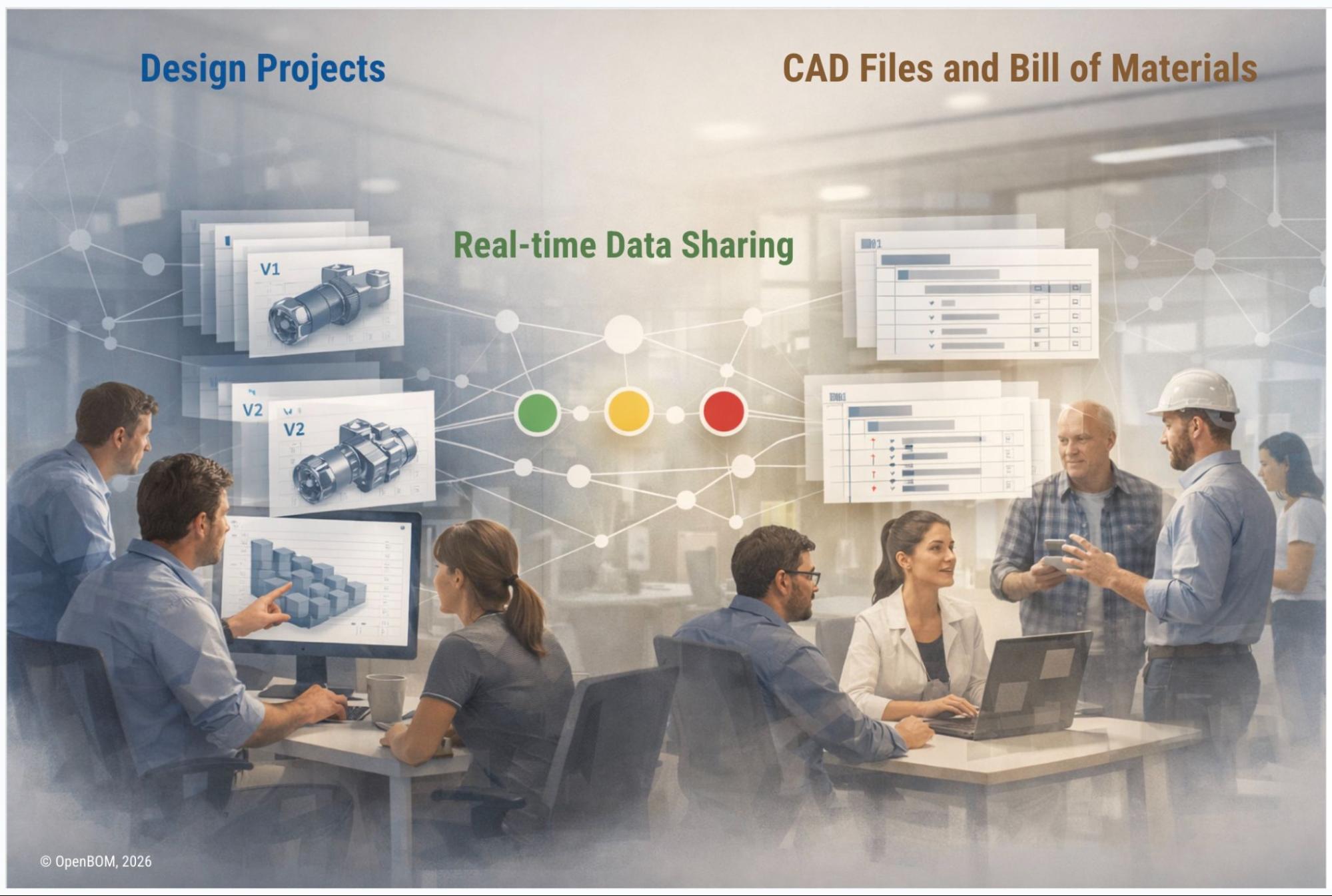
Design Projects becomes a shared workspace where OEMs and partners can collaborate without premature constraints. CAD files are allowed to evolve naturally, multiple alternatives can coexist, and history is preserved without forcing early part numbering or release decisions. Engineers can explore, compare, and iterate without the fear of breaking downstream rules too early.
For the OEM, this provides something email and shared folders never could: visibility without control. The most important outcome is not just access to files, but preservation of context. Teams can see why a design evolved the way it did, not just the final result.
BOMs as Alignment Tools, Not Approval Gates
The second shift is a change in how BOMs are used.
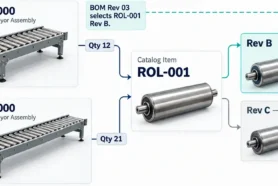
Instead of waiting until the design is complete, BOMs are introduced early as alignment tools. They are used to compare partner proposals, explore sourcing and cost scenarios, evaluate alternatives and risk, and understand downstream impact before commitments are made.
At this stage, there is no single final BOM. There are multiple views, each supporting a different conversation. What matters is not perfection, but connection. BOMs become shared thinking surfaces that allow teams to reason together rather than static artifacts delivered at the end of the process.
Collaboration Without Forcing Everyone Into One System
Underneath this approach is a fundamental architectural difference.
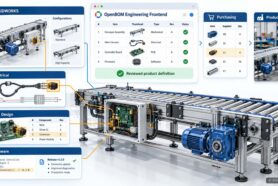
OpenBOM uses a multi-tenant data architecture combined with a flexible data model and lifecycle. This allows OEMs and partners to share information at the right level of granularity, whether that is a design project, a set of items, a BOM structure, or even specific attributes, without forcing everyone into a single PLM instance or corporate data model.
Partners remain productive in their own environments. OEMs maintain continuity and traceability across changes. Governance emerges naturally as decisions stabilize instead of being imposed upfront. The result is collaboration that is stronger than ad-hoc tools but far more adaptable than traditional PLM.
What Actually Changes
The most visible change is not simply smoother collaboration. It is a shift in how decisions are made and sustained over time.
When collaboration no longer needs to escape into email, spreadsheets, and side conversations, assumptions surface earlier instead of remaining implicit. Design alternatives, tradeoffs, and partner inputs stay visible while they are still negotiable, rather than being discovered late through rework or manufacturing surprises. Alignment happens before commitment, not after release.
As a result, rework decreases and accountability improves without adding layers of oversight. Decisions are no longer tied to individual inboxes or meeting notes. They become part of a shared product context that teams can revisit, question, and refine as the product evolves. Over time, this creates a living product memory instead of a fragmented trail of files and spreadsheets.
PLM continues to play an important role, but its role changes. It is no longer asked to carry every conversation, iteration, and decision across the entire lifecycle. Instead, it operates alongside a collaboration layer that absorbs variability and preserves context, allowing formal systems to engage when stability, compliance, and execution truly matter.
A Practical Starting Point: Collaboration Without Borders
One reason JDM and ODM collaboration so often fails is that systems demand big commitments upfront. Licenses, migrations, and long onboarding cycles are required before any value is proven.
With OpenBOM’s new 2026 pricing model, companies can start differently. Partners and stakeholders can participate through free, unlimited read-only access. Paid seats are only required for users actively managing data. Teams can start with a single project instead of committing to a company-wide rollout.
This makes it possible to test collaboration in the real world, across OEMs and partners, without friction, politics, or risk.
Conclusion
JDM and ODM collaboration does not fail because teams ignore processes. It fails because systems assume single ownership and linear decisions.
When data architecture reflects how products are actually designed, across companies, timelines, and partial commitments, collaboration stops being a liability and becomes a competitive advantage.
Start with one project. Invite your partners. See the difference.
👉 Check OpenBOM for one project and discover how modern collaboration is supposed to work.
REGISTER FOR FREE to get started with a 14 day trial of OpenBOM and check how it can help.
Best, Oleg
Join our newsletter to receive a weekly portion of news, articles, and tips about OpenBOM and our community.