When customers succeed, their products grow. When products grow, product data grows with them. What often breaks along the way is pricing.
Over the past year, we spent a lot of time listening to how teams at very different stages use OpenBOM. From engineers working on early ideas, to small startups shipping their first products, to growing manufacturing companies preparing for ERP integrations and AI-driven workflows. What we learned was simple: pricing should enable growth, not slow it down.
That insight led to OpenBOM’s new 2026 pricing model. It is built around two independent dimensions:
- Who uses OpenBOM — editors versus read-only users
- How much product data you manage — measured as data records
These two dimensions are intentionally decoupled. Collaboration should not be taxed. Data growth should be predictable.
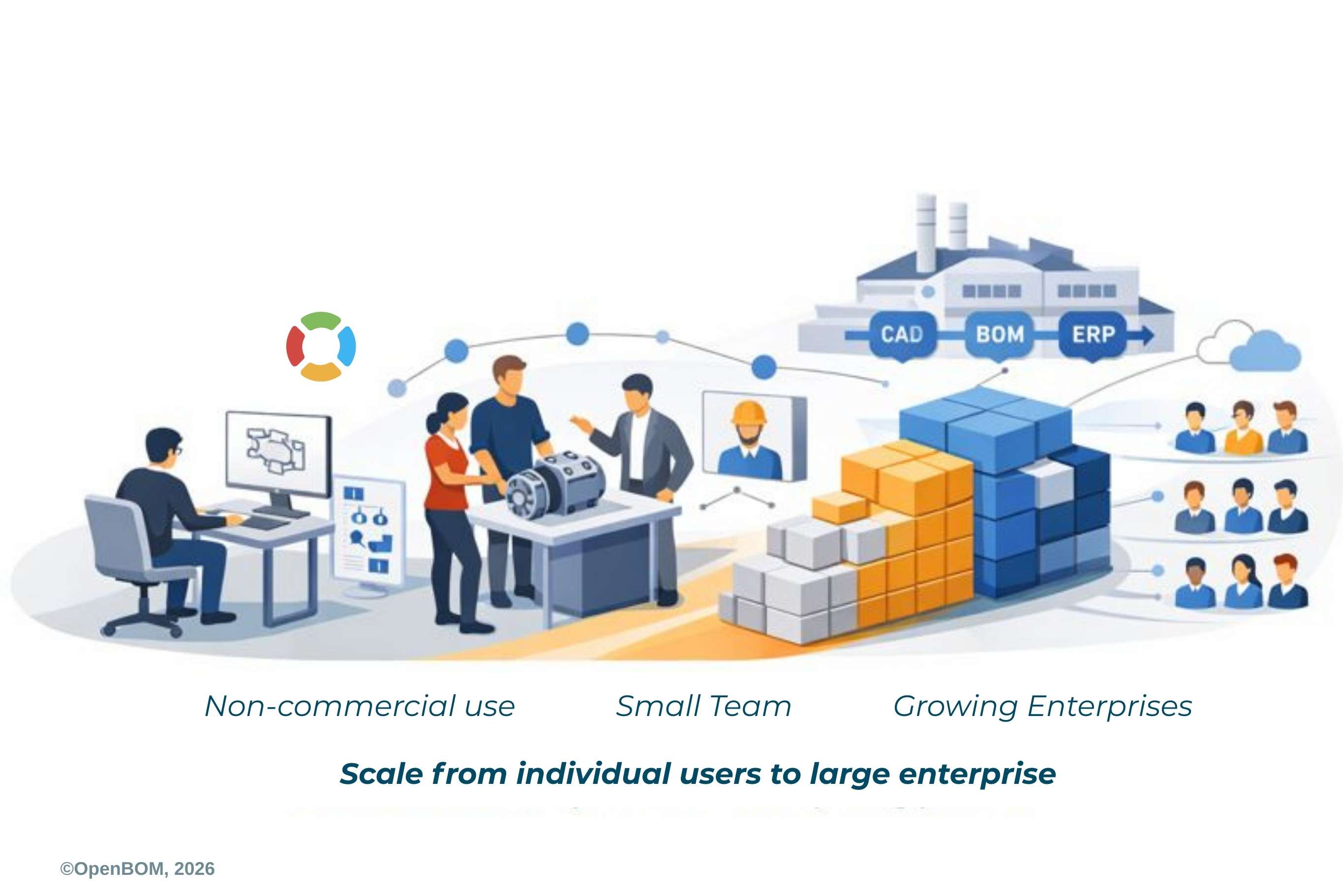
To show how this works in practice, let’s walk through three real-world scenarios.
Story 1: The Free Non-Commercial User
Alex is an engineer working on a personal hardware project. Sometimes it’s a weekend prototype. Sometimes an open-source idea. There is no company yet, no sales team, no ERP system. Just ideas, CAD files, and iterations.
Alex signs up for OpenBOM and notices something different.
There is no credit card required. No forced seat minimums. No pressure to upgrade.
Alex manages a few hundred parts, creates BOMs, revises designs freely, and iterates without worrying about cost. Revisions don’t increase usage. File size doesn’t matter. Storage is unlimited.
OpenBOM pricing is based on data records, and the first 2,000 records are free. Alex works comfortably within that limit, without friction.
This isn’t a trial. It’s a deliberate choice.
Early-stage work should be allowed to mature naturally. OpenBOM’s free non-commercial option exists so ideas can grow before pricing ever becomes relevant.
Story 2: The Small Team
Maria runs a small startup. She is the only engineer, but she works closely with a manufacturer and a purchasing partner. Her product is real. Customers are waiting.
She needs three things: a reliable BOM system, a CAD integration, manage inventory, order parts, and to have a simple way to share data with contractors and manufacturing partners without buying unnecessary seats.
With OpenBOM’s 2026 pricing, Maria pays only for what she actually uses.
Her setup is intentionally simple:
- One editor seat at $30/month (Team tier, annual billing)
- One CAD add-in at $25/month
- Unlimited free read-only users for partners and stakeholders
- Up to 2,000 data records at no charge
Maria revises designs freely, tracks BOM changes, and shares live product data with partners — without exporting spreadsheets or emailing files.
Most importantly, she is not forced to pay for visibility. Her partners can see everything they need, without editing rights and without extra licenses.
Small teams should not have to choose between collaboration and cost control. In OpenBOM, pricing scales only when product complexity grows, not when collaboration improves.
Story 3: The Growing Company
Daniel works at a manufacturing company with multiple engineering teams. Some use SolidWorks. Others use Altium. Operations needs ERP integration. Management wants real-time visibility. Suppliers need controlled access.
This is where traditional pricing models often break.
In many systems:
- Every user requires a paid seat
- Revisions increase storage costs
- Integrations are priced per user
- Activity creates unpredictable bills
OpenBOM works differently.
Daniel’s company has 10 people total. Four people actively edit data. Two use SolidWorks. One uses Altium. Six internal users need read-only access. The company also shares data with 10 external partners.
Here’s what they pay:
- Four editor seats at $90/month each (Company tier, annual billing): $360
- Three CAD add-ins at $25/month each: $75
- One ERP integration: flat, company-wide cost $600
- Six internal read-only users: free
- Ten external partner read-only users: free
Total: $1035/month with unlimited read-only access across the company and its partners.
Revisions don’t increase cost. Iterations don’t increase cost. Sharing data does not increase cost.
As product data grows from thousands to tens of thousands of records, pricing scales transparently in defined tiers. The company pays for real data growth, not system friction.
This matters as OpenBOM becomes infrastructure — connecting CAD and ERP systems, supporting API-based workflows, and preparing structured data foundations for AI. The pricing model reflects that reality.
What Counts as Data Records
Data records represent the scale and structure of your product data.
They include:
- Unique part numbers
- BOM part records
- Unique files managed by OpenBOM PDM
Data records do not include:
- Revisions or versions
- Derivative files
- Number of properties
- Storage size (storage remains unlimited)
For example, a small product with 500 part numbers, 1,000 BOM records, and 500 CAD files stays under the 2,000 free records. There is no data record charge.
A larger product with 10,000 part numbers, 20,000 BOM records, and 30,000 CAD files moves into graduated pricing tiers.
Teams can iterate freely, revise designs, and collaborate without worrying about hidden penalties.
Why This Pricing Model Exists
This change is not about charging more. It is about charging more fairly.
What we consistently heard from customers was clear:
- Early-stage teams want a low barrier to entry
- Growing teams want predictable, transparent scaling
- Mature organizations want pricing that reflects real data growth, not friction
- Everyone wants better ways to share data without paying for seats that only need visibility
OpenBOM pricing is designed to be easy to start with, scale naturally as products succeed, encourage collaboration and visibility, support integrations, APIs, and future AI workflows, and avoid penalties for iteration and experimentation.
When products grow, data grows. Pricing should follow that journey, not block it.
AI, Integrations, and Platform Economics
OpenBOM is increasingly used as infrastructure.
It connects CAD and ERP systems, supports API-based workflows, and provides structured data foundations for AI. At the same time, technology partners are changing their own licensing models, including API-based royalties and usage charges.
To sustainably support integrations, APIs, and upcoming OpenBOM AI capabilities, pricing needs to reflect that reality.
Later in 2026, we will introduce AI token-based pricing to support OpenBOM AI agents as they become available. This will be announced separately.
Conclusion: One Simple Idea
Whether you are building your first prototype, launching your first product, or scaling manufacturing across teams and systems, OpenBOM pricing is designed to meet you where you are — and grow with you when you are ready.
Success should never come with friction.
If you have questions about how this pricing applies to your situation, our team is always happy to talk.
REGISTER FOR FREE and start using OpenBOM today!
Best, Oleg
Join our newsletter to receive a weekly portion of news, articles, and tips about OpenBOM and our community.