I love all product development and manufacturing examples using the “food” analogy – it is my favorite pick. Therefore Thanksgiving in the U.S. is always a good opportunity to talk about the “Thanksgiving BOM”.
Thanksgiving dinner sounds simple when you describe it at a high level. Buy a turkey, make a few sides, invite the family, and put everything on the table at roughly the same time.
If you work in engineering or manufacturing, that description should make you nervous. It sounds a lot like “just send the CAD files to production.”
Behind every Thanksgiving table sits a product structure, shared components, suppliers, capacity limits, and stakeholders who submit changes after the deadline. Behind every family recipe sits something even harder to document: years of decisions, substitutions, and mistakes, stored in the heads of people who never measure anything. Let’s start with the BOM and see where it leads.
A thumbs-up is not an approval
The plan was reasonable: eight guests, one turkey, stuffing, mashed potatoes, cranberry sauce, and pumpkin pie. You built a spreadsheet, shared it with the family, and someone replied with a thumbs-up. You called that approval. That was your first mistake.
By Tuesday there were eleven guests. A vegetarian friend was coming, someone had given up dairy, and your uncle wanted the stuffing “the way we always make it,” though nobody could agree on what that meant. Thanksgiving Dinner Rev A was obsolete, and procurement had already bought against it.
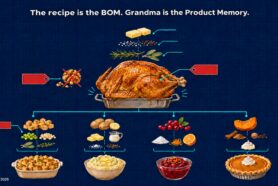
Your dinner has a BOM whether you write it down or not
A recipe tells you how to make a dish. A bill of materials tells you what goes into it and how much you need
| Assembly | Key components | Special requirement |
|---|---|---|
| Roast turkey | Turkey, butter, herbs, seasoning | Must fit in the oven |
| Stuffing | Bread, onions, celery, stock | Grandma’s approved recipe |
| Mashed potatoes | Potatoes, butter, milk | “Enough” is not a unit of measure |
| Cranberry sauce | Cranberries, sugar, orange | Make-or-buy decision pending |
| Pumpkin pie | Crust, filling, whipped cream | Supplier identity confidential |
The pie comes from a local bakery, but someone moves it to a family plate before the guests arrive. We can discuss supplier traceability after dessert.
Each recipe had enough butter, and the dinner did not
Butter goes into the turkey, the stuffing, the potatoes, and the pie crust. Everyone assumes there is some in the fridge, and nobody adds up the total. That is the moment a family discovers the flattened BOM: the combined quantity of every ingredient across every dish.
The same goes for onions, stock, and the herb everyone needs two teaspoons of but can only buy in a bunch large enough to landscape the yard. Meanwhile, three people buy cranberry sauce. Inventory accuracy for cranberry sauce is excellent.
“Quick question” is how every engineering change starts
At 4:47 p.m. on Wednesday, a message arrives: “Quick question. Can we make everything dairy-free? Also, we’re bringing two more people.”
It takes five seconds to read and the rest of the evening to assess. Butter is in four dishes, the milk is allocated to the potatoes, and the pie is already ordered. Then comes the follow-up: “Should be easy!” You have met this stakeholder.
Meanwhile, procurement reports that the preferred turkey is out of stock. The store offers a bigger one at a better price, so the substitution is approved. Manufacturing then discovers it doesn’t fit the roasting pan. The larger pan barely fits the oven, the schedule moves, the stuffing slides, and the vegetables collide with the pie. Someone mentions that this exact thing happened two years ago. That would have been useful at the store.
The group chat is not a change management system
By Wednesday night, the plan lives in a spreadsheet, a photo of a handwritten list, three private conversations, and a group chat with 74 unread messages. One person follows an old screenshot, another edits a personal copy, and a third buys ingredients based on a conversation nobody else remembers. Everyone has the latest version. Dinner has four latest versions.
A shared BOM fixes much of this. Everyone sees current quantities, agreed substitutions, and who owns what. You can still argue about raisins, but at least you are arguing about the same stuffing. What the rows don’t show is why. Why this ingredient? Who tried that substitute? Why does the recipe say twelve servings when it barely fed eight?
Grandma is your Product Memory system
Every family has someone who knows how everything works: which potatoes to buy, which pan to use, and why the card says 45 minutes when it always takes an hour. Ask how much stock goes in the stuffing and you hear, “You’ll know when it looks right.” An impressive interface. Difficult to integrate.
What Grandma holds is not a recipe. It is connected experience: ingredients tied to equipment, timing, people, and the results of earlier dinners. The recipe card is stored. The reason we stopped putting walnuts in the stuffing is stored exclusively in Aunt Susan.
This is what I mean by Product Memory: the connected context and decision history that explain how a product came to be and why it changed. A saved recipe is not Product Memory, and neither is a 74-message chat. It begins when a decision is connected to what it affects: this substitute, in this dish, requested by this person, with this result. Engineering has the same gap. Items, BOMs, files, and revisions tell you what was released. The reasoning behind them often sits in email threads and in the heads of a few experienced people.
AI can plan a dinner, but not yours
Ask an AI assistant to plan Thanksgiving and you get a menu, quantities, and a shopping list in seconds. It is a fine plan for an average family with an average oven. It doesn’t know that your oven rejects the big pan, which dairy-free substitute passed the taste test, or that last year’s twelve servings were gone before seconds. Without that, you get a beautiful plan that repeats every mistake your family has already made.
Now give it what your family actually learned: “Plan dinner for eleven, reuse the stuffing everyone liked, keep the dairy-free substitutes that worked, and check the turkey against our pan size.” The model brings the intelligence. The memory is what makes it useful. “Ask Grandma” remains a required approval step.
Next year should start where this year ended
After dinner, someone says, “Let’s do it exactly like this next year.” Great. What exactly did we do? Keep the final BOM. Write down the substitutions and why they happened, add notes on quantities, timing, and what people liked, and connect them to the dishes they describe. Each year adds a layer, and next year starts from experience instead of a blank spreadsheet.
That is why I care about Product Memory, and it shapes how we think about OpenBOM’s direction: helping teams connect product data with the context and decisions behind it. A family dinner is just a tastier example.
Happy Thanksgiving from OpenBOM
Thank you to our customers, partners, and community for sharing ideas, challenges, and experience with us this year. May your quantities be accurate, your substitutions approved, and your change requests arrive before Wednesday.
And please write down why you removed the walnuts. Next year’s team will thank you.
Want to plan your Xmas dinner using OpenBOM?
Register for free to create a trial.
Best, Oleg
Join our newsletter to receive a weekly portion of news, articles, and tips about OpenBOM and our community.