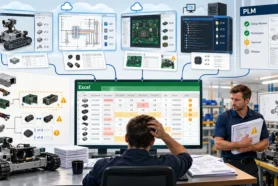
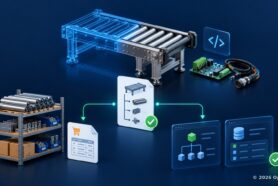
Every engineering and manufacturing team knows why BOMs must be validated before release. Catching a mistake early is cheap. Catching it late is expensive. A wrong quantity, a missing property, a design flaw, an unrealistic cost assumption, or a supply chain issue discovered at the review stage costs an hour of engineering time. The same problem was discovered after release costs rework, delayed purchase orders, scrapped inventory, and sometimes a production line waiting for parts.
But “review and validate” is more than catching mistakes. It is a structural problem of managing complex products. A modern product structure spans mechanical, electronic, and software components, multiple assembly levels, thousands of items, properties coming from different disciplines, sourcing decisions, cost targets, and compliance requirements. No single person holds all of this knowledge, and no single checklist covers it. Validating a complex product structure requires bringing together people from engineering, manufacturing, procurement, and supply chain, each checking the BOM from their own perspective, and coordinating what they find.
Yet in most organizations, this is how BOM reviews happen today. Someone exports the BOM to Excel. The file goes out by email. Comments come back in three different colors, a few screenshots land in a chat thread, and someone schedules a meeting to walk through the issues. Two weeks later, the BOM is released, and six months after that, nobody can explain why the quantity changed on line 47 or who decided to replace the connector.
The review happened. The knowledge is gone.
A few months ago, I wrote about why BOM review becomes the missing infrastructure in the AI era. In that article, I argued that BOM review is evolving from a procedural approval step into a collaborative context-building process, and that organizations need a shared environment where teams can assemble product context, discover issues, and reason about product structure before release. AI makes this need urgent, because AI amplifies both good and bad product data. Now we are taking the first step to turn that vision into a working product.
Today, I’m happy to introduce OpenBOM BOM Review, a new collaborative experience that helps engineering and manufacturing teams review, validate, and improve product structures before release, while capturing the discussions, decisions, and follow-up work generated along the way.
BOM Review is available immediately to every OpenBOM customer.
BOM Review Is the Missing Middle of the Product Memory Flywheel
For the last year, I have been writing about Product Memory, the idea that organizations need to capture not only product data, but the reasoning, context, and decisions that surround it. At OpenBOM, we describe how this works in practice as the Product Memory Flywheel, three connected activities:
- Capture: Product information comes into OpenBOM from CAD systems, Excel spreadsheets, suppliers, legacy systems, and other sources.
- Review: Teams collaboratively validate, discuss, and improve the product data.
- Flow: Validated information moves to ERP, MES, procurement, and other downstream systems, and back to CAD and engineering tools.
OpenBOM has always been strong at capture and flow. CAD integrations, Excel import, and connections to business systems have been part of the platform for years. BOM Review completes the middle of the flywheel. It gives teams a dedicated place to do the validation work that today lives in spreadsheets, email, and meetings, and it makes that work part of the product’s history.
A Bill of Materials Is Never Ready Until Someone Checks It
Creating a BOM is only part of the job. Before product data (eg. BOM) can be released, teams must answer hard questions. Is the BOM complete? Are required properties populated? Do quantities match reference designators? Are there duplicate or missing part numbers? Are there structural problems hiding in a deep assembly tree?
In most organizations, these checks are performed manually, inconsistently, and invisibly. The result is predictable: errors escape to procurement and manufacturing, where they cost real money, and the knowledge of what was checked and why disappears the moment the review meeting ends.
BOM Review brings these activities into one shared environment where the checking, the discussion, and the fixing all happen in the context of the product data itself.
Built on OpenBOM’s Patented Collaborative Workspace Technology
BOM Review is built using OpenBOM’s collaborative workspace, a patented method of BOM collaboration developed by OpenBOM that combines flexible data modeling with real-time, multi-user editing.
Multiple users can work on the same product data structure simultaneously, reviewing information, making updates, and coordinating changes without locking each other out or passing files around. The flexible data model means teams can represent complex product data structures with their own properties, terminology, and organization, rather than forcing every company into a rigid predefined schema.
This matters for reviews specifically because validation is a team activity. A review that only one person can perform at a time is a bottleneck, not a process.
Check Cards Turn BOM Validation Into an Expandable System
The central mechanism of BOM Review is an expandable set of check cards. Each card performs a specific validation against the product data and reports what it finds.
BOM Review ships with an initial set of out-of-the-box cards:
- Part Number validation checks that part numbers match the pattern your organization has set up, catching malformed or non-conforming identifiers before they propagate downstream.
- Property validation finds empty or missing properties, so a BOM does not reach procurement with blank descriptions, costs, or supplier fields.
- Quantity validation verifies that quantities match reference designators. If the quantity is 3, the card expects to see reference designators C1-C3, and flags the line if they do not agree.
- Structure validation analyzes the product structure and data itself, detecting loops and circular references that can break downstream processes.
These four cards address some of the most common and expensive BOM errors I have seen in more than 25 years in this industry. But the more important point is the architecture.
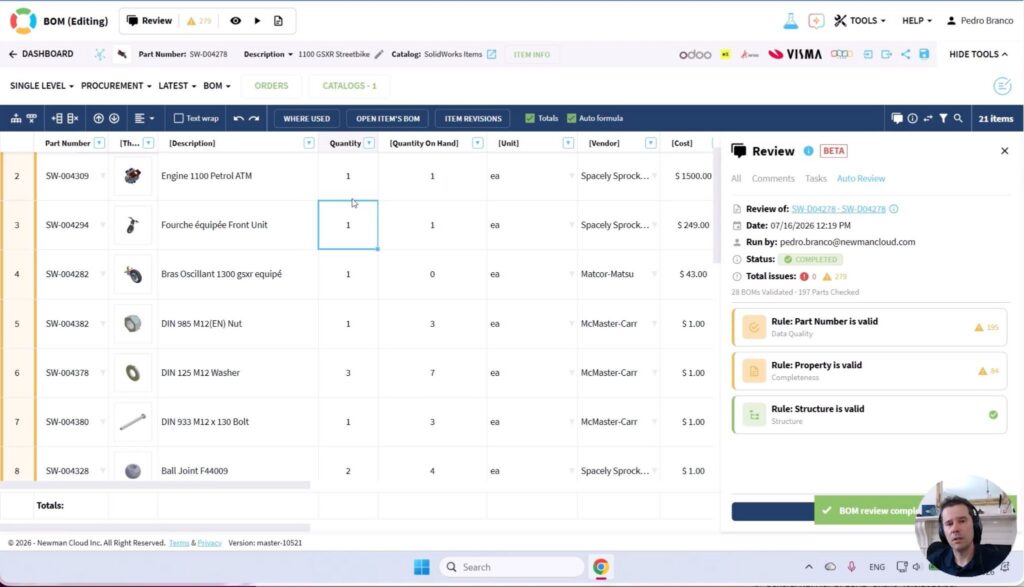
The check card framework is designed to be extended and programmed using OpenBOM tools and APIs. Over time, each card can become part of an organization’s AI-enabled validation framework, a way to encode how your company defines “ready for release.”
BOM validation is never based on a single universal checklist. Different industries, products, and lifecycle stages demand different rules. The expandable card model is how BOM Review adapts to yours.
Finding an Error Is the Beginning, Not the End
A validation result by itself changes nothing. Someone has to decide what to do, someone has to do it, and someone has to confirm it was done. That is why comments and tasks are core elements of BOM Review, not add-ons. We introduced chat and task management in OpenBOM earlier, and BOM Review now brings them together with validation into a single review experience.
Team members discuss identified issues using comments attached directly to the context of the product structure. Tasks assign the follow-up work to a specific person and track it to completion. The review moves naturally from validation to action:
- A check card identifies an issue.
- The team reviews and discusses it in comments.
- A task is assigned to the person responsible for the fix.
- The BOM is updated.
- The checks run again and confirm the issue is resolved.
Instead of scattering this activity across meetings, messages, and spreadsheets, OpenBOM captures it as part of the product’s evolving history.
Here is an example of finding of empty quantity value.
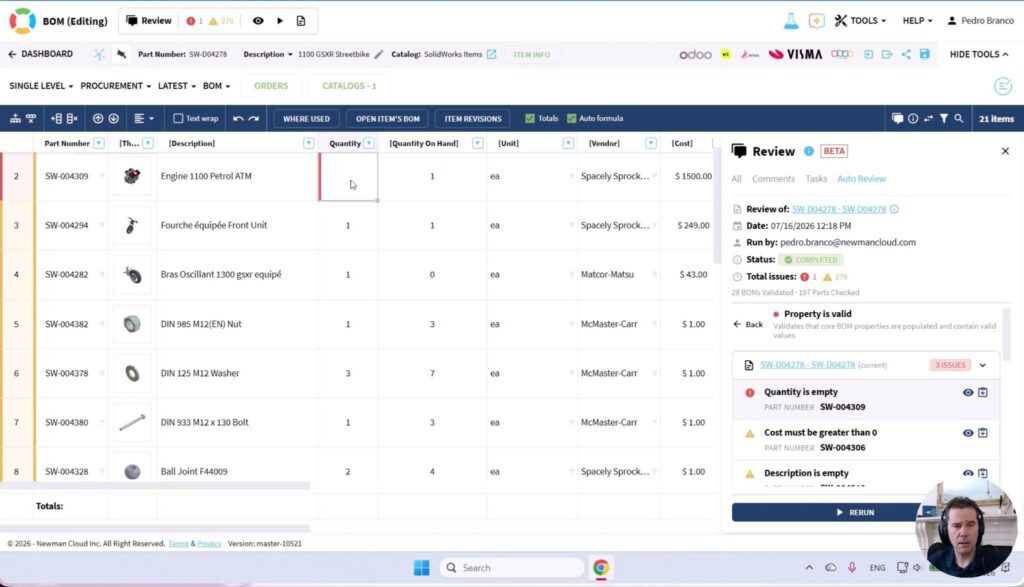
BOM Review is becoming a collaborative process where OpenBOM allows automatically to create comments, link to the task and assign it to a specific person.
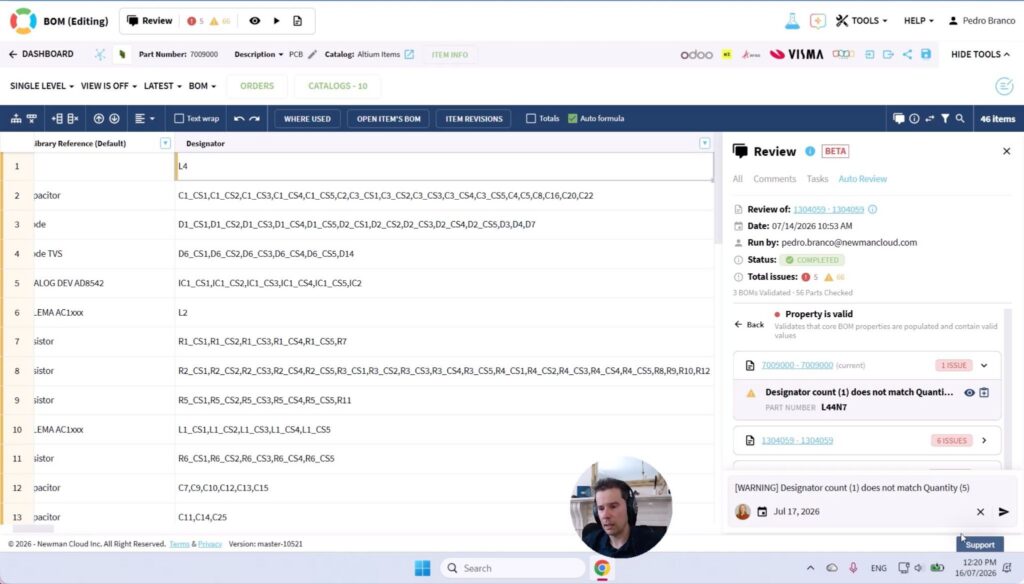
The outcome is a task management system connected to the review process.

Every Review Becomes Part of Product Memory
BOM Review is part of OpenBOM Product Memory Platform vision. This is where BOM Review connects back to the bigger picture. Product knowledge is not limited to data fields and documents. It includes what was reviewed, which issues were found, who participated, what decisions were made, what tasks were assigned, and why the product data and structure changed.
Traditional PLM systems record outcomes: the approval, the revision, the released state. What they lose is the reasoning. BOM Review captures both. Every review session adds to a persistent record that can support future engineering work, supplier collaboration, compliance, service, and, increasingly, AI-assisted workflows that need organizational context to be useful.
Watch the First BOM Review Demo
The first demo shows BOM Review the way it is meant to be used: as a team activity. Two people open a product data structure and run the validation checks. The checks find errors. One reviewer assigns a task to a colleague to fix an issue, the fix is made, the checks run again, and the team releases the BOM with no errors.
Watch the demo here:
Available Today, and We Are Looking for Design Partners
BOM Review is available immediately to every OpenBOM customer. Future enhancements are already in development.
We are also looking for design partners to work with us on AI and other BOM review capabilities, especially validation cards customized to a specific company’s knowledge and checks. If your organization has BOM validation rules that live in someone’s head, a spreadsheet, or a tribal-knowledge document, I would like to talk to you about turning them into programmable, AI-assisted checks. Reach out to us at OpenBOM to get started.
BOM Review is an important step in OpenBOM’s evolution from a collaborative BOM and product lifecycle platform toward a Product Memory Platform, one that captures not only product information but the history, decisions, and organizational knowledge connected to it.
This is only the beginning.
Contact us to discuss and REGISTER FOR FREE to check how OpenBOM can help.
Best, Oleg
Frequently Asked Questions
What is OpenBOM BOM Review?
OpenBOM BOM Review is a collaborative BOM validation experience that allows engineering and manufacturing teams to check product data and structures using expandable validation check cards, discuss issues with comments, assign tasks, and release error-free BOMs while capturing the review history as part of Product Memory.
What do BOM validation check cards do?
Each check card performs a specific validation against the BOM. The initial out-of-the-box cards include Part Number validation (checking part numbers against your configured pattern), Property validation (finding empty or missing properties), Quantity validation (verifying quantities match reference designators), and Structure validation (detecting loops and circular references).
Who can use BOM Review?
BOM Review is available immediately to every OpenBOM customer at no additional cost. You can try it by registering for a free OpenBOM account.
Can BOM validation checks be customized?
Yes, the check card framework is designed to be extended and programmed using OpenBOM tools and APIs. OpenBOM is currently looking for design partners to develop AI-enabled validation cards customized to company-specific knowledge and validation rules.
How does BOM Review support Product Memory?
BOM Review captures what was reviewed, which issues were found, who participated, what decisions were made, and why the product data and structure changed. This information becomes part of a persistent Product Memory that supports future engineering work, compliance, supplier collaboration, and AI-assisted workflows.
What is the Product Memory Flywheel?
The Product Memory Flywheel connects three activities: Capture (bringing product information into OpenBOM from CAD, Excel, and other sources), Review (collaboratively validating and improving product data structures), and Flow (delivering validated information to ERP, MES, procurement, and back to CAD).
Join our newsletter to receive a weekly portion of news, articles, and tips about OpenBOM and our community.