Every once in a while, something shifts in the way engineering teams collaborate. Sometimes it’s a new tool, a new integration, or a new way to structure data. And sometimes, it’s a set of capabilities that changes the daily experience of engineers, buyers, manufacturing planners, and anyone who touches a Bill of Materials.
This article is a small heads-up—because something important is about to land in OpenBOM, and it’s going to reshape how teams review, discuss, and act on product information.
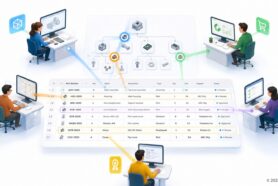
For years, engineering and manufacturing conversations have orbited around BOMs, yet the BOM itself was never the place where those conversations happened. Instead, discussions and reviews are scattered into email threads, Slack messages, meeting notes, spreadsheets with comments, PDF markups, and “someone please remember to do this” tasks that nobody actually tracks. And while everyone understands the importance of BOM quality, the tools supporting that process often remained disconnected and painfully manual.
Today, that changes.
OpenBOM is introducing a new suite of collaborative review capabilities—color coding, comments, tasks, and a new activity dashboard—that finally bring conversations and follow-ups into the product structure itself.
Let’s explore what’s coming and why it matters.
The Challenge Today: Review Chaos and Disconnected Conversations
If you have participated in any kind of BOM review, you already know the chaos. Once the design reaches a certain stage, someone exports a spreadsheet, sends it around, multiple versions start floating, people comment in their own copies, operations teams add notes, purchasing highlights sourcing concerns, engineering revises items, manufacturing spots inconsistencies—yet none of this feedback lives where the data lives.
Even when companies have PDM or PLM systems, review processes often feel separate from the data itself. These systems are great at storing files or managing revisions, but they’re not usually optimized for collaborative decision-making inside the BOM. The result is slow review cycles, confusion about the latest feedback, tasks scattered across multiple systems, and misalignment between engineering and operations.
As product complexity grows, this problem becomes even more painful. Everyone is talking, but the conversation is not connected to the data. Everyone wants clarity, but the signal gets lost in noise. And everyone wants accountability, but tasks dissolve into the cracks between spreadsheets and emails.
Modern engineering teams deserve better—real-time, contextual collaboration tied directly to the BOM.
OpenBOM’s Vision: Where Data, Decisions, and Conversations Meet
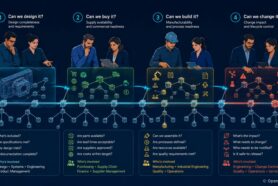
OpenBOM has always been about more than replacing spreadsheets or creating a digital list of parts. From the very beginning, the vision was to enable a connected digital thread—one where data flows transparently across engineering, manufacturing, supply chain, and operations.
Over the past few years, OpenBOM’s flexible data model, xBOM architecture, and collaborative multi-tenant platform have been steadily building toward this future. The next step is enabling richer interaction with the data: review, discussion, decisions, and action items—all happening in context and captured as part of the digital history.
With this new release, OpenBOM is adding capabilities that allow engineers and teams to review BOMs, exchange comments, track tasks, and monitor activity directly inside the product structure. It’s a move toward agent-assisted workflows, toward intelligent review processes, and toward a more human-friendly product memory system.
Let’s look at the new features one by one.
Color Coding in the OpenBOM Grid: Visual Signals for Smarter Decisions
If you’ve ever used conditional formatting in Excel or color-coded a task board, you already understand the power of visual cues. Colors help you instantly see what needs attention, what looks good, and what requires a second look. When you’re dealing with complex BOMs—often hundreds or thousands of items—those visual cues can be the difference between catching an issue early and missing it completely.
OpenBOM is introducing flexible color support in the grid, allowing teams to use color indicators for things like missing vendors, cost variances, sourcing risks, incomplete metadata, revision mismatches, alternates, substitutes, or anything else your workflow requires. Instead of scanning a long list line by line, your eyes immediately land on what matters.
Color coding turns the BOM into a dashboard—a living visualization of product readiness and potential red flags.
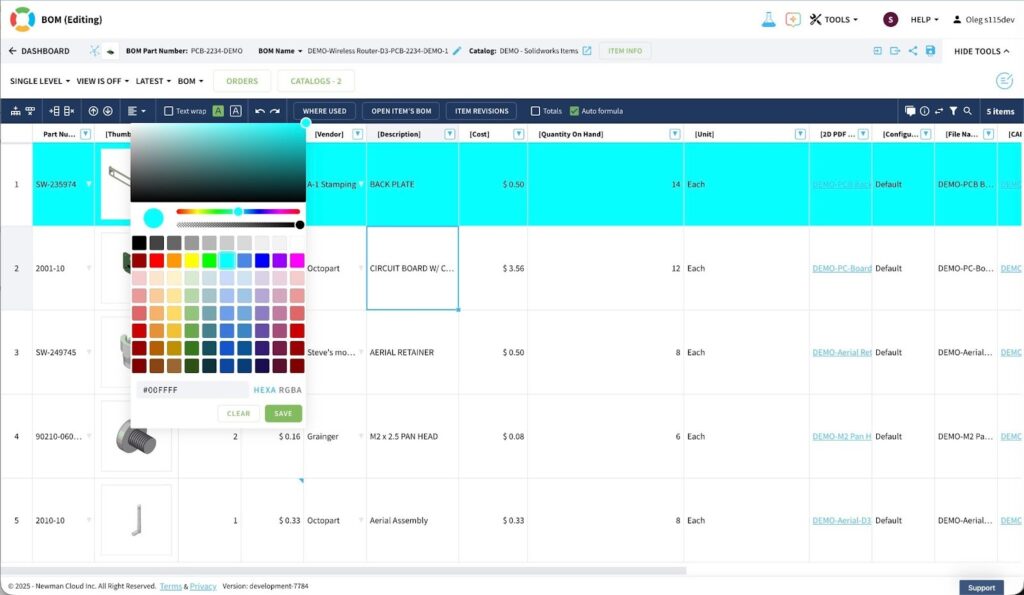
With color-coded cells, reviews become faster, more intuitive, and more accurate. And because the logic behind colors is part of the data model, teams can standardize review workflows across projects and organizations.
Comments: Bringing Conversations into the BOM
Engineering teams talk constantly—but until now, they were forced to talk around the BOM rather than inside it.
OpenBOM comments change that.
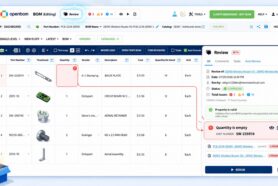
You can now comment directly on an item, a property, or a specific BOM line, creating contextual conversations tied to exactly the data you’re discussing. These comments are threaded, which means you can have back-and-forth discussions, ask questions, provide clarifications, and mark issues as resolved—all without leaving OpenBOM.
Comments become part of the product memory. Instead of guessing why a change happened or where a concern originated, the history is right there, connected to the data. Notifications ensure people know when they’re needed, and tagging makes it easy to involve the right teammates.
No more “Did you see my email?”
No more “Which version were you looking at?”
No more “I don’t know why this was changed.”
It’s all in one place, exactly where it belongs.
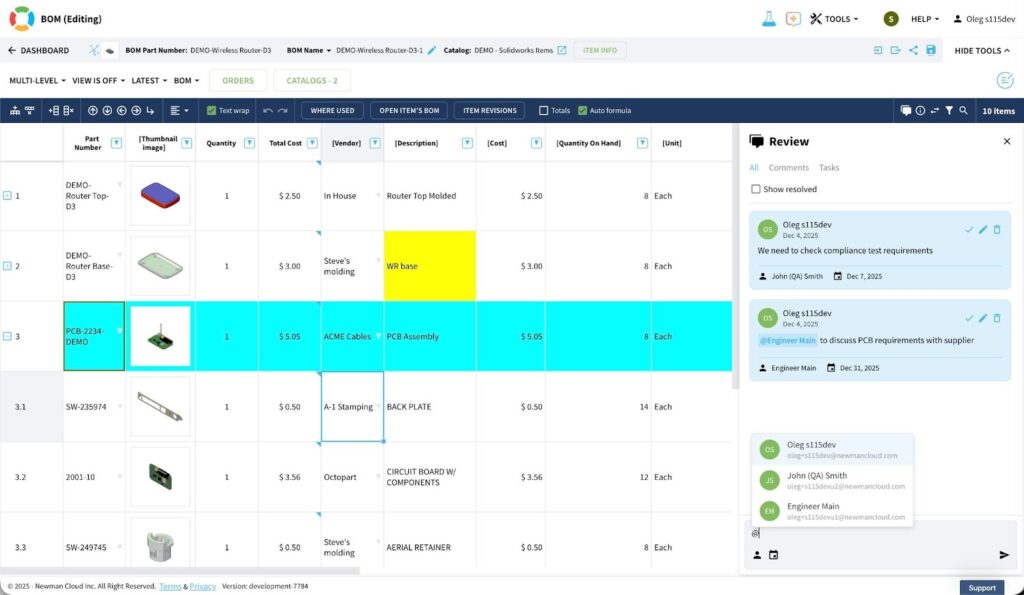
This small addition has a big impact: reviews become richer, misunderstandings decrease, and teams communicate with more clarity and less friction.
Tasks: Lightweight, Embedded Work and Task Management for Engineers
Tasks are the natural outcome of any review. Someone needs to fix a property, update a vendor, validate a quantity, revise a design, or clarify a sourcing issue. Traditionally, these tasks live outside the BOM—spreadsheets, email threads, project management tools, sticky notes on someone’s monitor.
OpenBOM now embeds tasks directly into the review process.
Tasks can be created manually, or they can originate from comments or specific item changes. Each task has an owner, a due date, and a status. Everything stays within the context of the BOM, which means the workflow for engineering is natural and intuitive. If you see a problem, you create a task. If you’re assigned a task, you see exactly which item or property needs attention.
This is not a generic project management tool bolted onto a BOM. It is a purpose-built engineering task layer that lives where the engineering decisions are made. It keeps teams aligned, allows managers to track progress, and ensures nothing falls through the cracks.
Tasks become the connective tissue between discussion and action—something engineering teams have needed for a long time.
The New Activity Dashboard: Your Engineering Radar
To bring everything together, OpenBOM is introducing an Activity Dashboard—a central workspace where you can see what’s happening across your BOMs and projects. The dashboard surfaces open tasks, recent comments, review activities, assignments, and anything that requires follow-up.
Think of it as your engineering radar. Instead of digging through emails, spreadsheets, or multiple interfaces, the dashboard gives you a unified view of the activity happening across your digital thread.
This matters for small companies where a handful of engineers juggle multiple responsibilities, and it matters even more for larger organizations with distributed teams and parallel product streams. The dashboard closes the gap between engineering work and engineering visibility.
It’s also the foundation for something bigger: a future where OpenBOM’s intelligent agents can assist reviews, suggest follow-ups, detect anomalies, and help orchestrate decisions.
Why This Matters: Engineering Work Finally Happens Where Data Lives
When reviews, comments, tasks, and decisions live outside the BOM, every workflow becomes slower and more error-prone. Teams spend too much time coordinating and not enough time creating. Issues slip through. Purchasing gets incomplete information. Manufacturing sends parts back for corrections. Engineering discovers late-stage mismatches nobody caught earlier.
By bringing review activity into the BOM itself, OpenBOM eliminates these disconnects.
Instead of exporting → sharing → commenting → updating → resending → reconciling → hoping nothing was missed, the entire process becomes a unified flow. Review activity becomes part of the product’s digital thread, traceable and auditable. Decisions get captured. Tasks are actionable. Conversations are connected to context.
This shift prepares organizations for the next stage: AI assistance.
AI doesn’t work without context. It cannot infer meaning from scattered spreadsheets and email threads. By centralizing the review process, OpenBOM lays the foundation for intelligent workflows—where agents help identify issues, track dependencies, and automate repetitive tasks.
A Glimpse into the Future: Agents, Automation, and Product Memory
This release is not just a set of features. It’s a step toward a much broader transformation of engineering workflows.
Imagine BOM reviews where an intelligent agent highlights inconsistencies, suggests corrective actions, recommends alternates, or auto-generates tasks when anomalies are detected. Picture a system that can trace decision history across revisions, understand why changes were made, or surface risk patterns across projects.
OpenBOM is building a product memory system—a knowledge layer that grows with your engineering activities. Comments, tasks, discussions, and decisions all become part of this memory. Agents can reason over it, assist teams, and create new value from the connections.
The new review capabilities are the foundation that makes this future possible.
Conclusion: Your Heads-Up—A New Review Era Begins
The introduction of color coding, comments, tasks, and the Activity Dashboard marks an important milestone in OpenBOM’s journey. Collaboration is no longer something that happens outside the BOM. It becomes part of the data, part of the decision-making, and part of the digital thread.
Engineering work can finally happen where the engineering data lives.
These capabilities will roll out soon, and we invite you to explore them, test them, and share your feedback. The more conversations we have with our users, the better OpenBOM becomes—and the more value we can unlock as we move toward agent-assisted engineering workflows.
Stay tuned for more updates. The next chapter of collaborative BOM management is just beginning.
Join our newsletter to receive a weekly portion of news, articles, and tips about OpenBOM and our community.