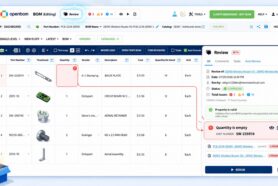
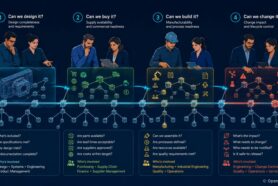
OpenBOM was developed over the last few years into an advanced online platform that can help you solve many business problems related to product lifecycle management, help manage CAD files and data, control and manages product structure and its revisions, manage Bill of Materials, collaborate and share data instantly.
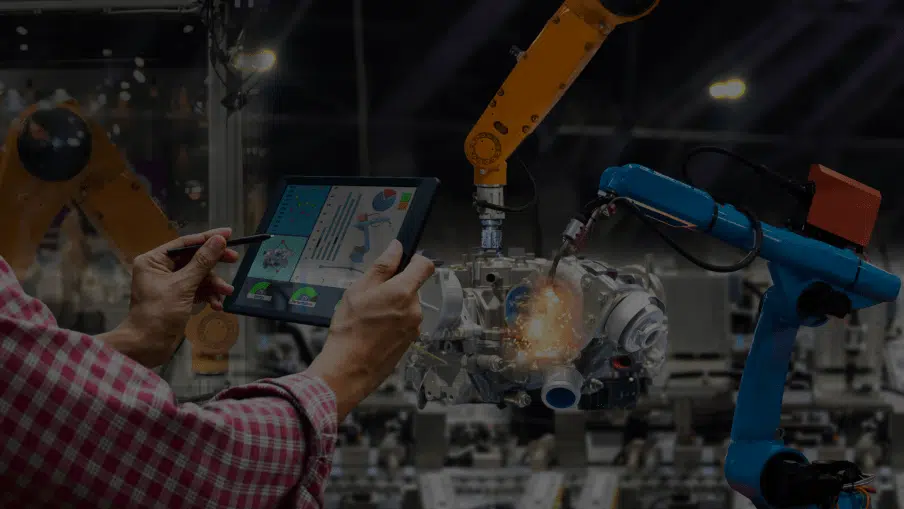
Problem – Product Development and Data Chaos
Ultimately, the goal of OpenBOM is to solve the problem of data chaos in product development and to help companies to make more intelligent decisions through data analysis and data sharing. A typical modern manufacturing company or engineering team is suffering from data management inefficiency – multiple users, and teams, working in different places, often for multiple organizations, managing product data, and exchanging information.

As you can see in the picture above, the data challenge is real. To solve it using a traditional data management approach is impossible because all traditional PDM, PLM, and ERP systems are focusing on creating a single data silo and are unfit to provide a solution that connects people and organizations together.
Global OpenBOM Platform
We developed the OpenBOM platform using a modern technological data stack, which is a golden standard for global web platforms and applications. It allows us to provide a global data management platform that can scale, with excellent unit economics, which makes it a great foundation to scale for many small and medium-sized companies as well as enterprises. It can be available on the public AWS cloud as a multi-tenant platform, but can also be hosted as BOM services for an enterprise developing application and looking for services integrated with the SaaS or PaaS platform.

Check the following top three characteristics of OpenBOM that make it different from all existing PLM platforms.
Architecture and Technological Differentiators
OpenBOM combines a unique set of technologies and system differentiators making the platform uniquely positioned to serve a large number of small and medium-sized enterprises as well as provide services to large enterprises scale solutions on top of modern cloud platforms such as AWS, Azure, and GCP.

Differentiator 1: Multi-Tenant Data Model
A core foundation of the OpenBOM platform is not a multi-tenant data model, which allows for organizing and management of granular sets of data logically distributed between separate users, teams, and companies, but at the same time, to have an ability to connect them together and to support sharing them in real-time. It is possible to get a full multi-disciplinary BOM of a car shared between multiple contractors and suppliers. Each one has an access to its own data set, but is logically connected together and accessible to a car company as a single whole.
Differentiator 2: Global Scale Polyglot Persistence Data Architecture
While practically all PLM systems were built on SQL-based relational databases, OpenBOM uses polyglot persistence data architecture and uses multiple databases for its data foundation including graph database, NoSQL document database, and search databases. A combination of databases provides a highly scalable data management foundation with flexible data model capabilities.
Differentiator 3: Real-time collaboration and simultaneous multi-user editing
We live in the era of collaboration. Since the beginning of Web 2.0 tools, online web tools and applications have created a collaborative user experience that is well known and adopted by everyone. Tools like Office 365 or Google Apps are great examples, but there are many others. OpenBOM brings the level of collaboration to structured BOM editing. Every piece of information in OpenBOM (catalog, bill of materials, order, etc) can be shared and edited in real-time. If you’re allowed read-only access the data will be updated in real-time.
Conclusion
OpenBOM is a new type of cloud-native product development and collaboration platform including functions of PDM, PLM, and ERP systems, globally distributed and connecting engineers, product development teams, and manufacturing companies located in different geographical zones, working with teams located in different companies, allowing you to collaborate in real-time. OpenBOM provides a unique set of differentiators, it is affordable and available for everyone.
REGISTER FOR FREE and start a 14-days trial to check out how OpenBOM can help you today.
Best, Oleg
Join our newsletter to receive a weekly portion of news, articles, and tips about OpenBOM and our community.