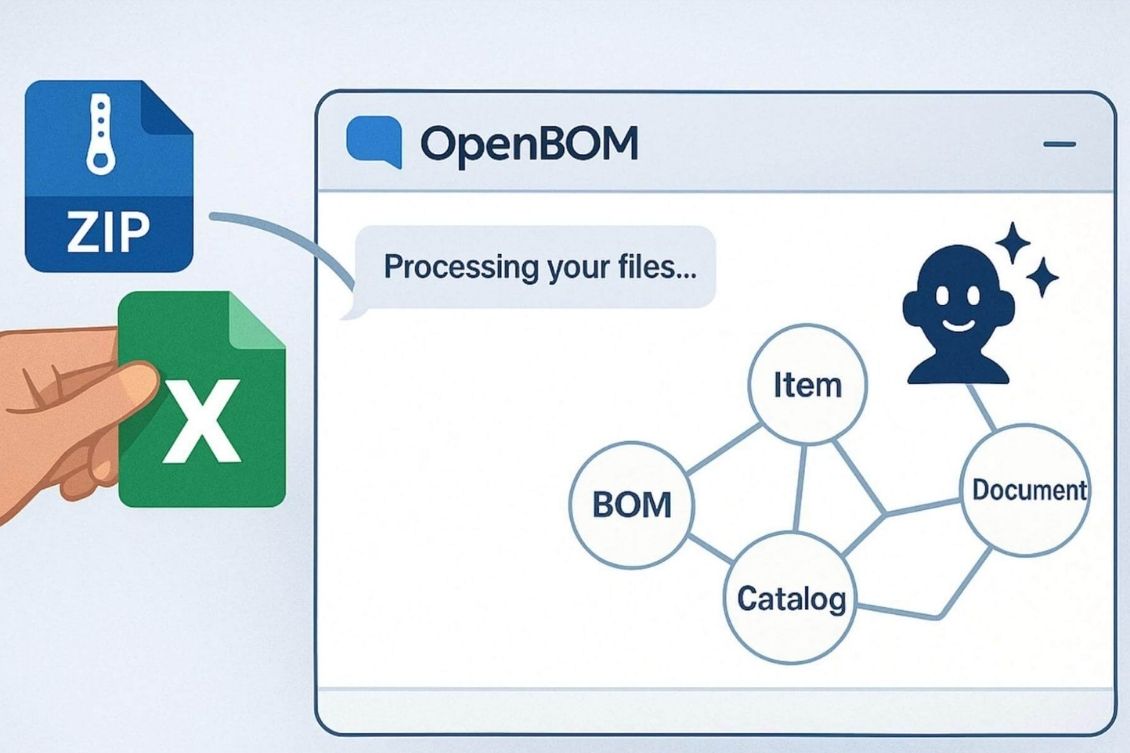
At OpenBOM, we’ve always believed that managing product data should be smarter, easier, and more connected, not just for engineering teams but across the entire product lifecycle. We’ve built a cloud-native platform designed not only to organize BOMs but to represent a complete picture of your product – items, structures, documents, costs, revisions, and more – in a way that’s flexible, shareable, and ready for automation.
In my article today, I’m excited to share more information that brings us even closer to that vision: seamless import via chat user interface, a key step toward the OpenBOM AI Agent experience coming later this year.
The Power of a Connected Data Platform
Before we dive into what’s new, let’s talk about the foundation. The OpenBOM platform isn’t just another SQL database or a spreadsheet on steroids – it’s a real-time, multi-tenant environment built to manage product knowledge as a dynamic, evolving OpenBOM Manufacturing Graph.
This means you’re working with a rich set of relationships: from items to BOMs, from suppliers to costs, from configurations to revisions, inventory, and purchasing, everything is interconnected. It’s all built on a modern and standard data foundation – Neo4j graph database and NoSQL database (e.g. Mongo DB, Elastic DB) technologies that allow us to model, query, and extend product data in ways traditional systems can’t (hint – check Graph Data Science Library for ideas)
So, when you drop in a BOM or create a catalog, OpenBOM doesn’t just store it – it translates that data into a broader digital thread. That’s what makes it possible to automate workflows, connect to ERP, and soon, to interact intelligently through AI.
Drag, Drop, Done: Seamless Import via Chat
Bringing data into a system is often one of the hardest — and most frustrating — parts of onboarding. We wanted to change that entirely. That’s why we created the new Seamless Import via Chat experience.
Now, all you need to do is drop an Excel or ZIP file directly into the OpenBOM chat window. That’s it. No field mapping, no setup screens, no need for training.
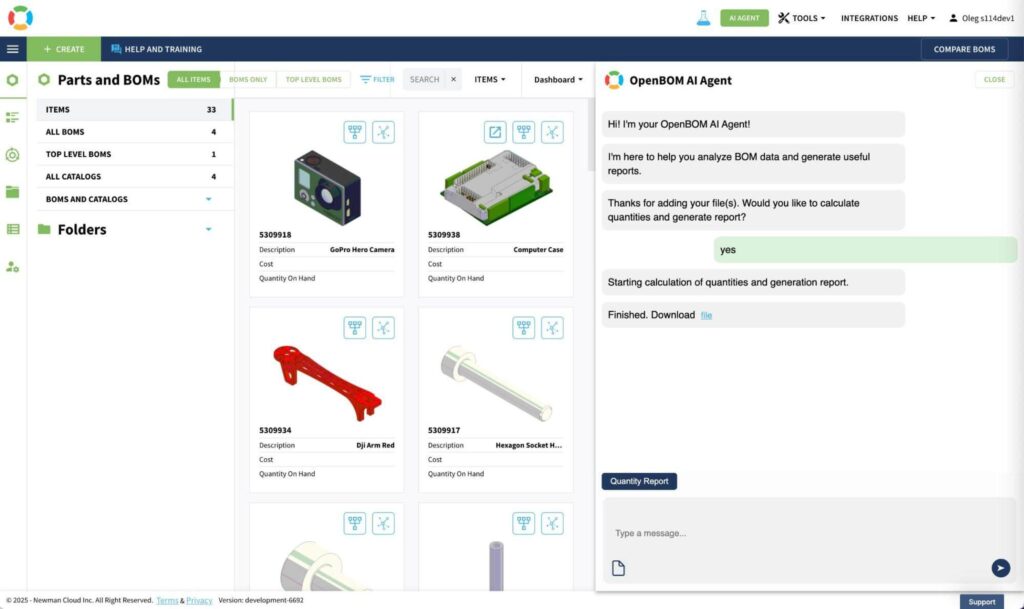
The system will recognize what’s inside — whether it’s a multi-level BOM, a list of items, supplier data, or even attachments like spec sheets and drawings. It organizes everything in your OpenBOM workspace, links it all together, and lets you know when it’s ready to go.
And yes — you can also do this programmatically using the OpenBOM API, which makes it easy to plug into existing systems or workflows.
This works beautifully with ZIP archives that contain multiple spreadsheets and attachments. Drop the ZIP into chat, and OpenBOM will unpack it, process the contents, link the files to the right items, and structure everything into your data model. All automatically.
This Is More Than an Import Feature
While it may look like just a cleaner, easier import, there’s much more going on here. This is actually the first step in bringing our OpenBOM AI Agent to life.
Seamless Import is powered by the same architecture that will soon support natural-language commands, task automation, and smart recommendations. The idea is simple: what if your product data system didn’t just store information, but understood what you were trying to do — and helped you do it?
In the coming months, you’ll be able to interact with the OpenBOM Agent to do things like:
“Compare this BOM to the last revision.”
“Prepare an RFQ package for this item.”
“Validate sourcing rules before release.”
And it will all happen in the same chat interface where you’re importing files today. As we mentioned in our previous announcement, that agent will “speak files” to organize a complete engineering workflow.
Watch It in Action
If you’re curious how it works, we’ve put together a quick demo showing a ZIP file with BOM spreadsheets and attachments dropped into chat — and how OpenBOM instantly builds the connected data structure behind it.
📽️Watch the video
It’s a small moment that shows a big shift – from file-based thinking to intelligent, contextual product data.
Conclusion
The way companies manage product data is changing. It’s no longer just about storing information — it’s about creating systems that understand relationships, support automation, and adapt to how teams actually work.
The OpenBOM platform is evolving into exactly that: a connected, intelligent space where product data flows naturally between people, systems, and tasks. With Seamless Import via Chat now available, and the OpenBOM AI Agent on the horizon, we’re making it easier than ever to bring your data into that space — and do more with it.
If you’ve been waiting for a better way to manage BOMs, catalogs, suppliers, and documentation — one that feels less like work and more like progress — this is your invitation to explore what’s possible.
Drop in your files. Let OpenBOM handle the rest. Want to try it? Please contact us today.
REGISTER FOR FREE instantly and check OpenBOM during the 2-week trial period.
Best, Oleg
Join our newsletter to receive a weekly portion of news, articles, and tips about OpenBOM and our community.