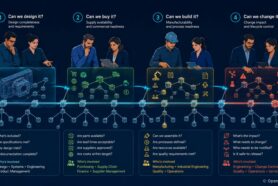
For a long time, APIs in PLM systems lived in an awkward place. They existed, protected by software vendors to make data extraction difficult and to support vendor data lock-in business strategies. As a result, these APIs sometimes worked, but often were not documented well and required significant efforts by service integrators with special knowledge to make them work and to figure things out. APIs were rarely treated as a first-class product surface. The real product was the user experience. APIs were something “technical teams” dealt with on the side used for implementation, customization and other special processes.
In 2025, that assumption no longer holds.
Today, APIs are not just integration tools. They are how platforms grow, how ecosystems form, and increasingly, how software is built. And with the rise of AI-assisted and agent-based development, APIs are no longer used only by humans. They are consumed by machines that design workflows, generate interfaces, and assemble solutions automatically.
This shift is one of the reasons why OpenBOM is enhancing its developer support by publishing OpenBOM Public REST API documentation in Swagger / OpenAPI format. While this may look like a documentation update on the surface, it is really a strategic move that reflects how we see the future of PLM platforms, integrations, and AI-driven customization unfolding.
APIs Have Become the Real Product Surface
In traditional PLM thinking, value was concentrated in predefined workflows, screens, and lifecycle processes. Customization meant configuration, scripting, or consulting projects. APIs existed to “connect” systems, but they were not how most people experienced the platform.
That model is breaking down.
Modern manufacturing organizations rely on a growing network of tools: CAD systems, ERP, procurement platforms, analytics tools, supplier portals, internal dashboards, and increasingly, AI-driven assistants. No single UI can cover all of these needs. What matters instead is whether the platform can reliably expose its data and behavior so that others can build what they need around it.
In this world, the API is the product surface. It defines what can be built, how safely it can be built, and how far the platform can extend beyond its original use cases. A strong API enables experimentation, iteration, and adaptation. A weak or ambiguous API quietly limits everything else.
This shift alone would already justify investing in better API documentation. But something else has changed as well.
AI Has Changed How Software Is Built
AI has not just made developers faster. It has started to change the structure of software creation itself.
AI copilots can generate code snippets. Integration tools can scaffold entire connectors. Agent-based systems can observe goals, inspect available APIs, and assemble workflows without being explicitly programmed step by step. In many cases, these systems are not just assisting developers — they are becoming builders in their own right.
However, AI agents do not work the way humans do.
They do not read blog posts. They do not infer behavior from partial examples. They cannot guess undocumented parameters or rely on tribal knowledge. What they need is a clear, explicit, machine-readable contract that describes what an API does, how it behaves, and how it should be used safely.
This is where traditional, human-oriented documentation starts to fail. A PDF or wiki page may be enough for an experienced engineer, but it is invisible to automated tools. Without a formal API definition, AI-generated integrations become brittle, unreliable, or impossible.
As AI-assisted development becomes more common, the quality and structure of API definitions move from “nice to have” to “non-negotiable.”
Why OpenAPI / Swagger Is a Strategic Move for OpenBOM
This is the context in which OpenBOM is introducing official API documentation in Swagger / OpenAPI format.
At a practical level, OpenAPI provides a structured, authoritative description of the OpenBOM REST API. It defines endpoints, parameters, request and response models, and expected behavior in a single, consistent format. Developers can explore the API interactively, test calls directly, and understand exactly what the platform supports without guesswork.
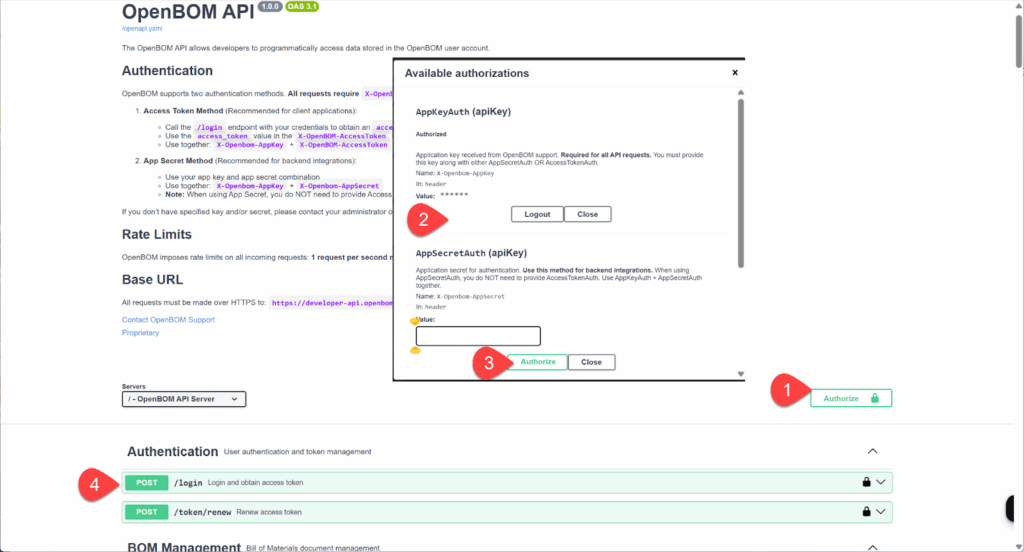
But the real significance goes beyond convenience.
OpenAPI acts as a formal contract between the OpenBOM platform and the software built around it. It turns the API from an informal interface into a clearly defined surface that both humans and machines can reason about. For developers, this reduces onboarding time and increases confidence. For AI tools, it provides the foundation required to generate integrations, interfaces, and workflows automatically.
In other words, Swagger documentation does not just explain the OpenBOM API. It makes the API usable by intelligent systems.
This distinction is critical. AI agents that build dashboards, connect systems, or automate processes rely on precise definitions. They need to know what data is available, how to access it, and what side effects to expect. OpenAPI provides exactly that — a machine-readable map of the platform’s capabilities.
From this perspective, OpenAPI is not an auxiliary feature. It is an enabling layer that allows OpenBOM to function as a composable platform in an AI-driven software ecosystem.
Better Experience for Humans and Machines
One of the strengths of the OpenAPI approach is that it improves the experience for everyone involved.
For human developers, the benefits are immediate. Interactive exploration replaces trial and error. Clear parameter definitions reduce support questions. A single source of truth eliminates confusion caused by outdated examples or incomplete notes. Building integrations becomes faster, safer, and more predictable.

For AI agents, the benefits are even more fundamental. With OpenAPI documentation in place, AI tools can inspect the OpenBOM API directly. They can reason about available operations, generate interface layers dynamically, validate data flows, and assemble task-specific applications on demand. This opens the door to scenarios where custom PLM views, lightweight tools, or integration logic are generated automatically based on context and intent rather than manually coded in advance.
This is not about replacing developers. It is about expanding what is possible — enabling faster experimentation, lower barriers to customization, and new ways of interacting with product data that were previously impractical.
A Real-World Signal: A Product Manager Can Use It
One of the most telling aspects of this release is not technical at all.
To demonstrate the new API documentation, we prepared a short video walkthrough — not with a backend engineer, but with Steve Hess, OpenBOM’s VP of Product. Steve is intentionally not a professional developer. His role is to think about product behavior, user value, and platform direction.
Yet with Swagger documentation in place, he can explore the API, understand its structure, and explain how it can be used without relying on internal tribal knowledge or engineering support. This is exactly the point. Good APIs — and good API documentation — are not just for specialists. They make the platform more transparent and approachable for anyone involved in building solutions.
Watch an example of OpenAPI usage by Steve Hess, our VP of Product.
Conclusion and Where OpenBOM Is Heading
Publishing OpenAPI documentation is not an isolated update. It is part of a broader shift in how we think about OpenBOM as a platform.
As more customers, partners, and solution builders rely on OpenBOM through integrations, automations, and AI-driven tools, it becomes essential to support these use cases deliberately. That includes not only APIs and documentation, but also tooling, environments, and subscription models that recognize development and extension as first-class usage patterns.
Over time, you will see OpenBOM place even more emphasis on enabling developers — human and AI — to build on the platform confidently. The goal is not simply to expose more endpoints, but to make OpenBOM a predictable, reliable foundation for long-term solution building, whether those solutions are handcrafted integrations or dynamically generated by intelligent agents.
In a world where software increasingly builds software, clarity matters. OpenAPI is one of the building blocks that makes this future practical rather than theoretical.
This release is a first step in that direction. More will come in 2026. Stay tuned.
Meantime REGISTER FOR FREE to check OpenBOM. Contact us about API licenses that will become available in 2026.
Best, Oleg
Join our newsletter to receive a weekly portion of news, articles, and tips about OpenBOM and our community.