“Can we build 10 units by December 15?”
It is a simple question. Answering it usually requires several people, several systems, and a spreadsheet someone creates specifically for the meeting.
Engineering has the design. Procurement has supplier information. Someone knows what is in stock. A contractor is waiting for a drawing. An assembly changed last week, but it is unclear whether the purchasing list reflects that change.
Each person brings a piece of the answer. The difficult work is connecting those pieces and deciding which information can be trusted.
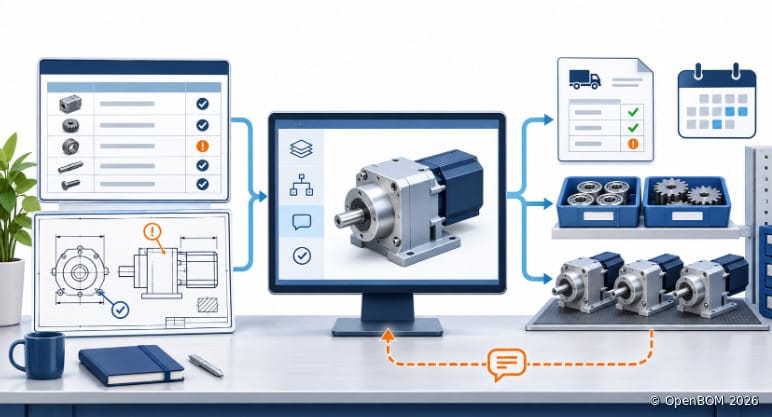
At OpenBOM, we are exploring how BOM review can support build readiness: understanding whether the product information, materials, and supporting evidence are sufficient for a specific build. BOM Review helps teams establish confidence in the product definition. Launch Master is the working name for an initiative connecting that definition to a production objective. Product Memory retains the information, evidence, and decisions generated along the way.
Together, they point toward a working environment that can help a team move from “here is our BOM” to “here is what we can build, what stands in the way, and what needs to happen next.”
A BOM Can Be Correct While the Build Is Still Blocked
A bill of materials is fundamental to manufacturing. It describes the components and quantities needed to make a product. But a complete product structure does not, by itself, establish whether a company can deliver an order.
A purchased component might have a long lead time. A make part might be missing the drawing a supplier needs. Inventory might be available today but committed to another order. A replacement component might exist without an approved decision to use it.
These situations connect engineering information with operational reality.
In this article, build readiness means assessing whether a defined product revision can be built in a specified quantity by a target date, using available evidence about materials, documentation, suppliers, and unresolved decisions. Material availability is one part of that assessment; capacity, reservations, and competing demand also matter where they are included in scope.
That connection changes what it means to review a BOM. The question expands from “Are the required fields populated?” to “Is this information sufficient for the decision we need to make?”
The answer depends on the objective. A prototype review, a supplier handoff, and a production commitment require different evidence. The same missing property might be acceptable during early design and become a blocker before purchasing begins.
BOM Review Builds Confidence in the Product Definition
OpenBOM BOM Review provides a collaborative place to check product structures, investigate findings, discuss issues, and coordinate corrections in the context of the product data.
As described in the anatomy of a BOM Review Agent, its check card approach provides a practical starting point. Checks can address required properties, part numbering, circular references, and quantity consistency. Findings lead people back to the information that needs attention.
The collaboration around a finding matters as much as discovering it. Someone explains why a quantity is unusual. A colleague identifies a missing document. A reviewer decides that an exception is acceptable for a prototype. A task gives a correction an owner.
These activities generate knowledge about the product. When that knowledge remains connected to the relevant items, structures, and revisions, it becomes useful beyond the immediate review.
This is the connection to Product Memory: retaining what was reviewed, what people decided, and why the information changed. A product context graph connects that knowledge to the relevant product information.
Launch Master Starts With a Commitment
The following scenario illustrates the direction we are exploring. It brings existing BOM Review concepts together with proposed Launch Master workflows and shared review capabilities.
Launch Master approaches build readiness from the perspective of a specific commitment.
Instead of beginning with an open-ended review of the definition, it starts with an objective: build a particular quantity of a product by a particular date.
Our initial Launch Master direction brings together product structure, available inventory, supplier information, and lead times to assess feasibility and identify gaps. The broader development opportunity is to connect that assessment directly with the review work needed to resolve those gaps.
Consider an illustrative scenario. A team wants to build 10 units of an assembly. The available information supports six units. Building the remaining four depends on replenishing two purchased components. A make part also requires a drawing review before the contractor can begin.
An effective assessment should explain those dependencies. It should distinguish an estimated arrival based on lead time from a date confirmed by a supplier. It should identify missing information and show which assumptions affect the conclusion.
The result becomes a working explanation of the commitment, with evidence the team can inspect and actions it can take.
What Engineering Can Learn From OpenRouter
In his article “Is PLM About to Become Engineering’s OpenRouter?”, Paul Empringham raised an interesting question about coordinating specialist tools around engineering objectives.
OpenRouter’s common access to AI models offers a useful analogy. Engineering teams will increasingly have access to specialist capabilities for validation, costing, sourcing, drawing analysis, and other work. Coordinating those capabilities around a user’s objective becomes an important part of the experience.
For OpenBOM, I see a practical application of that idea in the next stages of BOM Review and Launch Master development.
A user could ask, “Review this assembly for a 10-unit build next month.” The environment would establish the relevant product baseline, identify the information available, and propose the checks needed for that objective.
Some checks would use deterministic calculations. Others could use AI analysis, customer-defined rules, or external services. Selection would depend on applicability, available inputs, permissions, and execution conditions.
The user would be able to understand the proposed plan and inspect the results. Model and tool choice would support the engineering work, with the product context remaining central.
Connecting BOM Validation With Build Readiness
I believe BOM Review and Launch Master should share a common framework for checks and findings.
A missing supplier lead time illustrates why. BOM Review might find it during a sourcing readiness review. Launch Master might discover the same gap while estimating replenishment for a shortage. Both workflows need access to the same underlying information and corrective work.
| Shared capability | BOM Review perspective | Launch Master perspective |
|---|---|---|
| Structure and quantity checks | Is the product structure consistent? | Can component demand be calculated reliably? |
| Required information checks | Is the definition ready for handoff? | What missing information prevents a feasibility assessment? |
| Supplier and lead time checks | Is sourcing information sufficiently complete? | Can shortages be replenished in time? |
| File and drawing checks | Are the required documents available? | Can the contractor begin the work? |
| Revision comparison | What changed since the previous review? | Does the change affect this production commitment? |
This is a development direction. A shared framework would let the two experiences reuse checks while preserving the scope and purpose of each assessment.
How Review Decisions Become Product Memory
Imagine that a team accepts a documentation exception for an internal prototype. Months later, the product enters production planning.
The earlier decision is valuable, but its conditions matter. Product Memory should help the team recognize that the exception applied to prototype use and still requires assessment for production.
Similarly, correcting a finding should remove it from the current list of problems while preserving the history needed to explain the correction. The record should connect the input revision, check performed, evidence, decision, responsible person, and verification.
For Launch Master, the same principle extends to commitments. An assessment needs to retain the inventory snapshot, supplier information, assumptions, and product baseline on which it depended.
When those inputs change, the team needs a new assessment and an explanation of the difference. A supplier delay or engineering change can then be evaluated against the commitments it affects.
That is how Product Memory becomes part of daily work: people resolve real questions, and the relevant context is retained as they do it.
A Practical Next Step
The next step I would prioritize is a focused connection between review and build feasibility.
A team selects a product revision, enters a quantity and target date, and runs the relevant checks. The assessment presents the supported build quantity, blockers, missing information, and assumptions. People investigate findings, assign corrective work, and record decisions. A subsequent run explains what changed.
The scope of the calculation must remain visible. If competing orders, inventory reservations, or production capacity are outside the assessment, those limitations need to accompany the result. A material availability assessment is only one part of delivery feasibility.
Over time, the framework could incorporate supplier confirmations, approved alternatives, additional engineering checks, and specialist tools. Recorded outcomes could help teams evaluate which checks are useful for particular products and decisions.
Building Product Memory Through Work
OpenBOM’s Product Memory Flywheel connects Capture, Review, and Flow. Product information is captured from engineering and business sources. People review it, resolve questions, and establish confidence. Validated information flows to the people and systems that need it.
Launch Master gives that cycle a concrete purpose: assess a commitment and identify what must happen to fulfill it. BOM Review provides a collaborative mechanism for examining the product information behind the answer.
The opportunity is to make each cycle leave the company better informed. The next engineer can see why an alternative was accepted. Procurement can understand which change affected demand. A production manager can trace a build estimate to its assumptions.
That is the direction I see for OpenBOM: an environment where product data, specialist tools, and human judgment work together, and where the knowledge generated by the work remains connected to the product.
How does your team answer “What can we build, and when?” If you have a BOM review or build readiness scenario to explore, contact OpenBOM. We would like to learn which information, decisions, and handoffs create the biggest gaps in your process.
NOTE: This article describes our ongoing development. If you’re interested in this work, please contact me directly – we would be happy to discuss how you can get access to the earlier versions.
Meantime, REGISTER FOR FREE to check how OpenBOM can help you.
Best, Oleg
Join our newsletter to receive a weekly portion of news, articles, and tips about OpenBOM and our community.