Manufacturing companies are constantly looking for ways to improve their processes and increase efficiency. Change management is a fundamental part of all engineering and manufacturing processes. Improving change management processes can be an important element of overall process improvement. While large manufacturing companies have software for process management allowing to route approvals between departments and teams, when it comes to prototyping teams and SMEs, it is easier to say than get it done.

Small Teams and Complexity of Processes
The thing that we learned over time, is that small company and agile teams have their own level of complexity, which is coming from a slightly different perspective than what happens with large enterprises. Every large company has clearly set roles and responsibilities. People and organizations are well structured and processes are well defined.
When it comes to prototype teams and SME (small and medium enterprises), the situation is completely different. People in these companies are wearing multiple hats and processes are usually less structured and not well defined. These companies want to move fast and get things done. However, the desire of these companies is to get things under control and establish formal change management processes.
There are multiple reasons why we can see a growing demand to establish change processes in small teams and companies. The complexity of products is growing (hardware, electronics, software), processes are more distributed and people are working for multiple companies in different locations. What was easy in a small room where everyone is located together is hard when a small company is located in multiple continents and time zones.
OpenBOM Change Management Process
OpenBOM helps you to automatically keep track of changes and manage revisions of data (immutable records to preserve released records of the information). Both mechanisms are flexible and give you a way to organize change management processes in your organization. Check out what OpenBOM does today by navigating through these two articles:
The diagram below gives you an idea of how to manage the overall change management process in OpenBOM.

Today, I want to talk about the approval process and what we do at OpenBOM to support it. The fundamental part of OpenBOM’s approval process is change requests and change orders (a collection of change requests).
Simple Change Approval Process
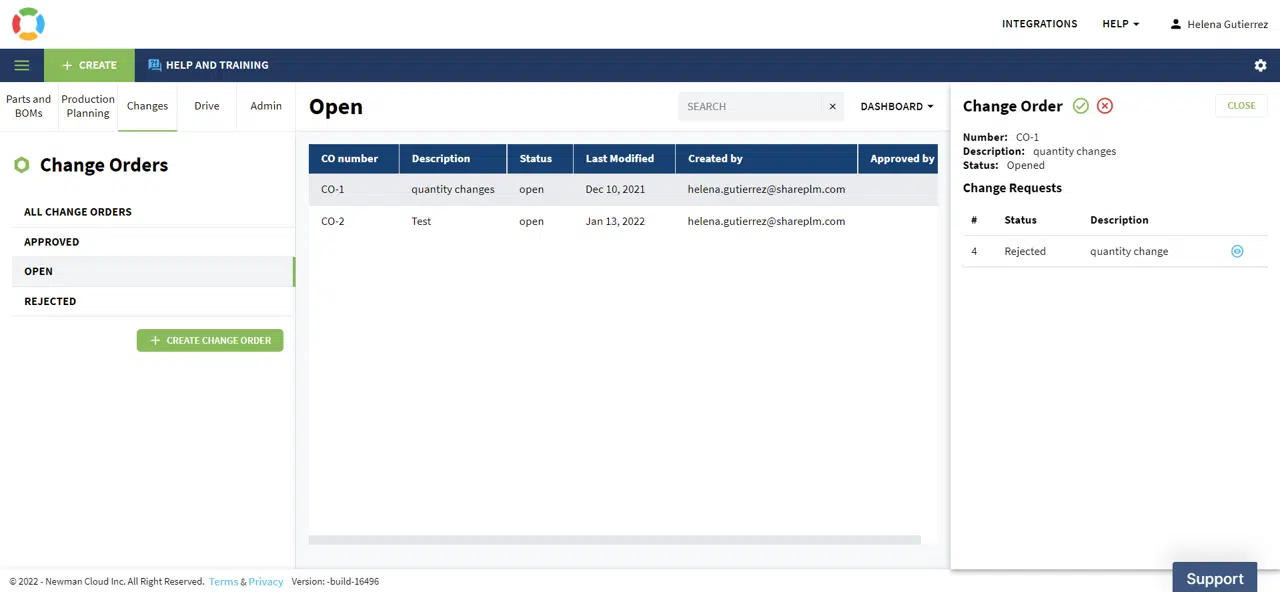
The simplest way to approve a change request or change order is to use a change approval panel in OpenBOM. Everyone can create a change request (CR) and change order (CO), but to approve it, the user must have special approval rights defined by a system administrator. It creates a simple mechanism that allows you to control the revision creation process and who can approve revision and finally get the approval done.
Here is an example of how approval is done by simple command and a person with the approvals rights.
Collaborative Approval Workflows
A new mechanism is coming to OpenBOM, which will allow supporting a more complex approval process, but at the same time to keep things simple as you always like to do with OpenBOM. The mechanism we develop will provide a guided collaborative process between multiple people involved in the process.
The biggest challenge of all processes is to have them routed between people and make them not transparent to other people. In such a way, if something is stuck or a person is not available, it is hard to figure out what is going on and how to make this process flow through without delay.
The technology we are developing at OpenBOM will bring a new type of approval mechanism that will bring all people together using the same real-time collaborative technologies we develop at OpenBOM.
In such a way instead of routing workflow messages, OpenBOM’s new approval workflow mechanism will create a real-time collaborative dashboard where everyone will be able to approach and review the list of changes, make approval and review the overall status of the approval process.
In the screenshot below, I’d like to give you an idea of how a workflow process will be presented in the actionable collaborative grid to support the approval mechanism. It will increase visibility and will simplify the process.
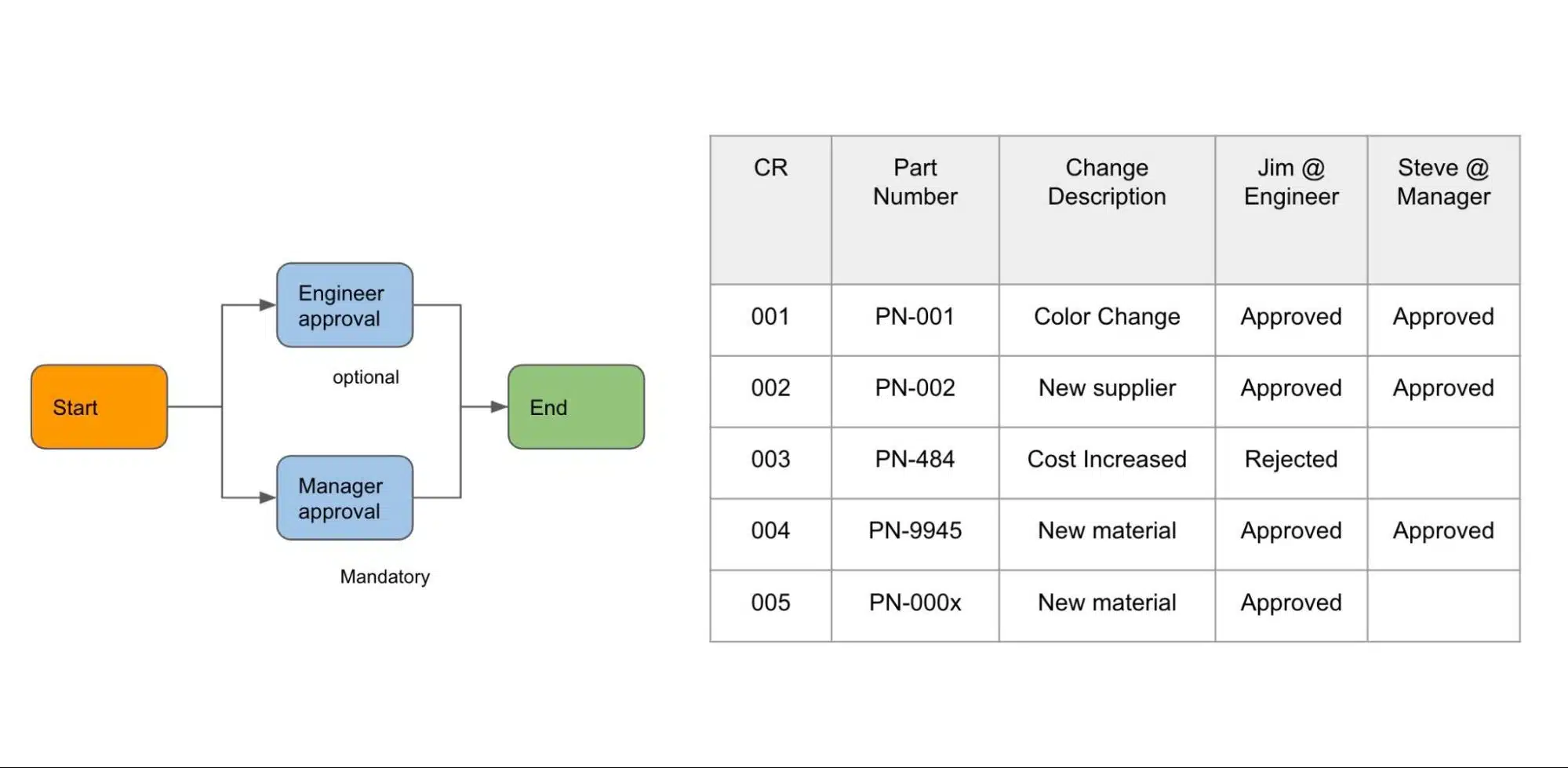
The mechanism will have a setting for business rules defining each person in the team his approval rights – review, notification, approval. Also, the system will provide a role for the manager to perform an overall approval overriding everyone else to make the process flow smoothly.
Conclusion
At OpenBOM we focus on how to simplify the user experience and at the same time provide an innovative and collaborative mechanism to solve old business problems in a new way. Collaborative change management processes and workflow approval are one of them. We are bringing OpenBOM patented collaborative technology to solve the business process approval in a modern way. Stay tuned for the first demo of the OpenBOM collaborative approval process that is coming soon. In the meantime register for our FREE 14 Day Trial and see all that OpenBOM has to offer.
Best, Oleg
Join our newsletter to receive a weekly portion of news, articles, and tips about OpenBOM and our community.