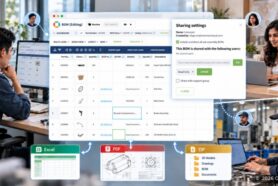
In every manufacturing company, one of the hardest gaps to close is between engineering and procurement. Design teams create product definitions — part structures, quantities, revisions, alternates. Procurement teams buy the materials that make those designs real. And yet, these two functions often live in completely separate worlds.
For decades, the disconnect between CAD, spreadsheets, and ERP has been the silent killer of efficiency. When a product design changes, that update rarely makes it to the purchasing department on time.
Materials get over-ordered or under-ordered.
Production slows.
Everyone scrambles.
OpenBOM was created to fix that. It builds a digital bridge between engineering and procurement, turning CAD and BOM data into live, actionable information for ordering, inventory, and supply chain management.
Why Connecting Engineering to Procurement Matters
Ask any manufacturing manager where the most expensive mistakes happen — and they’ll likely point to the handoff between engineering and purchasing.
Engineering defines what should be built. Procurement decides how to source and deliver it.
When these functions aren’t in sync, chaos follows.
- Parts are ordered with the wrong revisions.
- Quantities are mismatched.
- Suppliers receive incomplete specifications.
- And production lines wait for parts that never arrive.
This isn’t because people are careless — it’s because systems don’t talk.
CAD and PLM systems were built for designers. ERP systems were built for finance. In between them, engineers and buyers are forced to rely on emails, spreadsheets, and phone calls.
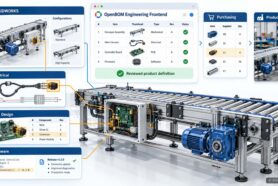
OpenBOM closes that gap.It connects engineering data to procurement operations through one shared, live workspace — ensuring that every part, quantity, and supplier stays connected and up-to-date across the entire organization.
The Traditional Disconnect – Files, Spreadsheets, and Emails
The old workflow looks painfully familiar. An engineer finishes a design in SolidWorks or Fusion, exports a BOM to Excel, and emails it to the buyer. The buyer reviews it, makes a few changes, and maybe imports the data into another spreadsheet for pricing. Meanwhile, engineering continues to refine the design — generating a new BOM version that no one outside the CAD team sees.
By the time purchasing receives the update, the old parts are already on order. This lag between design and procurement isn’t just inefficient — it’s expensive. It drives waste, excess inventory, and last-minute firefighting.
The core problem? Data doesn’t flow.
OpenBOM’s mission is to change that — by creating a continuous digital thread from CAD through BOMs, to inventory, purchasing, and ERP systems.
OpenBOM’s Approach – From Engineering BOM to Inventory, Orders, and Procurement
OpenBOM takes the engineering data that defines what to build and connects it directly to how it’s built and sourced.
It does this by combining BOM management, inventory control, supplier data, and ordering workflows into a single, cloud-based workspace.
Think of it as two sides of one bridge:
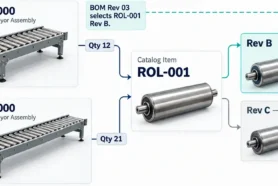
- On the engineering side, OpenBOM captures part data, structures, quantities, and revisions directly from CAD or xBOM.
- On the business side, it enables teams to manage inventory, create RFQs, issue purchase orders, and track supplier deliveries — all from the same connected data model.
This means that when an engineer updates a component or changes a material, procurement immediately sees the impact.
No emails. No files. No waiting.
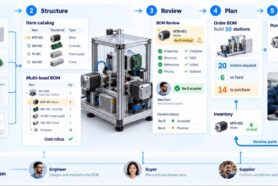
The process is transparent and traceable:
- Items define reusable components and their metadata.
- BOMs link those items into structured assemblies.
- Inventory tracks what’s in stock.
- RFQs and POs handle what needs to be purchased.
Each step is connected — automatically. So when you make a change in engineering, it reflects in procurement in real time.
“With OpenBOM, procurement doesn’t wait for spreadsheets — they act on live engineering data.”
OpenBOM as a “Light ERP” – For Teams Without ERP Systems
Not every manufacturing company has a full ERP system — and not every company needs one.
For many small and medium-sized manufacturers, ERP is expensive, rigid, and time-consuming to implement.
That’s where OpenBOM’s “light ERP” capabilities come in.

OpenBOM provides intuitive tools to manage essential procurement and inventory workflows:
- Batch inventory processes — update stock levels, costs, and quantities with one click.
- Purchase order creation — generate and manage POs directly from the BOM.
- Supplier and pricing management — link vendor catalogs, preferred suppliers, and price tiers to each item.
- Cost roll-ups — automatically calculate total assembly or project cost.
For many companies, OpenBOM becomes the first digital backbone connecting design and purchasing — a simple but powerful platform that replaces spreadsheets without requiring ERP infrastructure.
For many manufacturers, OpenBOM becomes their first digital purchasing backbone. Learn more about how OpenBOM manages inventory and orders in our online documentation.
OpenBOM + ERP: Seamless Integration for Advanced Operations
Of course, many companies already have an ERP or accounting system in place.
In these cases, OpenBOM doesn’t replace ERP — it connects to it.
OpenBOM integrates seamlessly with popular ERP and business tools:
- QuickBooks
- Odoo
- NetSuite
- Dynamics 365
- Xero
- Visma
and more are coming… .
The benefit of this connection is two-way data synchronization:
- Engineering data from OpenBOM automatically flows into ERP for purchasing and planning.
- Cost and supplier data from ERP flows back into OpenBOM for engineering visibility.
- Purchase orders and inventory updates stay aligned with product revisions and BOM structures.

Integrations can be configured out-of-the-box or customized via OpenBOM’s API and integration framework — ensuring every company’s workflow is supported.
The result is a seamless handoff between engineering, manufacturing, and finance — one that eliminates data re-entry and reduces lead times.
Learn more about what ERP integrations are provided by OpenBOM.
Customer Example – FenceQuip and the ROI of Connected Procurement
One of the clearest examples of this transformation comes from FenceQuip, a manufacturer that implemented OpenBOM to connect its design and procurement processes.
Before OpenBOM:
“Engineering and purchasing operated in silos, with valuable design data stuck inside CAD models while procurement teams scrambled to interpret spreadsheets and emails to determine what to order. Sometimes, mistakes were caught too late — materials were either over-ordered, increasing waste, or under-ordered, causing production delays.”
After implementing OpenBOM, FenceQuip connected engineering data directly to procurement. Now, as soon as a design changes, purchasing sees updated part requirements in real time.
The company reduced ordering errors, streamlined inventory management, and improved purchasing accuracy. In short, they replaced reactive supply chain management with proactive planning — and saw immediate ROI.
FenceQuip’s experience isn’t unique. It’s the story of many OpenBOM customers who realized that the key to manufacturing efficiency is data flow — not just data storage.
Conclusion: Building the Engineering-to-Procurement Digital Thread
At its core, OpenBOM is about connection. It connects design data from CAD, xBOM, and PDM systems to the people who make daily purchasing and planning decisions.
It closes the historical gap between engineering and business, ensuring that every stakeholder — from design engineers to buyers to suppliers — is working from the same live data model.
This connection creates what we call the engineering-to-procurement digital thread — a continuous, traceable, and collaborative flow of information that ties product definition to execution.
“OpenBOM transforms disconnected engineering and purchasing processes into a single, collaborative, data-driven workflow.”
As manufacturers continue their journey toward digital transformation, OpenBOM stands out as the system that makes product data truly useful — across the entire lifecycle, from design to delivery.
Stay tuned for Day 14, where we’ll explore how OpenBOM’s cost roll-up, quantity analysis, and validation tools build intelligence on top of this connected data model — helping teams make faster, smarter, and more accurate decisions.
REGISTER FOR FREE to check how OpenBOM can help you.
Best, Oleg
Join our newsletter to receive a weekly portion of news, articles, and tips about OpenBOM and our community.