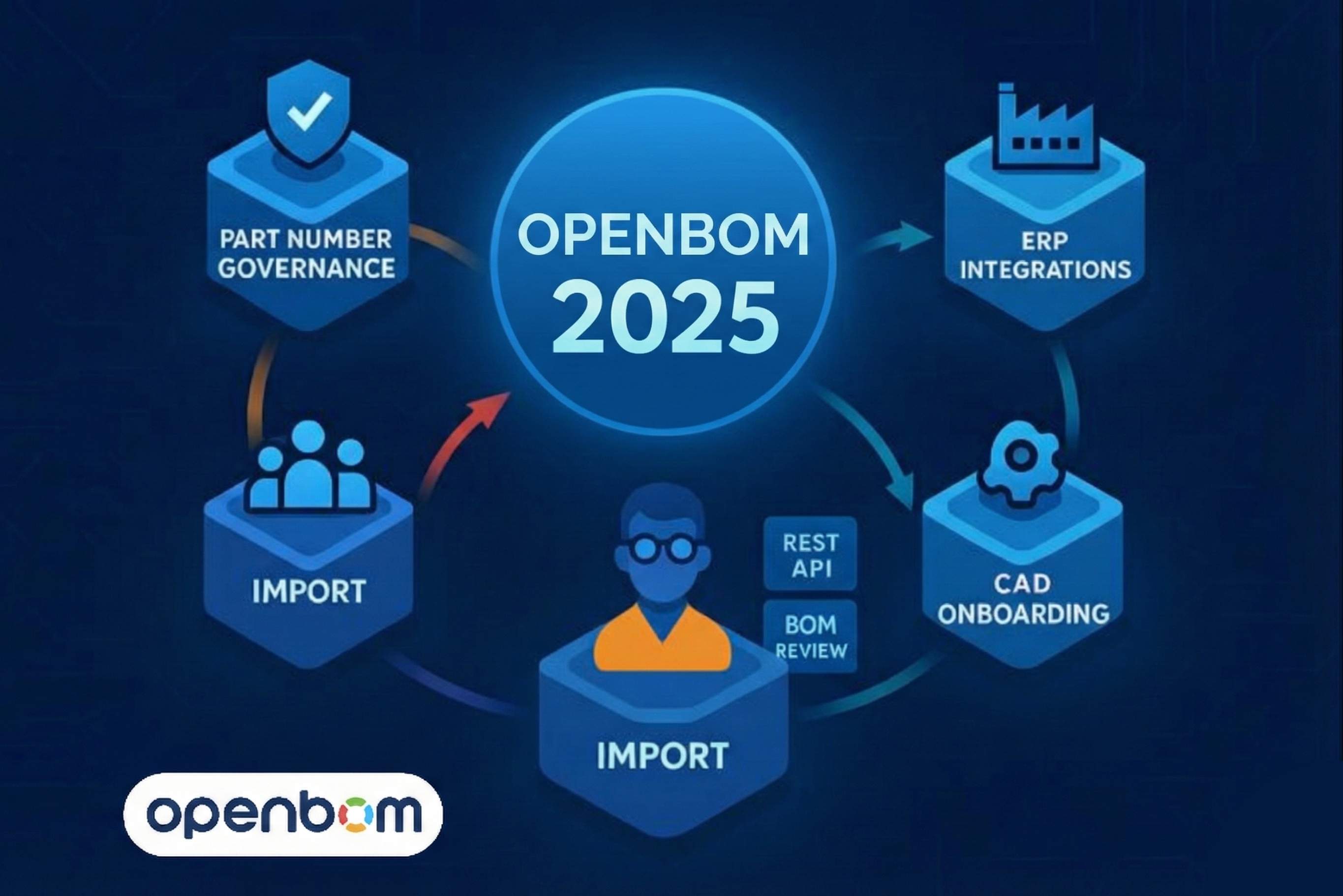
Looking back at 2025, it is clear to me that this was a year of tightening the foundation. Many of the changes we delivered were driven by the same underlying question: how do we make product data more reliable, more usable, and easier to connect across tools, teams, and processes?
To give a better retrospect of what we did, I want to focus on ten enhancements that best represent how OpenBOM evolved during the year. These are not independent features. They reinforce each other, and together they show a clear direction: reducing friction, increasing trust in data, and preparing the platform for deeper collaboration and automation.
1. Stronger part number governance and duplicate prevention
Part numbers look deceptively simple. In reality, they are one of the most fragile elements in any product data system, especially once multiple sources are involved. CAD systems, spreadsheets, vendor catalogs, and ERP integrations all bring their own assumptions, and duplicates often appear quietly.
In 2025, we significantly improved how OpenBOM handles part number uniqueness across catalogs. This included stronger validation rules, clearer feedback when conflicts occur, and better handling of data coming from external systems. The goal was not to impose rigid control, but to prevent silent corruption of the data model.
Reliable part numbers are a prerequisite for everything else: BOM integrity, change tracking, ordering, and integration. Strengthening this area removed a surprising amount of downstream friction.
2. Items Dashboard redesign as a primary navigation experience
For a long time, BOMs were the dominant entry point into product data. That made sense historically, but it increasingly created friction as products and relationships became more complex. Users often wanted to understand an item first, not navigate through multiple structures to find it.
In 2025, we redesigned the Items Dashboard to become a primary navigation experience rather than a supporting view. Direct access to Open BOM, Where Used, and relationship navigation shifted the focus from browsing structures to understanding context.

This change seems subtle, but it fundamentally alters how users move through OpenBOM. Instead of asking “which BOM do I need,” users increasingly ask “what is this item connected to,” which is a more natural way to reason about impact and change.
3. Faster CAD onboarding with Quick Start and team-level controls
CAD integrations are often judged by how well they work for an individual user. What we observed over time is that this is not enough. A workflow that only works for one expert does not scale to a team.
In 2025, we introduced Quick Start to simplify BOM creation directly from CAD systems and reduce setup time. This made it easier to go from design to structured data without deep configuration.
Here is an example of OpenBOM for Autodesk Fusion quick start. Similar mode exists for other CAD add-ins as well.
At the same time, we expanded team-level controls so mappings, templates, and integration behavior could be standardized. This shifted CAD integrations from being personal tools to shared infrastructure, which is essential in collaborative environments.
4. Import improvements for complex, multi-level BOMs
Spreadsheets remain a reality, especially at the beginning of projects or during transitions between systems. However, importing real-world BOMs often requires extensive preprocessing, manual cleanup, or artificial restructuring.
In 2025, we made meaningful improvements to data import, including support for numeric level depth and better handling of complex spreadsheet structures. These changes reduced ambiguity and preserved hierarchy more reliably.
We also introduced new BOM import options that eliminate the need to manage separate BOM and catalog imports. With drag-and-drop support and a new BOM import panel, importing data became a more direct and predictable process. This reduced the gap between how data exists in the real world and how it enters OpenBOM.
Read more about OpenBOM import improvements and coming AI agents. Also, learn about new importers for images and files using zip formats.
5. Change Management UX improvements and dashboard direction
Change management is not only about documenting outcomes. It is also about making changes visible, understandable, and traceable while they are happening.
In 2025, we improved the Change Request user experience by clarifying dialogs, reducing ambiguity, and making the flow easier to follow. These improvements addressed common pain points around creating and reviewing changes.
More importantly, we began shaping the direction toward a Change Request Dashboard. This represents a shift from isolated actions to a more coordinated, visible approach to managing change. The emphasis is on shared understanding rather than hidden workflows.
Read more about the introduction of change request dashboard.

6. Unified Import for items and BOMs
One of the recurring sources of friction we observed was the artificial separation between items and BOMs during onboarding. Users typically want to “bring their data in” and start working, not decide upfront which objects belong where.
Unified Import became an important enhancement in 2025 because it aligns OpenBOM with how projects actually start. Items and BOMs can now be imported through a single guided workflow, reducing setup complexity and confusion.
This change shortened onboarding time and made early project stages more predictable, especially for teams migrating from spreadsheets or legacy systems.
Here is a video with the enhancements of the import.
7. Expanded ERP, Financial and Other Enterprise integrations
As OpenBOM adoption grew, so did the need to connect engineering data to business systems. CAD-to-BOM workflows alone are no longer sufficient once ordering, manufacturing, and finance are involved.
In 2025, we expanded ERP and enterprise integrations, including, Odoo, Xero, Visma NXT, and Microsoft Dynamics 365 Business Central. We made a major refresh to QuickBooks integration. Also, we developed an early preview of integration with Aras Innovator. This reinforced OpenBOM’s role as a bridge between engineering and downstream systems. More integrations are coming…
Read more about out of the box ERP integrations we developed. More ERP connectors are coming including AI tools to develop your own ERP integrations.
The emphasis here was not on one-time data transfer, but on sustained integration. Product data needs to stay connected as it evolves, and these integrations are an essential part of that continuity.
Learn more about available OpenBOM Integrations.
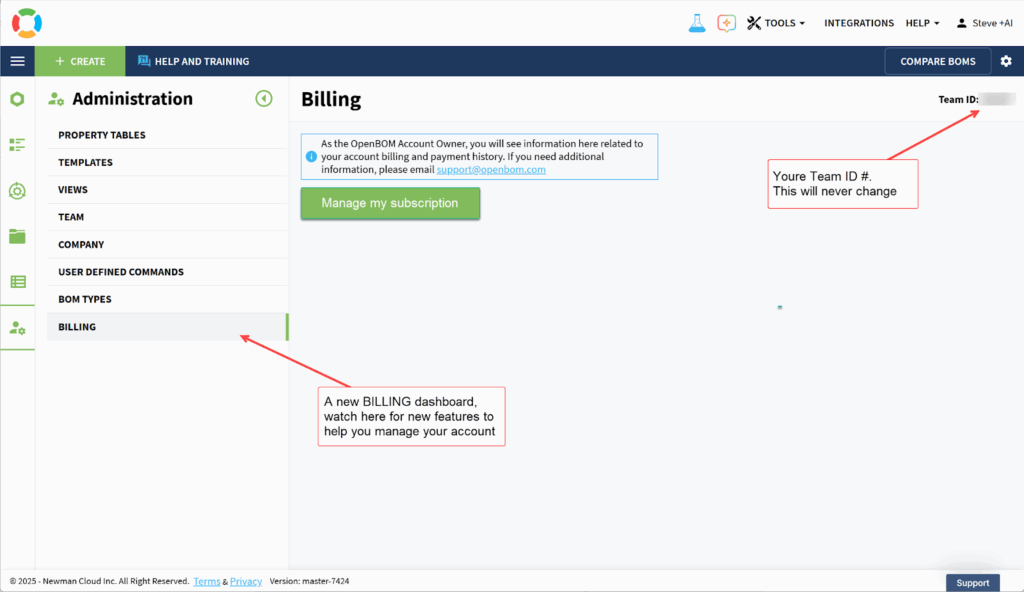
8. Transition to a new billing and licensing foundation
Some of the most important work in 2025 happened behind the scenes. We began migrating OpenBOM to a new billing system, not as an administrative exercise, but as a foundation for future user experience improvements.
The goal is to make licensing and purchasing part of the product experience rather than a separate process. Integrated licensing reduces friction, improves transparency, and supports scaling as teams grow.
While much of this work is not immediately visible, it is critical for aligning how users access OpenBOM with how they actually use it.
If your account is already transitioned to the new billing system, you will see it in your billing dashboard.
9. December 2025 release: REST API enhancements and Swagger documentation (coming)
The final release of 2025 focuses on strengthening OpenBOM’s developer surface. APIs are essential for automation, integration, and extension, yet they often receive attention only after users encounter limitations.
In this release, we expanded and refined the REST API surface and improved consistency across endpoints. We also prepared Swagger-based documentation to make APIs easier to explore, understand, and maintain.
In parallel, we enhanced the underlying user and account infrastructure to simplify API usage. Upcoming support for automatic API key and secret management will reduce friction for developers and make programmatic access to OpenBOM more straightforward. Together, these changes clarify the developer story and lower the barrier to building on top of OpenBOM.
10. December 2025 release: BOM Review announcement
The year concludes with the introduction of BOM Review. This is not an isolated feature, but a capability that builds on everything delivered before it.
BOM Review brings structured collaboration, review, and decision-making directly onto live BOM data. Instead of exporting spreadsheets or fragmenting discussions across tools, teams can review and resolve issues in context.
This capability reflects a broader direction: keeping decisions close to the data they affect and reducing the need for workarounds that fragment information.
Conclusion: Preparing for what comes next
Taken together, these ten enhancements show a year spent strengthening foundations and preparing for what is coming. Data integrity, usability, integration, and infrastructure all moved forward in a coordinated way. Check our article about OpenBOM vision for 2026
As we move into 2026, this foundation enables deeper collaboration, more automation, and clearer ownership of product data. The work done in 2025 sets the stage for what comes next, without forcing users to change how they think about their work.
That, in many ways, was the point.
The holiday season is coming- it is the great opportunity to explore how OpenBOM can help you – REGISTER FOR FREE and you get OpenBOM 14 day trial automatically open for you until the end of the year.
Best, Oleg
Join our newsletter to receive a weekly portion of news, articles, and tips about OpenBOM and our community.