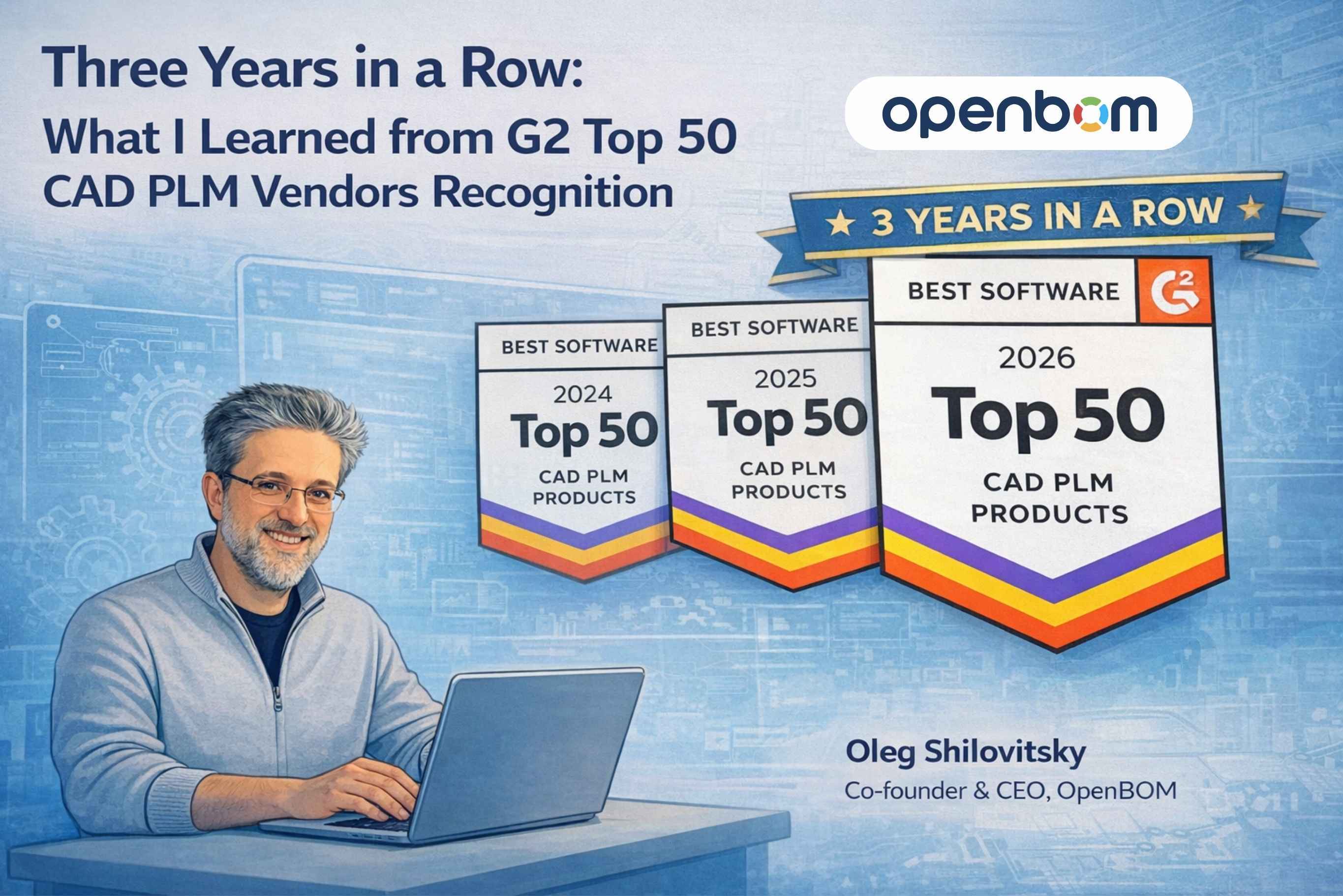
For the third consecutive year, OpenBOM has been recognized in the G2 Top 50 CAD & PLM Software list.
When I first saw the notification, I paused for a moment. Awards in enterprise software are common. Rankings come and go. Badges appear on websites and disappear a year later. But three years in a row is not a coincidence.
I wanted to reflect on the industry I worked for more than two decades and what I learned.
The Industry I Grew Up In
I’ve spent long enough time around CAD and PLM systems. I remember when PDM installations required careful server sizing, weekend deployments, and months of configuration before the first engineer could check in a file. PLM was a decision often accompanied by consulting projects that lasted longer than the products themselves.
Back then, that made sense. Infrastructure was heavy. Connectivity was limited. Integration was complex. But engineering didn’t slow down. It accelerated.
Cloud tech changed expectations. Tools became easier to try, easier to adopt, easier to compare. Engineers no longer accepted the idea that software should require months before it delivers value. They started to expect the same simplicity from PLM that they were experiencing in other cloud tools – CRM, ERP, marketing, finance. And yet, for years, PDM PLM lagged behind.
What Recognition Reflects
The G2 rankings are not analyst opinions. They are not influenced by vendor relationships. They are based on verified reviews from real users who choose to share their experience publicly.
OpenBOM has now crossed more than 700 reviews there. More than half of them are five-star ratings. That number is not just a statistic. It represents engineering managers, purchasing teams, startup founders, manufacturing leads — people who decided to replace spreadsheets, manual exports, and disconnected systems with something more structured.
Recognition across the entire CAD & PLM category, not just a niche subcategory, tells me something important. It tells me that the definition of what “good PLM” looks like is changing.
The Shift I’ve Been Watching
For a long time, PLM was evaluated by feature depth and enterprise footprint. The bigger the deployment, the more impressive it looked. Complexity was almost seen as a strength.
But something subtle happened over the last few years.
Engineering teams began prioritizing speed over ceremony. They wanted systems that integrates directly to Dassault Systèmes SOLIDWORKS, Autodesk Fusion, PTC Onshape, and other design tools without friction. They wanted bills of materials generated automatically, not manually reconstructed in Excel. They wanted purchasing to see accurate data without waiting for exports. They wanted to have seamless out of the box integration with ERP systems (not a 5 months integration project)
Most importantly, they wanted transparency in architecture and in pricing. That expectation reshaped how we think about PLM at OpenBOM.
Cloud-native was not just a deployment model. It became a philosophy. Instead of building walls around data, we focused on connecting data and companies. Similar to tools like Google Workspace, it allows you to create an account and start working right away.
Recognition, in this context, is not about celebration. It’s about confirmation that the direction is right.
The Friction Problem
Traditional PLM often introduced friction. For small and mid-sized manufacturers, this is a current focus of OpenBOM, the very companies that most needed structured product data, PLM often felt out of reach.
That friction didn’t just slow adoption. It shaped perception. Many engineers began associating PLM with bureaucracy instead of productivity.
We’ve been working deliberately to remove that perception. The recent business model and pricing reshaped OpenBOM’s way to lower the entry point to new accounts and allow them to grow. It includes – transparent subscription tiers, lower entry points, no minimum number of seats, free read-only access with unlimited users. Direct CAD integrations. API-first architecture so that ERP systems and procurement tools can connect without gymnastics. The goal has never been to simplify for marketing purposes. It has been to simplify so that engineering teams can focus on products, not infrastructure.
Beyond the Badge
There is always a temptation to treat awards as endpoints. But in technology, especially in PLM, nothing is static. AI is reshaping industries and tools. The industry is moving toward deeper connectivity, toward what I often describe as product memory — the idea that product data is not just a record of parts and revisions, but a living system of relationships, decisions, and dependencies.
If the last few years were about proving that cloud-native, collaborative PLM works, the next few will be about making that data intelligent and contextual.
The recognition from G2 does not signal completion. It signals OpenBOM readiness.
It tells us that thousands of engineers trust OpenBOM enough to speak publicly about their experience. It tells us that usability and transparency matter as much as technical depth. It tells us that the market is rewarding solutions that reduce complexity rather than amplify it.
A Personal Reflection
As someone who has watched PLM evolve over decades, I don’t see this as a marketing milestone. I see it as part of a broader transformation in how engineering software is evaluated.
The center of gravity is shifting. Power is moving closer to engineers. Adoption is becoming bottom-up. Reviews matter. Real-world usage matters. Architecture matters.
And perhaps most importantly, trust matters. For the third year in a row, that trust has been reflected in the G2 Top 50 CAD & PLM list.
I’m grateful for that. But I’m even more motivated by what it represents.
The real work in PLM is not winning awards. It is helping teams build better products with less friction and more clarity.
That journey continues.
—
Oleg Shilovitsky
Co-founder & CEO
OpenBOM
Join our newsletter to receive a weekly portion of news, articles, and tips about OpenBOM and our community.