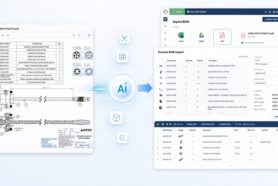
Engineering and manufacturing organizations rely on product information that is accurate, accessible, and shared across teams. This is easy to say but not easy to achieve. Data is often scattered across CAD systems, spreadsheets, legacy databases, supplier lists, and countless files that move around through email.
In my previous article about connected BOM workflows, I described how OpenBOM responds to this challenge by building a foundation that collects and organizes this information. The goal is to give teams a structured, reliable view of their product data so they can make decisions with clarity.
This new article today continues the same storyline. After creating the foundation, the next step is helping engineering, manufacturing, procurement, and other stakeholders work together inside the same environment. The reality I see with many companies that despite many efforts, the default approach has been to export data into spreadsheets and circulate comments back and forth. I’ve seen it with small companies and large enterprises. It works until it does not. As teams grow and as complexity increases, the limitations of spreadsheets become visible. A more robust and integrated review process becomes necessary.
Collaborative BOM Review is the natural evolution of that idea. When real-time structured data meets the ability to discuss, assign, track, and visualize comments and tasks, teams gain something more powerful than a real time shared data – it is becoming actionable. They gain a shared review environment connected directly to the product information itself.
With the early sharing news about BOM Review introduction, we are excited to share the story how we see this transformation will happen.
From Data Organization to Team Alignment
The story begins with OpenBOM’s ability to organize data using flexible graph data model. This step is foundational. Without structured information, collaboration becomes a chain of emails. Every engineering team has dealt with situations where data is inconsistent or spread across several disconnected tools, shared using emails and attachements. One designer uses a spreadsheet stored on a shared drive. Another maintains a local file. Someone else pulls information from a CAD system to PDM. These situations slow down the process and introduce errors at the moment when a team needs clarity.
OpenBOM was created to solve this fragmentation by bringing all product information into a single, structured and shareable data model. Data flows in from mechanical CAD, ECAD, PCB design, Excel, Google Sheets, ERP exports, supplier lists, procurement lists, and older databases. It becomes part of an organized, consistent source that reflects the real state of the product and can be used by engineers, manufacturing planners, procurement teams, and others. OpenBOM out of the box import and many integrations with engineering tools support this process.
This foundation is what makes alignment possible. Once data is structured and accessible, teams can begin reviewing it with confidence. They no longer rely on outdated files or multiple versions of a spreadsheet. They work with live information that reflects current design decisions and changes. The previous article described how establishing this single place for product data sets the stage for review and collaboration. Collaborative BOM Review builds directly on that foundation.
Collaborative Workspace: The Real-Time Editing Layer
Once the data is organized, teams need a place to interact with it. The Collaborative Workspace is OpenBOM’s answer to this need. It combines the best qualities of spreadsheet-style editing with the advantages of structured, system-aware product data. Many users describe it as “Google Sheets on steroids,” and for a good reason. It feels familiar, yet it provides capabilities that ordinary spreadsheets cannot match.
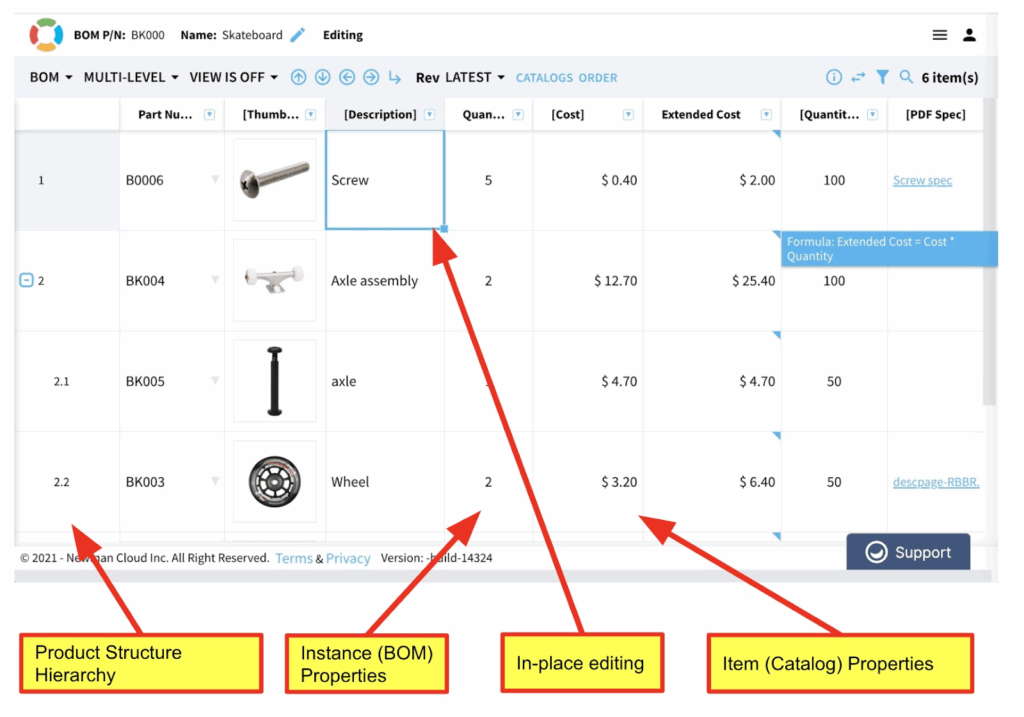
Inside the Collaborative Workspace, multiple users can edit a BOM at the same time. They can update item properties, adjust quantities, add new items, or modify metadata, and those changes become visible instantly to everyone else. The days of waiting for someone to close a file or merge edits disappear. Collaboration becomes seamless because the shared environment handles synchronization automatically.
The Workspace also maintains structure. While spreadsheets are flexible, they do not inherently understand product relationships, item references, configurations, or revisions. OpenBOM does. It understands that a BOM is a structured representation of a product and preserves the relationships between components, sub-systems, and items. This structure ensures that collaboration does not compromise data integrity.
This real-time environment becomes the place where teams gather around the BOM. It becomes a shared surface for engineers, designers, manufacturing planners, and procurement specialists. The Workspace eliminates the need for offline spreadsheets and redundant files, making it much easier for teams to stay aligned.
From Spreadsheet Comments to Collaborative BOM Review
Collaboration around a BOM traditionally begins by exporting data into a spreadsheet. It is a method so common that most teams do it automatically. They pull the data into Excel or Google Sheets, add comments, highlight issues, and exchange feedback. Early-stage collaboration often depends on this pattern because it is familiar and accessible to everyone.
However, as soon as the volume of data grows or more people join the process, the limitations of spreadsheets become visible. Simple comments are easy to lose. Multiple versions of the file appear. It becomes unclear who is responsible for resolving an issue or making a change. Teams begin spending more time coordinating than reviewing.
This is where the evolution towards Collaborative BOM Review becomes meaningful.
Check this early preview of BOM Review.
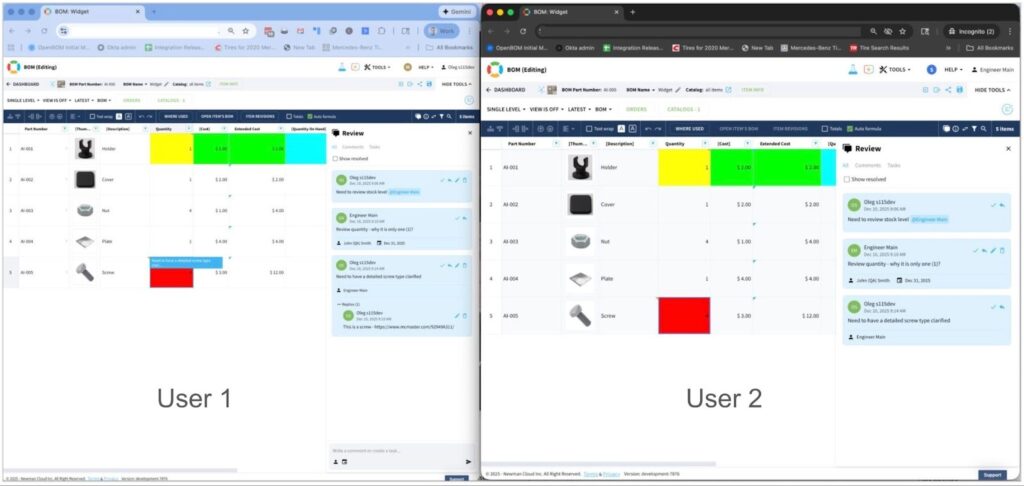
OpenBOM moves from the simple comments you can leave in Google Sheets or Excel to a collaborative BOM review system with tasks and visualizations. This shift changes the nature of collaboration. Comments become structured conversations rather than scattered notes. Tasks create accountability and ownership. Visualizations help teams understand what has been reviewed, what remains open, and where attention is needed.
A BOM is no longer a spreadsheet table. It becomes a shared review environment, updated in real time, track history and connections where conversations and decisions happen in context. Teams can focus their attention on the specific items, properties, or configurations that require review, and they can track the progress of those review activities in a clear and organized way.
Turning Review Into Workflow: Comments + Tasks + People
Collaborative BOM Review does more than simplify discussions. It introduces a natural workflow layer into product data management. Instead of switching between spreadsheets, chat tools, email threads, and shared drives, all review activity happens directly inside OpenBOM.
A comment can be placed on a specific part or property. A task can be assigned to a person who is responsible for verifying a quantity, updating a description, reviewing supplier data, or confirming compliance information. These tasks exist within the context of the BOM item itself. Everyone can see what is assigned, what is in progress, and what is done.
This tight connection between data and workflow provides clarity. A question about an item is not buried in an email chain. A task is not hidden in a project management system that is disconnected from the BOM. Everything lives in one place, linked to the data it references.
This integrated approach removes unnecessary steps from the process. When a task is completed, the update happens directly in the Workspace. When a comment is resolved, the BOM reflects the change immediately. Conversations and decisions do not get lost. They become part of the product data itself.
This approach creates a lightweight yet powerful workflow that supports real collaboration without introducing complex overhead. Teams gain structure without rigidity. They gain clarity without additional tools. They work directly on the product data rather than managing multiple communication channels around it.
Collaborative BOM Review and Digital BOM
The introduction of Collaborative BOM Review marks an important point in OpenBOM’s evolution. It creates a new layer in the product data environment – one that sits directly above the structured information and the Collaborative Workspace.
This new layer is the collaborative decision layer. It is where review cycles take place, where tasks are created and tracked, and where teams resolve issues and confirm details. The combination of data, collaboration, and workflow moves OpenBOM closer to what I call the Connected Digital BOM. It is not simply a bill of materials stored in a system. It is a living representation of the product that includes structure, context, decisions, and actions taken throughout the development process.
The Digital BOM is a foundation for more advanced capabilities. Structured reviews, engineering change processes, approvals, workflow automation, and intelligent agent-assisted features all depend on the ability to review data collaboratively. By establishing this review environment, OpenBOM builds the necessary infrastructure for future evolution. Each new capability will build on the idea that decisions must be captured, tracked, and correctly linked to the product information they affect.
Collaborative BOM Review is the beginning of this direction. It aligns teams, reduces friction, increases clarity, and creates a more integrated workflow around engineering data.
Conclusion: Next Step Toward the Digital BOM Maturity
Product development has always required collaboration, but the tools that support this collaboration have not always kept up with the complexity of modern engineering. Exporting spreadsheets, writing notes in the margins, and juggling multiple communication channels can only take a team so far. At some point, collaboration must move into the same environment where the data lives.
OpenBOM’s Collaborative BOM Review brings this idea to reality. It completes the process that began with organizing data and enabling real-time multi-user editing. Adding comments, tasks, visualizations, and structured review elements transforms a BOM from a document into a shared workspace where decisions are made and tracked.
This evolution marks a meaningful shift in how engineering teams work with product data. It introduces a lightweight workflow layer that makes collaboration natural and transparent. It ensures that review activities are connected directly to the data they reference. And it creates the groundwork for future enhancements that will make the Digital BOM even more intelligent and capable.
Collaborative BOM Review represents an important milestone on the path to making engineering work more connected, aligned, and effective. It brings people, data, and decisions together in a single environment and creates a new foundation for the next generation of OpenBOM capabilities.
REGISTER FOR FREE to check how OpenBOM can help.
Want to get on the meeting to discuss how to make BOM Review available for your company? Contact me directly.
Best, Oleg
Join our newsletter to receive a weekly portion of news, articles, and tips about OpenBOM and our community.