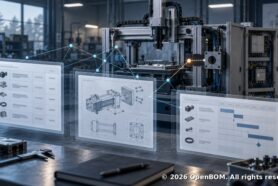
Let’s speak about how to turn BOM structure, change history and dependencies into product memory to support intelligent decisions.
Earlier this year, on Beyond PLM, I wrote about Context Graphs and why systems must evolve beyond being systems of record. It was taken on a traditional PLM and their evolutionary path. Traditional PLM software was designed to manage documents, control revisions, enforce check-in and check-out, and maintain structured BOM reports. That model made sense when the primary objective was governance and traceability.
But governance is no longer the hardest problem.The harder problem today is understanding how product decisions ripple across engineering, manufacturing, and supply chains over time.
Earlier this week, I shared an OpenBOM article, BOM in the AI Era, I described the evolution of the BOM itself — from a static “BOM document,” to a structured “BOM data system of item records,” and ultimately toward something richer: a connected context of product information.
These two discussions converge around a practical reality.
Modern products are defined not only by structure and attributes, but dependencies, and the changes they undergo across time. A part’s lead time influences sourcing risk. A geometry modification impacts tooling. A supplier substitution affects quality and cost. A late-stage ECO can increase scrap rate and delay shipment. These are not isolated data points. They are connected behaviors across functions.
At OpenBOM we move forward – Digital BOM is just the beginning of the journey. Here is the next logical step – structured product data and captured change history must evolve into rich product context and from there into Product Memory capable of supporting better decisions.
This is not a new direction. But it evolves and becomes more specific with the huge progress that is made by industry in the last couple of years and specifically the last few months with AI tech stack and LLMs. It is the natural continuation of what we have been building using Graph Data foundation and Digital BOM Collaborative Workspace.
The Missing Layer: Behavior Over Time
Most PLM systems are effective at storing structured information. They maintain BOM hierarchies, revision histories, ECO records, CAD files, and associated documents. They can reconstruct the state of a product at a particular moment in time.
However, storing states is different from understanding behavior.
A system may record that a housing moved from Revision B to Revision C. It may show the ECO approval and associated drawing updates. But it typically does not recognize that this type of geometry change historically triggers gasket modifications, tooling updates, and adjustments in manufacturing instructions. It does not observe that similar changes have repeatedly led to downstream consequences.
It records what happened. It does not interpret patterns in what usually happens next. That interpretive layer is what has been missing.
Digital BOM as a Connected Foundation
From the beginning, OpenBOM was designed differently. Our Digital BOM was not conceived as a typical SQL database or object records with attached documents. It was built on a flexible, graph-based data model capable of capturing each change automatically, connecting items, attributes, suppliers, alternates, documents, revisions, and cross-functional views through xBOM.
The flexible data model in OpenBOM allows every item in OpenBOM to carry structured attributes such as lead time, cost, compliance status, lifecycle state, and supplier relationships. Assemblies are connected not only hierarchically but through dependency reference links across mechanical, electronic, and operational domains. ECOs capture the intent behind changes. Revisions record the evolution of design decisions.
Importantly, these elements are not stored independently in SQL tables. OpenBOM build a connected graph of product context.
In the first phase of OpenBOM’s development, our focus was on building this Digital BOM foundation. We created rich data structures, integrated with engineering and design applications to capture information at the source, and ensured that structural changes, attributes, and revision history were preserved in a connected model.
The goal was to move beyond static SQL based PLM databases toward a rich graph based structured dataset. That foundation is ready and now we are moving forward.
Later in this article I want to speak about several use cases how OpenBOM can learn from the data – attributes, dependencies, change history, and cross functional data sets.
Learning from Attributes: Risk Hidden in Product Data
Attributes are often treated as simple metadata fields. In reality, they encode intent and operational implications.
Consider a recurring scenario in supply chain management. Over multiple programs, components with lead times exceeding eight weeks repeatedly trigger late-stage alternates. Engineers select technically suitable parts early in the design cycle. As delivery pressure increases, procurement escalates concerns. Within weeks, engineering introduces substitutes. Expedite costs rise. Delivery dates slip.
Each of these events is recorded somewhere: in part attributes, in ECO logs, in purchase orders. But unless they are connected and analyzed as a pattern, the organization fails to learn from them.
Within a connected Digital BOM, attributes such as lead time, supplier count, and lifecycle state become part of a behavioral dataset. Over time, the system can recognize that specific combinations of attributes correlate with downstream instability. A single-source component in a high-volatility commodity category may consistently introduce risk. The attribute itself becomes predictive because it is linked to historical outcomes.
Similarly, compliance attributes tied to specific regions may reveal recurring late-stage documentation requirements. Voltage level, market region, and product category together may repeatedly necessitate certification steps that are introduced too late in the design process. When such patterns are visible, decision-making can shift earlier and become more proactive.
Understanding Dependencies: The Ripple Effect of Change
Dependencies reveal how interconnected modern products truly are.
Imagine that over several releases, a housing geometry modification consistently triggers a gasket revision within two weeks. The gasket revision then requires a tooling adjustment and updates to assembly instructions. This pattern repeats across programs, yet it remains tribal knowledge held by experienced engineers.
Traditional systems show each revision independently. They do not highlight the recurring chain reaction.
In a graph-based Digital BOM, relationships between housing, gasket, tooling, and documentation are explicit. Structural connections and cross-functional xBOM views expose how components relate across disciplines. Over time, change history layered onto these dependencies reveals behavioral patterns.
When a similar geometry modification occurs in the future, the system can reference historical relationships and highlight likely downstream impacts. This is not automation of engineering judgment. It is structured recall of organizational experience.
Change History as Organizational Memory
“Change history” is the most powerful ingredient.
Suppose the system observes that ECOs introduced within thirty days of production release correlate with higher scrap rates and assembly rework. Or that a particular fastener type increases assembly time by twelve percent and is later replaced in subsequent revisions. Or that supplier substitutions reduce cost initially but increase quality escapes during field operation.
These are not hypothetical scenarios. They are common across engineering organizations.
Yet in most companies, this knowledge lives in conversations, spreadsheets, and memories. It rarely becomes structured insight.
When attributes, dependencies, and ECO histories are connected in a unified Digital BOM, patterns across time become visible. The organization can see that certain timing decisions increase production instability. It can observe that particular design shortcuts consistently generate rework. It can identify suppliers whose historical performance deviates from expectations.
This accumulation of connected history forms Product Memory.
Cross-Functional Context as Decision Intelligence
Product Memory becomes truly powerful when it spans engineering, manufacturing, and supply chain together.
A sourcing decision influences engineering alternates. An engineering tolerance affects machining yield. A cost-saving substitution impacts field reliability. A late ECO affects assembly scrap and delivery schedules.
In a siloed environment, each domain manages its own consequences.
In a connected Digital BOM environment, these consequences become visible as part of a unified product context. Over time, the system develops a structured understanding of how decisions propagate across functions.
Decision intelligence emerges when this historical context informs future actions. When selecting a component, the system can reference its historical supply stability. When modifying geometry, it can surface past dependency cascades. When introducing an ECO late in the lifecycle, it can highlight historical production impacts.
This is not about replacing human expertise. It is about augmenting it with structured memory.
Conclusion: The Next Phase of OpenBOM
At OpenBOM, we are entering the next phase of our evolution.
Digital BOM was never just about replacing spreadsheets or storing structured item records. It was about building a connected product data foundation, a graph-based model capturing items, attributes, dependencies, revisions, and cross-functional xBOM relationships across engineering, manufacturing, and supply chain. That foundation is now established.

The next step in our strategy is to move beyond storing documents and revision history and toward transforming connected product data into living context. By turning structured attributes, dependency networks, and change history into Product Memory, OpenBOM evolves from a platform that records decisions into one that understands patterns and supports decision intelligence over time.
Here are 3 important steps in OpenBOM evolution:
- Digital BOM gave us structure
- Product Memory gives that structure continuity across time.
- Decision intelligence is where continuity becomes guidance.
This is the natural progression of our architecture. It is the logical next step. And it defines where OpenBOM is headed.
Join our newsletter to receive a weekly portion of news, articles, and tips about OpenBOM and our community.