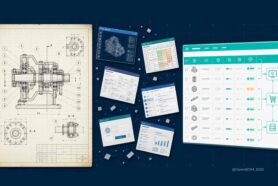
For years, one of the biggest challenges in manufacturing has been getting engineering data out of CAD and into the hands of everyone who needs it — purchasing, operations, supply chain, and even leadership.
CAD systems are powerful at design, but once a model is finished, it too often becomes an island. Emails, PDFs, and spreadsheets take over. Versions drift. Errors multiply. And everyone blames “the latest file.”
Then comes the OpenBOM moment — the realization that design data doesn’t have to stay trapped inside engineering. It can flow automatically to the rest of the organization.No exports. No versions chaos. Just a single, connected source of product truth.
The “Aha!” Moment: Breaking the CAD-to-Business Barrier
Every OpenBOM customer has a story like this: “We used to spend days manually exporting data from CAD and updating Excel sheets for purchasing. Now, our BOMs are live. As soon as engineering makes a change, procurement sees it.”
That’s the transformation OpenBOM brings — the ability to connect CAD data directly to business operations.
Traditionally, CAD and PLM systems were designed for control — check-in/out, versioning, vaults — but not for communication. Engineering and business systems lived in parallel universes, joined only by the occasional email.
OpenBOM changes that by providing a direct, real-time data bridge. It connects CAD data with BOMs, vendors, and inventory, creating a unified model that flows across departments.
And for many companies, that’s the moment everything clicks.
The Integration Gap: Why CAD and Business Don’t Talk
The separation between design and business didn’t happen by accident — it’s a legacy of how engineering software evolved. PDM and PLM tools were built decades ago to manage design files, not to share data. Their job was to keep CAD safe in a vault, not to let it out.
The result:
- BOMs exported as Excel files.
- PDFs passed around in email threads.
- Change requests printed and annotated by hand.
- Purchasing left guessing what’s current.
Every company has felt this pain — disconnected decisions, missed updates, and last-minute scrambles when suppliers receive outdated part lists. It’s a costly, frustrating, and unnecessary bottleneck.
OpenBOM removes that friction. With modern cloud integrations, the CAD data flows where it needs to go, when it needs to go — automatically.
OpenBOM Integrations: The Bridge Between Design and the Organization
OpenBOM offers a broad set of integrations with the tools engineers already use every day:
- SolidWorks
- Autodesk Fusion
- PTC Onshape
- Altium Designer
- Solid Edge, Inventor, Creo, NX, and others.
Each integration is built and maintained by OpenBOM to ensure reliability, security, and deep data access.
What makes these integrations different from traditional PDM links is their granularity.
OpenBOM doesn’t just copy files — it extracts structured data: every part, property, configuration, and relationship that defines the product.
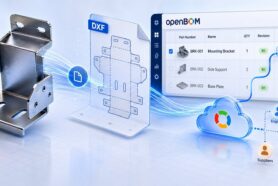
For example: When an engineer checks in an assembly from SolidWorks, OpenBOM automatically updates the associated BOM, metadata, and derivative files — including STEP, PDF, and DXF exports — following your CAD settings. The result is a live, data-driven BOM, not just another static file on a server.
With every change in CAD, OpenBOM updates the corresponding items and structures — ensuring that everyone across the company works from the same version of truth.
SmartSync – The CAD-to-Cloud Backbone
Behind this seamless flow is SmartSync, the mechanism that connects desktop CAD environments to OpenBOM’s cloud platform.
SmartSync enables engineers to:
- Upload and synchronize CAD files and structures securely.
- Control check-in/out through collaborative locking.
- Maintain version history and metadata links automatically.
- Connect CAD data directly to Items, Catalogs, and BOMs.
- Handle derivative files like STEP, PDF, DXF, and more.
Speed and efficiency are key. SmartSync optimizes file uploads to handle large CAD assemblies quickly, even across distributed teams — without the need for VPNs or local servers.
It’s also fully integrated into OpenBOM Design Projects, the PDM service introduced earlier in this series (see Day 10). Together, SmartSync and Design Projects form a complete cloud-based PDM and collaboration layer — where file management, versioning, and BOM synchronization happen in real time.
The Flow of Data: From Design → BOM → Procurement
Let’s follow what happens in a real-world workflow.
An engineer designs an assembly in SolidWorks, Autodesk Fusion, or some other CAD system. When they check in the project using OpenBOM, all relevant information — items, part numbers, configurations, and metadata — flows directly into the system. From there, the Bill of Materials is automatically built and maintained. Quantities, materials, and costs update in real time.Procurement and planning teams can immediately see what’s changing, what needs to be ordered, and how costs are evolving. No one waits for an Excel export. No one needs to manually reconcile spreadsheets.
As one customer put it:
“A design update today means purchasing knows what to order tomorrow.”
Here’s a demo video showing how OpenBOM’s CAD integrations bring this process to life — turning design data into actionable information across teams.
Mixed CAD Environments and Cross-Discipline Collaboration
Modern products aren’t just mechanical. They’re systems — a combination of mechanical assemblies, electronics, and software. And that means multiple CAD tools working together.
OpenBOM’s integration framework was built for exactly this world. It connects data from mechanical CAD (SolidWorks, Fusion, Onshape) and electronic CAD (Altium Designer, KiCad, etc.) into a single, consistent structure — the xBOM.
Each CAD tool contributes its metadata, structure, and files to the shared product graph. A PCB from Altium, a housing from Fusion, and a cable harness from SolidWorks all appear as parts of the same BOM.
This is how OpenBOM enables multi-disciplinary collaboration — where everyone works on their own design tools, but contributes to the same product data model.
For companies producing robotics, IoT devices, or complex machinery, this unification is game-changing. It turns scattered design data into a single, navigable digital product.
From CAD Integration to Business Impact
The technical foundation is impressive — but the real impact is business transformation.
Connecting CAD data to the rest of the organization means:
- Faster handoffs between engineering and procurement.
- Fewer manual errors, since no one is transcribing data.
- Real-time cost visibility, with automatic roll-ups from BOM data.
- Accelerated design-to-production cycles, as everyone works from the same live data.
Companies report saving hours — even days — every week.As one OpenBOM user said: “We used to spend two days reconciling spreadsheets after every design change. Now, it’s automatic.”
This flow of information also builds trust between teams. Engineering no longer worries about losing control, and procurement no longer waits in the dark. Everyone can see exactly what’s happening — and why.
Conclusion – One Continuous Flow of Product Knowledge
The power of OpenBOM’s CAD integrations isn’t just that they synchronize data.They unify it.
Designs, BOMs, catalogs, suppliers, and even ERP data now live in one continuous flow — a digital thread that connects engineering creativity with business execution.
OpenBOM eliminates the walls between design and operations. Instead of engineering sending data to business, both work on the same living model — one that evolves with every design iteration and every purchasing decision.
This is the essence of the modern digital enterprise: data that moves freely, instantly, and intelligently.
And tomorrow, we’ll explore how that same connected foundation extends further — from procurement into full ERP integration — creating a seamless bridge between engineering, supply chain, and finance.
REGISTER FOR FREE to check how OpenBOM can help you.
Best, Oleg
Join our newsletter to receive a weekly portion of news, articles, and tips about OpenBOM and our community.