We are almost at the end of our 30 day journey of OpenBOM. Today we speak about data architecture and security.
How we protect customer data and support growth across teams and enterprises of different sizes. This is the number one question OpenBOM answers when customers create their account and plan to move their data to OpenBOM.
Therefore, no surprise, security is always part of the earliest conversations I have with engineering and manufacturing teams. It is a natural concern because companies are protective of their intellectual property and internal processes, and cloud adoption always brings thoughtful questions. These questions become even more important when teams learn that OpenBOM uses a multi-tenant cloud architecture and allows structured data sharing across internal teams and external partners.
In this article, I explain how OpenBOM addresses these concerns and supports customers of any size. I will walk through the physical infrastructure, the logical architecture, deployment options, data protection practices, permission models and compliance. My goal is to give a clear and transparent picture of how the OpenBOM platform is designed to be secure, scalable and suitable for companies ranging from small engineering teams to large enterprises operating massive product structures.
OpenBOM Cloud Infrastructure
The foundation of OpenBOM is built on established cloud infrastructure. OpenBOM is not limited to a specific hyperscaler, but currently we host OpenBOM using AWS services, which gives us access to global availability zones, strong physical security, redundancy and a mature operational model. This includes automated backup systems, load balancing and regional fault tolerance. AWS provides the baseline foundation for reliability and availability, and we build on top of that with our application and data services.
The logical architecture sits above this physical infrastructure. OpenBOM uses databases-as-a-service combined with application services deployed in ECS. The platform is multi-tenant by design and follows an API-first approach. This architecture allows us to provide consistent services to every tenant while isolating data at the logical data model level.
OpenBOM uses a combination of data management and data storage technologies. We follow polyglot persistence data architecture combined with micro-service architecture, which means use the right database for the right service. The data is stored in high-performance NoSQL and Graph DB. OpenBOM uses a graph database to complex data modeling and data relationships ensuring flexible data modeling combined with high performance. Each technology is selected based on performance and consistency characteristics needed for specific workloads and workflows.
When these layers work together, they deliver reliability, predictable performance and the ability to support many simultaneous users and large data sets without requiring any customer-side infrastructure. At the same time, OpenBOM remains standard complaint and portable between different infrastructures and deployment.
Deployment Models
OpenBOM customers by default use our public-cloud multi-tenant deployment. It is included in all standard subscriptions and default enterprise level subscriptions. This provides an immediately available service with low total cost of ownership. In this model, tenants share the same application environment but have complete logical isolation at the data level. Tenants cannot access each other’s information. Access is controlled by tenant-specific logical model and restricted API-based logic.
Some enterprise customers need more isolation for internal policies, regulatory reasons, region needs or specific IT governance. For these cases, we provide private-cloud deployments or customer based deployments. This is an isolated environment that still uses the OpenBOM multi-tenant architecture but is dedicated to a single customer organization or multiple customer organizations (eg. OEM + all suppliers and contractors). In the last case, the customer can control who can create an account in this environment.
For organizations with very strict requirements, OpenBOM can also be deployed in a customer-hosted environment. In those deployments, OpenBOM runs in an infrastructure controlled by the customer while maintaining the same functionality and architecture.
These three deployment models allow OpenBOM to support companies of different sizes and with different compliance requirements while preserving the core multi-tenant architecture.
Data Residency, Encryption and Backups
Data residency is a common requirement for global manufacturers. OpenBOM allows customers to select the regions where their data is stored. This helps organizations meet their internal policies and operate within regional compliance frameworks.
Encryption standards are applied during transmission and storage. All data communication uses TLS 1.2 or higher. Data at rest is encrypted using modern algorithms supported by AWS-managed storage and database systems. Sensitive metadata is stored in secure vaults with strict access policies.
Backup procedures include regular snapshots, incremental backups and multi-zone replication. Recovery processes are tested as part of our operational readiness reviews. This ensures that customer data remains protected from hardware failures or regional disruptions.
How Multi-Tenant Architecture Protects Customer Data
The concept of multi-tenancy requires careful explanation. In OpenBOM, each tenant has its own logical data model and identity configuration. Even though multiple tenants use the same application environment, data isolation is enforced by the core architecture. Tenants do not see or access each other’s data unless explicit sharing is configured by the data owner.
This isolation is achieved through a combination of identity scoping, tenant identifiers encapsulated in every data access path and logical segmentation inside the underlying storage systems. The architecture ensures that operations performed by one tenant are always scoped to that tenant’s namespace.
Cross-tenant collaboration is possible only because OpenBOM supports data object sharing. Shared objects appear in the recipient’s environment with controlled access rights, but they remain owned and managed by the originating tenant. This avoids data duplication and preserves the integrity of the digital thread when companies collaborate.
Permissions and Role-Based Access Control
A secure data management system requires predictable and controllable access rules. OpenBOM provides a role-based permission model that allows each tenant administrator to manage internal and external access. Roles include users with different access levels – owner, admins, editors, viewers and restricted user defined views with limited visibility.
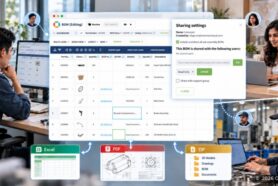
OpenBOM supports data object-level sharing (e.g. share design project, catalog, BOM, order, etc). This means a company can share a specific BOM, catalog or vendor item with an external company without exposing any other data. This is important for multi-company collaboration where only a limited portion of the product data is relevant to a contractor, supplier or manufacturing partner.
Object-level sharing also eliminates the need for exporting data and sending them as attachments when you need to share it between two customers using OpenBOM. Because data never leaves the structured OpenBOM environment, traceability and control are preserved.
Scalability and Performance
Scalability is an important characteristic of OpenBOM’s architecture. The platform is capable of serving very small companies that manage a few hundreds of items and large enterprises that manage millions of items with deep multi-level product structures. The multi-tenant model provides automatic scaling of both storage and compute resources. Customers do not need to install additional hardware or reconfigure systems as data grows.
The combination of NoSQL databases, graph databases and optimized data storage allows OpenBOM to support large amounts of data and a high frequency of updates. The platform also supports simultaneous editing and real-time collaboration because the data model and storage systems are designed for this functionality and mutli-tenant architecture supports it. Think of operations similar to sharing online documents (eg. Google Doc). OpenBOM applies similar tech and logic to share highly structured data and allows simultaneous editing of data objects (eg. BOMs, catalogs, design files).
Elastic scaling means that OpenBOM can provision new tenants instantly, manage updates for all tenants efficiently and operate reliably even as the overall workload grows.
Compliance and Operational Practices
Compliance is a critical part of operating a cloud platform for manufacturing companies. OpenBOM is SOC 2 Type II certified. This certification requires continuous auditing of operational processes related to security, availability, processing integrity and confidentiality.
OpenBOM maintains active monitoring and logging across all environments. This includes security monitoring, intrusion detection and secure deployment processes. Updates and security patches are applied automatically without customer intervention. The platform is updated continuously, which allows us to improve performance and security on an ongoing basis.
Customers who want to review the details can visit the security section of the OpenBOM website and access our SOC 2 report through standard request processes. Check OpenBOM’s security page for more information.
Conclusion
OpenBOM provides a secure, scalable and modern data management environment designed specifically for engineering, manufacturing and supply chain workflows. The combination of multi-level security practices, database isolation, flexible deployment models and SOC 2 Type II compliance creates a strong foundation for building a digital thread that spans PDM, PLM, BOM, procurement and service information.
Multi-tenancy allows OpenBOM to support controlled cross-company collaboration while maintaining strict data boundaries. The architecture also allows customers to grow from early-stage usage to enterprise-scale workloads without reconfiguration.
Security, scalability and compliance are central to OpenBOM’s design. As customers extend OpenBOM usage across teams and partners, the platform provides the infrastructure needed to manage data safely and reliably.
If you have questions about OpenBOM infrastructure and security, please contact OpenBOM support to talk to our team.
Meantime, REGISTER FOR FREE and check how OpenBOM can help you.
Best, Oleg
Join our newsletter to receive a weekly portion of news, articles, and tips about OpenBOM and our community.