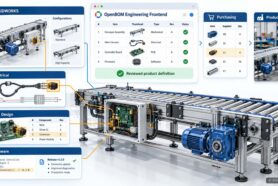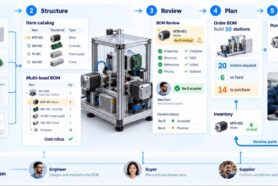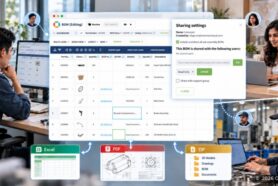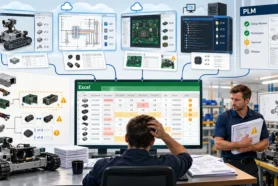
Every manufacturing company today is under tremendous pressure to deliver products faster, more efficiently, and with fewer mistakes. Product complexity keeps rising, but most organizations still rely on disconnected spreadsheets, emails, and tools that don’t speak the same language. Engineers scramble to align data. Procurement tries to chase suppliers. Operations works with whatever information they can get. Meanwhile, deadlines don’t move and customers don’t wait.
For decades, PLM ROI was measured almost exclusively through the lens of engineering productivity. If engineers could create drawings faster, manage revisions more accurately, or release changes more efficiently, the PLM implementation was considered successful. And to be fair, engineering productivity is still an important and very real benefit.
But modern manufacturing is no longer an engineering-only activity. Products are developed in a hyper-connected environment where decisions in design have implications for procurement, supply chain, manufacturing, finance, customer delivery, and even service. All these moving parts are intertwined. A design decision taken without validation with supply chain or manufacturing engineer, incorrect counting, etc can ripple across the entire organization and impact the results .
Because of this, ROI must be redefined.
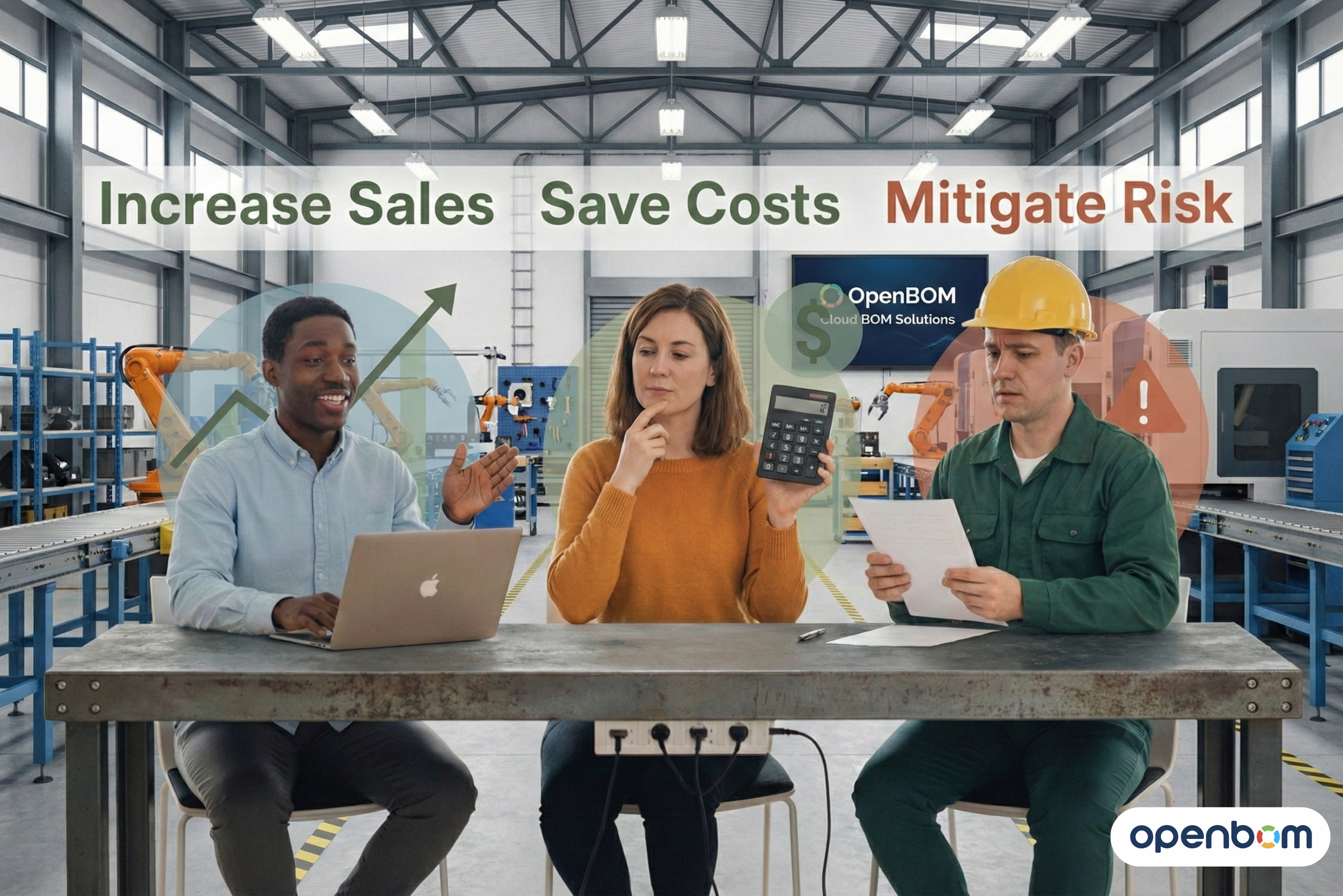
PLM is not an engineering tool as it was defined for the last 20 years. Instead of seeing PLM as a tool that improves engineering efficiency, manufacturers must view it as a system that impacts both the top line and the bottom line. Faster quoting speeds up sales. Earlier visibility into supply-chain risk helps avoid delays. Accurate data across engineering and operations prevents costly mistakes. Real-time coordination reduces waste and accelerates time to market.
This is exactly where OpenBOM creates value. And it is why we see OpenBOM customers see ROI very differently from the way it was measured twenty years ago.
Today’s blog—Day 28 of the 30-Day OpenBOM series—explores the expanded ROI model of modern manufacturing. We’ll look at how OpenBOM helps companies increase revenue, reduce operational costs, and mitigate risks across the entire lifecycle of a product, from design to ordering to manufacturing.
Rethinking ROI: The Manufacturing World Has Changed
If you walk into any manufacturing company, you’ll hear the same story: “We move slower than we want,” “We spend too much time fixing mistakes,” and “We should be using better data, but our systems don’t support it.” For years, engineering teams tried to solve these challenges by focusing inward—better CAD, better PDM, better drawings, better control over what engineering produces. Those efforts mattered, but they didn’t address the full picture.
A modern ROI model must acknowledge that engineering is only part of the equation. Design decisions now directly shape how fast a sales team can quote, how early procurement can act, whether suppliers can deliver on time, how smoothly manufacturing can build, and how reliably products reach customers. This is no longer a world where engineering hands off data and hopes for the best. This is a world where engineering, procurement, operations, and supply chain must all work from the same real-time information.
OpenBOM delivers ROI because it eliminates the cost of misalignment and allows companies to operate as one cohesive system rather than several disconnected islands.
How OpenBOM Helps Companies Capture More Revenue
One of the most underestimated sources of ROI is the ability to increase revenue by moving faster and delivering more reliably. In manufacturing, revenue is rarely limited by the sales team alone—it is constrained by the speed and accuracy of engineering and procurement.
When engineering works in spreadsheets, BOMs are always behind the design. Procurement works with partial or outdated information. Operations waits for updates. Sales can’t quote accurately. Opportunities disappear.
OpenBOM replaces that chaos with clarity. A design change in CAD flows directly into OpenBOM, instantly updating quantities, costs, and supplier information. Quoting becomes faster because everyone sees the same real-time data. Procurement can begin sourcing earlier and with more confidence. Operations no longer scrambles to understand what changed and why. And customers experience shorter lead times because the entire organization moves in sync rather than in sequence.
Speed becomes a revenue driver.
Another significant revenue benefit comes from quoting. Many companies lose deals simply because they can’t assemble a complete and accurate quote fast enough. OpenBOM gives them the ability to produce quote-ready BOMs in minutes instead of days. That speed increases win rates and provides more predictable sales cycles.
OpenBOM also makes engineering more productive without forcing companies to hire more staff. When manual tasks like updating spreadsheets, tracking revisions, or explaining changes are eliminated, engineers reclaim hours every week. Those hours are reinvested in product development, accelerating innovation and increasing throughput.
And perhaps the most modern source of revenue lift comes from early supply-chain visibility. When engineers can see lead times, availability, and alternates during design—not after release—they make choices that avoid delays, shortages, and costly redesigns. Weeks saved upstream translate into months of additional revenue downstream.
How OpenBOM Helps Companies Reduce Costs
Cost reduction is the most familiar component of ROI, but it is often misunderstood as purely labor savings. In reality, cost is reduced when the entire organization works more efficiently and fewer avoidable problems reach production.
One of the simplest and most powerful cost-saving mechanisms OpenBOM provides is freedom from spreadsheet chaos. Spreadsheets break easily, hide errors, and require constant manual maintenance. Teams may spend dozens of hours each week reconciling versions, updating quantities, or chasing down missing data. OpenBOM replaces these fragile tools with structured, automated, real-time BOMs that generate themselves directly from CAD and remain accurate throughout the lifecycle.
Purchasing is another major area where OpenBOM reduces cost. Without visibility into changes, procurement teams often order too much inventory, purchase the wrong parts, place urgent rush orders, or buy outdated revisions. These mistakes cost far more than labor. OpenBOM gives purchasing teams accurate quantities, cost information, and supplier data early, allowing them to make informed buying decisions instead of reactive ones. The result is less waste, less scrap, fewer rush orders, and more predictable operations.
Rework is another silent killer of profitability. Whether it’s scrapped parts, reassembled builds, or delayed shipments, every mistake consumes time, materials, and credibility. Because OpenBOM synchronizes revisions across engineering and operations, teams build the correct version the first time, dramatically reducing scrap and rework.
OpenBOM also enables reuse. Over time, catalogs, items, and subassemblies become shared resources that engineering and procurement can apply across projects. This reuse leads to standardization, faster development, and lower purchasing costs.
How OpenBOM Helps Companies Mitigate Risks
Risk mitigation often produces the highest ROI because the cost of mistakes in manufacturing can be enormous. A single incorrect order, a wrong revision, or a missed supplier change can halt production and cost tens or hundreds of thousands of dollars.
OpenBOM mitigates these risks by ensuring that everyone works from a single, real-time source of truth. Purchasing mistakes drop dramatically when procurement has accurate data. Engineering revisions no longer get lost or misinterpreted. Supply-chain volatility becomes easier to navigate when alternate components and suppliers are visible early.
Compliance and traceability extend the risk mitigation story. Many industries require strict documentation of revisions, approvals, and change processes. OpenBOM maintains this information structurally and automatically, reducing the risk of audit failures or quality issues.
The real value in risk mitigation is that it prevents the worst-case scenarios—the ones that would otherwise erase months of profit.
The OpenBOM ROI Equation
When you combine all these effects—faster cycles, fewer mistakes, better purchasing decisions, higher throughput, and increased predictability—the ROI becomes compelling. A simple equation emerges:
ROI = (More Sales + Faster Cycles + Fewer Mistakes + Lower Cost of Operation) – Subscription Cost
In most cases, the subscription cost is trivial compared to the operational and financial value OpenBOM delivers. And because the benefits compound as teams scale and processes mature, the ROI grows over time.
OpenBOM is not a cost. It’s a system for running profitable, resilient manufacturing operations.
Where Companies See ROI First
Across hundreds of customers, the pattern of ROI emergence is consistent.
The first signs appear in time savings—OpenBOM eliminates the most painful manual tasks almost immediately, freeing engineers and operations staff to focus on higher-value work. Shortly after, procurement begins to feel the impact as purchasing becomes more predictable, accurate, and consolidated.
Eventually, the entire operation stabilizes. Production errors decline. Supply-chain surprises decrease. Engineering changes flow cleanly. Communication becomes easier. And the organization stops operating in crisis mode.
When companies reach this stage, OpenBOM becomes not just a system but a core operational advantage.
Why Many Companies See ROI in the First Month
Traditional PLM systems require long, difficult implementations before delivering value. OpenBOM works differently. Its lightweight, data-first architecture integrates quickly with existing tools and begins producing results immediately.
With OpenBOM, value starts showing up almost immediately—CAD integration works on day one, BOM automation kicks in the moment your designs sync, procurement and inventory visibility start to fall into place naturally, and even revision control and traceability come online without any complicated setup.
As soon as spreadsheets disappear and information begins to flow automatically, the ROI becomes tangible.
Customer Examples: Real ROI in Action
One of the clearest ways to understand OpenBOM’s ROI is to look at how real companies use it every day to move faster, work smarter, and avoid costly mistakes. Across industries—from energy systems to automotive to industrial equipment—OpenBOM consistently delivers measurable improvements in quoting, purchasing, engineering coordination, and supply-chain communication.
Consider Canmet Design story, a company that needed to accelerate quoting and costing. Their manual process simply couldn’t keep pace with customer demand. After adopting OpenBOM for SOLIDWORKS, their quoting cycle became dramatically faster and more accurate. As the team put it, “OpenBOM lets us move from design to costing and quoting almost instantly, which wasn’t possible before.” Their story shows how real-time BOM data directly fuels sales velocity.
Xponent Power offers another strong example. They struggled with revision clarity and keeping contract manufacturers aligned with product updates. OpenBOM provided a structured release process that finally gave them control. They described the transformation simply: “OpenBOM gives us a clear, controlled release process so everyone knows what version we’re working from.” Read more about them in this story.
FenceQuip’s experience highlights OpenBOM’s impact on purchasing. Before OpenBOM, buying decisions were scattered across spreadsheets that often contained errors. After implementation, their purchasing became lean, consistent, and accurate. They explained, “We reduced purchasing mistakes by over 50% because OpenBOM showed us exactly what to buy and when.” Read their case study here.
Vartech Systems saw significant savings not only in efficiency but also in engineering time. Before OpenBOM, their engineers spent hours reconciling changes and managing spreadsheets. Read more about it in the story. After adopting OpenBOM, those hours disappeared. The team shared, “We save at least two hours of engineering time every day with OpenBOM, and we finally have quick impact analysis when parts change.”
Tomcar, an amazing off-road vehicle manufacturer, uses OpenBOM to coordinate engineering and global manufacturing partners. For them, accuracy and shared visibility are essential. With OpenBOM, their teams and suppliers work from an always-updated product definition. As Tomcar described it in their story, “OpenBOM lets us deliver a complete product definition globally and keep everyone aligned—from engineering to manufacturing partners.”
RF IDeas, working with contract manufacturers, focused on improving communication and speeding up ECO cycles. Read more in their story by navigating this link. OpenBOM’s structured collaboration and data-sharing tools made a measurable difference. They noted, “OpenBOM helped us streamline communication with our contract manufacturers and speed up our ECO cycle.”
Across all these stories, a consistent pattern emerges: OpenBOM improves more than engineering workflows. It improves quoting, purchasing, release processes, ECOs, and supply-chain communication. Each improvement connects directly to revenue, cost, or risk—exactly what modern ROI requires.
Conclusion – OpenBOM as a Modern ROI Engine
Manufacturing today is not simply about designing products—it is about orchestrating a complex network of decisions across engineering, procurement, operations, and supply chain. Traditional PLM systems did a good job improving engineering productivity, but the ROI expectations of modern manufacturing extend far beyond that. Companies now need systems that accelerate sales cycles, reveal supply-chain risks early, coordinate changes instantly, reduce costly mistakes, and deliver data that supports the entire organization.
OpenBOM is built for this new reality. It provides a connected, real-time digital thread powered by flexible xBOM structures and integrated procurement workflows. This connection turns scattered information into reliable, actionable insights and unifies design, engineering, inventory, suppliers, and purchasing into one coherent environment. When these elements move in harmony, the entire product lifecycle becomes faster, smoother, and more cost-effective.
The impact is immediate. Companies that adopt OpenBOM find themselves winning business more consistently because they can quote with accuracy and speed. They ship products faster because engineering and procurement work together instead of chasing each other. They waste less money because errors and duplications begin to disappear. And they operate with confidence because everyone sees the same information in real time.
OpenBOM is not just about managing product data—it is a profitability engine for modern manufacturing. Its ROI is fast, easy to measure, and grows every month as teams align more deeply and replace fragmented workflows with connected ones. As manufacturing complexity continues to rise, the companies that invest in connected data and scalable workflows will be the ones who outperform their competitors. OpenBOM is built for that future—and it begins delivering ROI from the very first day.
REGISTER FOR FREE to check how OpenBOM can help.
Best, Oleg
Join our newsletter to receive a weekly portion of news, articles, and tips about OpenBOM and our community.