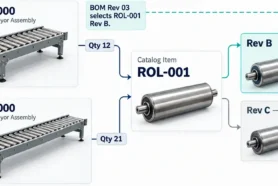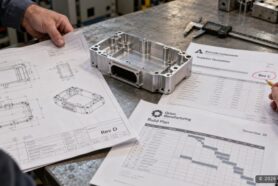
Change is the most constant thing in product development. Therefore managing changes is quickly becoming a paramount challenge for every product development team. If your product development team relies on spreadsheets, you will quickly find yourself in a mess of multiple Excel files and a continuous process of finding differences between them. The culmination of the mistakes will be the wrong Excel that will be sent to a contract manufacturer and you will burn a lot of money finding why the production batch you order will go to the trash.

If you think, the process I described above won’t happen to you, think twice. At OpenBOM, we contracted with small companies and large Fortune 500 enterprises both using spreadsheets to manage bills of materials and struggling to organize their revision and change management process.
Why Develop A New Revision Management Process?
Revision and change management was around for a few decades, so you might ask yourself why companies are struggling with BOM management and why to develop a new revision management process as we do at OpenBOM?
There are 3 fundamental changes that happened recently in product development and manufacturing that made us think that traditional systems won’t fit and we need to find a better way.
- Distributed Teams
- Agile product development
- Collaboration
The time when the team of engineers was located in the same building is gone forever. Companies are working globally and teams are located in different places and they need to work together. How do you let multiple team members work together and keep up to speed is a big challenge? You won’t be able to do so by sending Excels attached to emails or sharing files on Google Drive or similar locations.
Companies are looking at how to work faster and more efficiently. Companies are adopting agile methodologies allowing teams to deliver results faster and with higher quality. But in order to do so, they need new data management tools to allow them to manage their tasks and corresponding data.
To organize agile distributed teams, companies need to find a way to collaborate with their tasks without blocking each other and deliver results in a manageable and controlled way. Real-time collaboration, combined with simultaneous editing capabilities – is a challenge for most of the traditional data management tools designed to work in sequential order, editing data, loading a new revision, and then replacing them.
Real-Time Collaboration
At OpenBOM, we invented a technology that allows you to organize collaborative editing of structured data such as Bill of Materials by multiple people at the same time without creating conflict and without multiple users blocking each other. OpenBOM patented BOM collaboration is the method that allows teams to do multiple edits, resolve conflicts, and consolidate the work done by multiple people located in different places.

New Revision Management Method
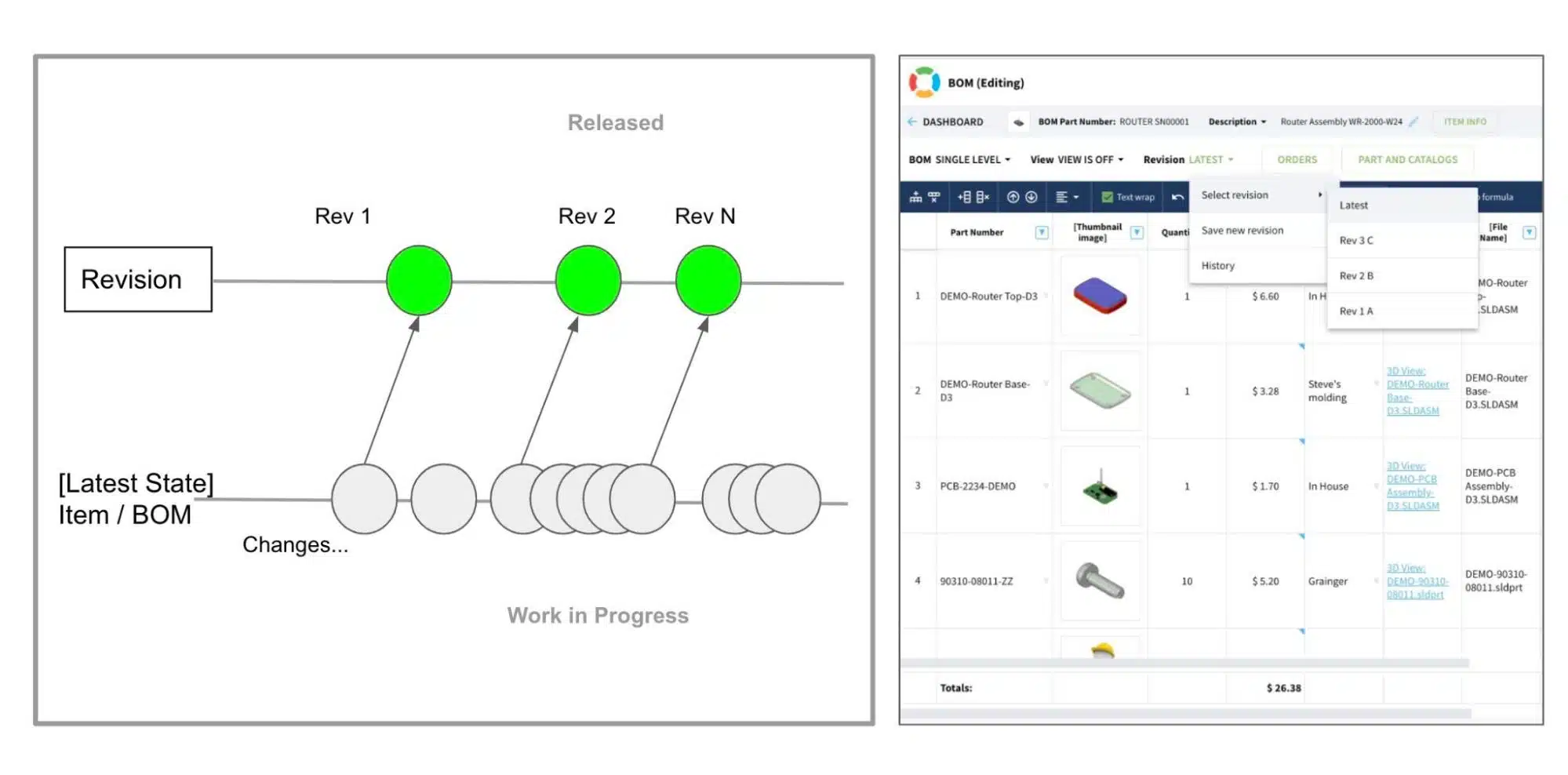
A new collaborative editing mechanism requires rethinking the way to manage BOM revisions and track changes. We’ve been inspired by GitHub and many other modern version control software to create a new mechanism to manage BOM revisions.
We just took it upside down from what is traditionally done. Instead of creating a new revision, making changes in the revision, and then releasing it, OpenBOM uses a collaborative space “Latest State” that allows multiple people to edit information using the Real-time collaboration mechanism I described above and once the team is coming to the sufficient maturity state, to create a “revision” that is immutable. OpenBOM captures full history automatically and allows you to compare and show the difference between multiple revisions.
Conclusion
Modern manufacturing and product development environments created a demand to rethink the way revision control can be done for distributed teams to support the agile product development methods. OpenBOM allows multiple users to perform simultaneous editing of BOM’s “latest state” and promote the results to a revision once the desired maturity level is reached.
To sum it up, OpenBOM allows the team to manage revision and change management processes by multiple engineers, production and procurement planners, contract manufacturers, and suppliers all working together collaboratively in real-time. It saves tons of time and money for manufacturing companies.
REGISTER FOR FREE and start a 14-day trial to check out how OpenBOM can help you establish a modern BOM revision control.
Best, Oleg
Join our newsletter to receive a weekly portion of news, articles, and tips about OpenBOM and our community.