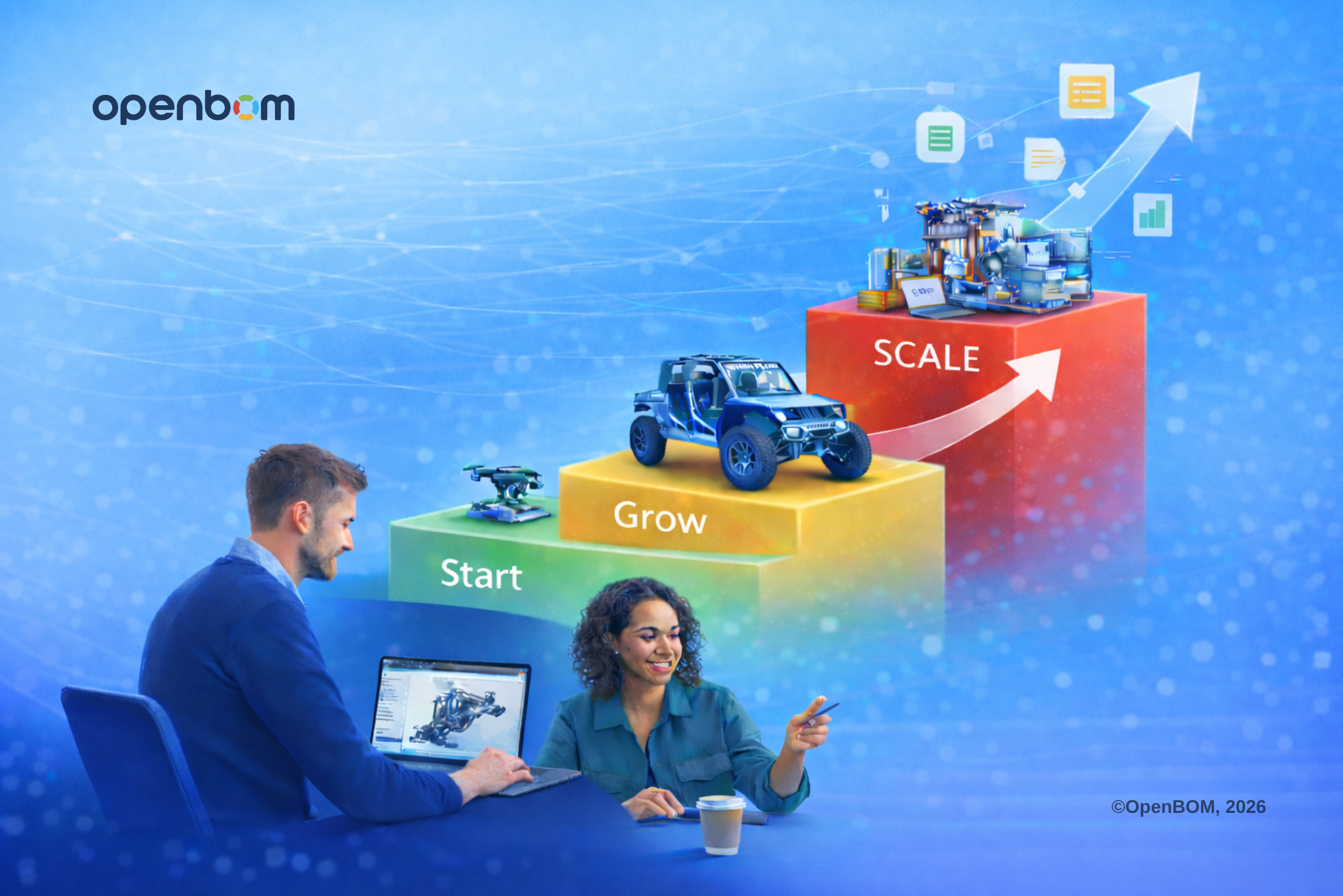
When customers succeed, their products grow. And when products grow, product data grows with them.
Over the past year, we listened closely to how teams at different stages use OpenBOM — from early product development to large, data-heavy environments preparing for integrations and AI. What we learned is simple: pricing should enable growth, not slow it down.
That’s why we’re introducing a new OpenBOM pricing and licensing model for 2026, designed to start small and scale naturally with our customers’ businesses.
Read OpenBOM Pricing 2026 Press Release.
What we learned from customers
OpenBOM is used by a wide range of organizations. Some teams manage a few hundred parts and want to get started quickly. Others manage tens of thousands of parts, collaborate across departments, integrate with CAD and ERP systems, and increasingly think about AI readiness.
What we consistently heard is this:
- Early-stage teams want a low barrier to entry
- Growing teams want predictable, transparent scaling
- Mature organizations want pricing that reflects real data growth, not friction
- Everyone wants better ways to share data without paying for seats that only need visibility
Our 2026 pricing model is built around these realities.
What’s changing in OpenBOM pricing
The new model introduces a few important concepts while keeping the core structure familiar.
Foundation licenses
We continue to offer foundation licenses at three levels:
- Team
- Company
- Enterprise (available via sales)
These licenses define the collaboration scope and core capabilities of OpenBOM.
Function- and role-based licensing
Some OpenBOM capabilities are used by specific roles rather than by every user. The new model reflects this by introducing licenses for functions such as:
- CAD add-ins (only for seats using CAD)
- ERP integrations (flat rate for the entire company)
- API-based access (reflected in the number of records, not limiting number of calls or activity)
This allows organizations to license OpenBOM based on how it is actually used.
No minimum seats requirement
We are removing the need to purchase the minimum number of seats, which we got a strong feedback about our customers, especially those that coming from small engineering teams and SMB/SME manufacturing.
Free read-only access
We are introducing free read-only seats to encourage data sharing across teams and partners. Visibility should not be a barrier to collaboration, and read-only access should not require a paid seat. Read only seats also allows you to export data to any formats (Excel, PDF, Zip).
Scaling based on data, not activity
One of the most important changes in the 2026 model is consumption-based scaling tied to product data size. We call this data records.
What data records are
Data records reflect the scale of your product data:
- Unique part numbers
- BOM part records
- Unique files managed by OpenBOM PDM
What data records are not
Data records do not include:
- Revisions or versions
- Derivative files
- Number of properties
- Storage size (which remains unlimited)
This means teams can iterate freely, revise designs, and collaborate without worrying about hidden penalties.
Example: How it works in practice
- Small startup and/or product
500 part numbers + 1,000 BOM records + 500 CAD files
→ No data record charge - Larger product
10,000 part numbers + 20,000 BOM records + 30,000 CAD files
→ Charged proportionally based on data record tiers
The intent is straightforward: small products and companies stay affordable, and larger datasets scale gradually and transparently.
Pricing structure for 2026
The fundamentals remain familiar.
- Billing options: Monthly and Annual
- Core tiers:
- Team — $30 / seat / month (annual billing)
- Company — $90 / seat / month (annual billing)
- Enterprise — via sales
- Functional tiers:
- CAD add-in – $25 / seat / per CAD (only for users of a CAD system).
- ERP integration – flat price per integration (no seats)
Data records include up to 2,000 records at no charge, with graduated tiers beyond that (10,000, 20,000, 25,000+ records).
Example: 10 people team with 4 people editing data, 2 SolidWorks users, 1 Altium user developing small products and sharing read-only data with 10 partners (see an example above 2000 data records ) will be paying $90×4 (company) + $25×3 (CAD add-ins) and getting 6 free read-only seats. Total $435 / month for annual billing and unlimited read only company and partner users.
AI, integrations, and platform economics
Another reason for this update is how OpenBOM itself is evolving.
OpenBOM is increasingly used as infrastructure:
- Connecting CAD and ERP systems
- Supporting API-based workflows
- Preparing structured data foundations for AI
At the same time, our technology partners are changing their own licensing models, including API-based royalties and usage charges. To sustainably support integrations, APIs, and upcoming OpenBOM AI capabilities, our pricing needs to reflect that reality.
Later in 2026, we will introduce AI token-based pricing to support OpenBOM AI agents as they become available. This will be announced separately.
What stays the same for existing customers
This is important to say clearly.
- Existing customers are fully grandfathered
- Current contracts remain unchanged
- Renewals can continue under existing terms
The new pricing model applies only to new customers.
During the transition period, new customers can choose:
- The existing online pricing model, or
- The new 2026 pricing model by working with OpenBOM sales
Why we’re doing this
This change is not about charging more. It’s about charging more fairly.
We want OpenBOM to:
- Be easy to start with
- Scale naturally with product success
- Encourage collaboration and visibility
- Support integrations, APIs, and AI without friction
As customers grow, their product data grows. Our pricing should reflect that journey — not get in the way of it.
Frequently Asked Questions
Q1: Does this pricing change affect existing OpenBOM customers?
No. All existing customers are fully grandfathered. Your current contract remains unchanged, and you can renew under your existing terms.
Q2: When does the new pricing take effect?
The new pricing model is available immediately (January 2026). During the transition period, new customers can choose between the existing online pricing or the new 2026 pricing model by working with OpenBOM sales.
Q3: Who is required to use the new pricing model?
Only new customers who choose the 2026 pricing model. Existing customers are not required to migrate.
Q4: What exactly counts as a data record?
Data records reflect the scale of your product data, including:
- Unique part numbers
- BOM part records
- Unique CAD and managed files in OpenBOM PDM
Q5: What does NOT count as a data record?
The following are not counted:
- Revisions or versions
- Derivative files
- Number of properties
- Storage size (storage remains unlimited)
Q6: Will frequent edits or iterations increase my cost?
No. You can revise designs, update BOMs, and iterate freely. Pricing is based on data scale, not activity or change frequency.
Q7: Why introduce consumption-based pricing now?
Customers increasingly use OpenBOM as a data foundation for integrations, APIs, and future AI workflows. Consumption-based pricing allows OpenBOM to scale fairly with real data growth while supporting ongoing investment in these capabilities.
Q8: Will OpenBOM introduce AI pricing?
Yes, later in 2026 we will introduce AI token-based pricing to support OpenBOM AI agents and automation features. This will be announced separately.
Q9: How do I know which pricing option is right for me?
If you’re a new customer, you can either purchase using the existing online pricing or work with our sales team to evaluate the new 2026 model based on your data and usage patterns.
A new pricing page will be soon available online. If you have questions about how the new pricing applies to your situation, our team is always happy to talk.
Best, Oleg
Join our newsletter to receive a weekly portion of news, articles, and tips about OpenBOM and our community.