How many bill of materials do you actually need? I get this question a lot from engineering and operations leaders who are scaling their product development. The short answer: it depends on your product complexity and where you are in the product lifecycle.
In my experience working with manufacturing companies, teams that use only one BOM across all functions end up with misaligned data, production surprises, and service headaches. Different lifecycle stages and teams require different BOM types.
In this article, I’ll walk through the main ones: eBOM, mBOM, sBOM, and pBOM. I’ll explain how they differ, and help you decide how many you actually need.
REGISTER FOR FREE to see how OpenBOM helps you manage multiple BOM types in one connected system.
What Are the Main BOM Types?
A bill of materials (BOM) is not a single document. Depending on your business, you may work with several BOM types, each serving a different team and a different stage of the product lifecycle.
If you need a foundational refresher on bill of materials types, formats, and examples, that guide covers the building blocks. Here is a quick overview of the main lifecycle types:
| BOM Type | Full Name | Primary User | Lifecycle Stage |
|---|---|---|---|
| eBOM | Engineering BOM | Engineering team | Design & development |
| mBOM | Manufacturing BOM | Manufacturing teams | Production & assembly |
| sBOM | Service BOM | Field service & support | Post-sale maintenance |
Each BOM type captures the same product from a different angle. Together, they form the backbone of efficient product lifecycle management and supply chain coordination across your organization.
Engineering BOM (eBOM)
An Engineering BOM (eBOM) represents the product as designed by engineering, typically generated from CAD and PLM systems. It captures design intent, design specifications, and all components as the engineering team envisions them, before any production constraints are applied.
The eBOM is structured around design, functional and logical relationships between components. It answers the question: what should this product be?
It includes raw materials, assemblies, subassemblies, fasteners, electronics, and all associated design documentation. When engineering makes a change, updating a dimension, swapping a component, or releasing a new revision, the eBOM is the record that captures that change.
What makes the eBOM different from other BOM types is its design-centric orientation. It is not optimized for the shop floor. It does not include routings, tooling, or packaging.
Its job is to define the product completely and correctly at the design level, so that every downstream function (manufacturing, procurement, service) can be built from a reliable foundation.
Use the eBOM during the design phase, during engineering change management, and whenever you need to trace a component back to its design origin. Consistent part numbering is foundational here, see part number best practices for how to set this up correctly from the start.
Manufacturing BOM (mBOM)
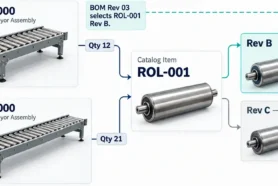
A Manufacturing BOM (mBOM) adapts the engineering BOM for shop-floor production. While the eBOM defines the product as designed, the mBOM defines the product as built.
It includes everything the production line needs that the eBOM does not: routings, tooling references, packaging materials, consumables, and production-specific groupings that reflect the actual assembly process.
In practice, the mBOM may split a single eBOM assembly into multiple production steps, or combine several eBOM items into a single kit for a workstation. It reflects the production process as it happens on the floor, not as the engineer imagined it at the CAD screen.
This makes the mBOM critical for production planning, material allocation, and execution in ERP and MRP systems.
The transition from eBOM to mBOM is one of the most critical handoffs in product development. When this handoff is managed poorly, through email threads, disconnected spreadsheets, or manual copy-paste, the result is costly: wrong parts ordered, production delays, scrap, and rework.
When it is managed well, through a connected digital workflow, the manufacturing teams get accurate, up-to-date materials required for production planning without having to chase engineering for clarifications.
The mBOM is also where packaging materials, production-specific labels, and bulk consumables enter the picture. These items are materials required for the assembly process but rarely belong in the design definition. That separation is intentional and valuable.
Ready to connect your eBOM and mBOM? Register for free and explore how OpenBOM bridges engineering and manufacturing in one platform.
eBOM vs mBOM: Key Differences
For companies that manufacture products, both BOM types are almost always necessary. Here is how they compare:
| Dimension | eBOM | mBOM |
|---|---|---|
| Defines | Product as designed | Product as built |
| Created in | CAD / PLM | ERP / MES / BOM tool |
| Owned by | Engineering team | Manufacturing teams |
| Includes | Design specs, components, assemblies | Routings, tooling, packaging, consumables |
| Structure | Functional / logical | Production-oriented |
| Change trigger | Engineering change order | Process or production change |
When do you need both? For virtually any manufactured product beyond a prototype. The eBOM and mBOM serve different teams with different needs.
Trying to use one BOM for both functions is one of the most common BOM mistakes that leads to misalignment, downstream confusion, and avoidable production delays.
The eBOM-to-mBOM transition is also where the “digital thread” concept becomes real. A connected digital thread means that when engineering updates the eBOM, manufacturing teams see the impact on the mBOM immediately, not days or weeks later.
Service BOM (sBOM)
A Service BOM (sBOM) lists the parts, installation steps, and repair instructions needed for field maintenance and after-sale support. This is distinct from a software bill of materials: in manufacturing, the sBOM is about physical serviceable components, not software dependencies.
The sBOM is built for field technicians and support teams who need to know which spare parts to stock, how to diagnose a failure, and what the replacement sequence looks like. It typically includes bearings, seals, filters, wear parts, and any component with a predictable service interval or failure mode.
For products that require ongoing maintenance (industrial equipment, medical devices, consumer durables) a service BOM directly affects customer satisfaction and uptime. It supports spare parts management, warranty planning, and maintenance scheduling.
Quality control is also improved when the sBOM is current: technicians use the right parts, and field failures are traced back to actual components rather than guesswork.
Not every organization needs a formal sBOM on day one. But as soon as your product enters service and customers start calling for support, the absence of a structured service BOM becomes expensive very quickly.
Procurement BOM (pBOM)
A Procurement BOM focuses on purchased components, lead times, and supplier information for purchasing teams. In general manufacturing, it surfaces the supplier-facing data needed to execute sourcing decisions: approved vendors, minimum order quantities, and supply chain dependencies.
It answers the question: what do we need to buy, from whom, and when? It is the view of the bill of materials that procurement and supply chain teams work from daily.

Other BOM Types You May Need
Beyond the four core types, a few additional BOM structures are worth knowing:
Planning BOM
A Planning BOM is used early in product development before designs are finalized, for demand forecasting and capacity planning. It is built on anticipated product configurations, giving procurement and operations teams the lead time they need to prepare materials and resources before the eBOM is formally released.
This is especially valuable in industries with long lead-time components where waiting for a final design means missing production windows.
Production BOM
A Production BOM lists all components with quantities and costs needed for a specific production order. It is closely related to the mBOM but scoped to a single manufacturing execution event, capturing actual quantities consumed, lot-level traceability, and the associated costs for that specific build.
It is the BOM of record for manufacturing execution and quality traceability.
How Many BOMs Do You Actually Need?
The problem I described above is real and companies are struggling with information spread around in multiple Excels and BOMs. Eventually, companies are looking at how to organize their information (multiple Excels) and the real question that comes up is: how many BOMs are really needed?
There is no universal answer to this question. There are multiple factors that impact the decision of BOM organizations and how information can be managed. Here are some typical factors that can be used to decide:
- The manufacturing process (MTP, CTO, ETO)
- The complexity of the product and changes
- The enterprise system setup
However, regardless of the number of BOMs you decide to manage, it is absolutely critical to ensure that the Bill of Materials represents a single source of truth about product data and that you organize the mechanism of data synchronization to support keeping the information updated and supporting the flow of information between organizations and multiple functions.
At OpenBOM we are working to provide robust support allowing our customers to manage multiple bills of Materials and share them with the right people in the organization and outside contractors and suppliers. These days we are working on new features to support seamless EBOM-MBOM communication and support for custom BOMs in OpenBOM. Check more about it here: BOM Transformations.
The answer depends on your product, your supply chain, and your operational complexity. Here is a practical decision framework:
- Simple products with direct manufacturing: An eBOM and mBOM are usually sufficient. Engineering defines the product; manufacturing executes it.
- Products with after-sale service requirements: Add an sBOM. The moment your customers need spare parts or field support, you need a structured service view.
- Infrastructure, pipeline, or procurement-intensive projects: Add a pBOM. The supply chain complexity and regulatory compliance requirements demand it.
- Highly configurable products or product families: Add a configurable BOM. Managing variants through a single structured model is far more scalable than maintaining dozens of independent BOMs.
- Products still in early development: Consider a planning BOM to support capacity and procurement preparation before the engineering release.
Most manufactured products with any meaningful complexity will end up using at least an eBOM and mBOM. Products with field service needs will add the sBOM. Infrastructure or procurement-heavy operations will add the pBOM.
For real-world scenarios and worked examples, this practical guide to different BOM type usage is a useful companion. The digital thread concept, connecting all these BOM types into a coherent, traceable data flow, is what makes managing multiple BOMs practical rather than painful.
Managing Multiple BOM Types
Managing multiple BOM types is where many organizations feel the strain, especially if they rely on disconnected spreadsheets and email. The challenges are real: version control, keeping every BOM up to date as designs evolve, and making sure the right team is always working from the right view.
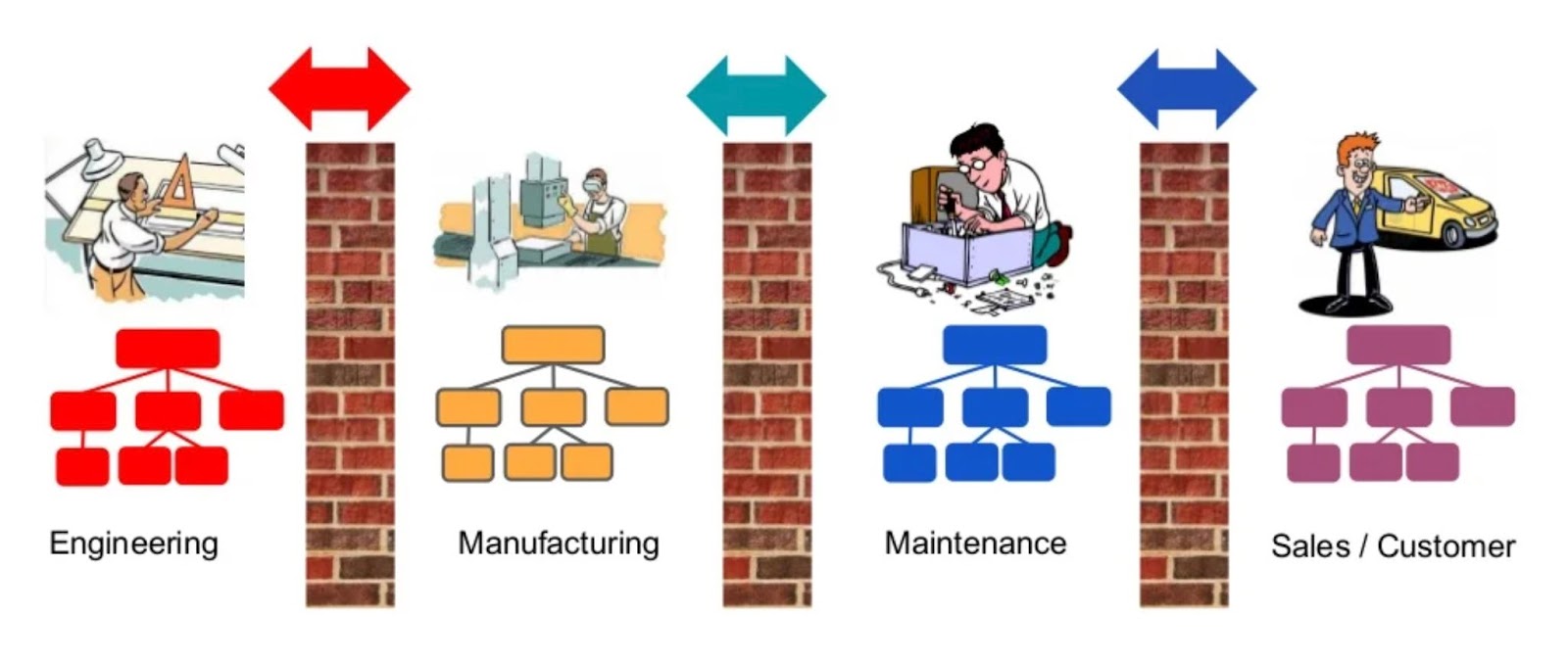
Effective BOM management across types requires a few foundational practices: a single source of truth for part data, revision control that propagates changes across related BOMs, and clear ownership for each BOM type.
Engineering owns the eBOM. Manufacturing owns the mBOM. Service and procurement own theirs. But all of them must stay connected. This is the idea behind multiple BOM types as product memory, where each BOM type contributes a distinct layer of knowledge about the product across its lifecycle.
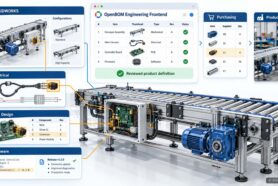
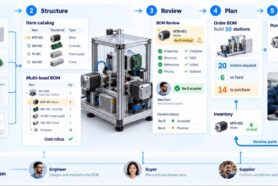
Cloud-based BOM tools like OpenBOM make this practical. Instead of maintaining separate files per team, a connected platform lets each function work from a shared product data model, with role-appropriate views, change notifications, and rollup visibility.
The result is faster change management, less rework, and more confident production execution. For a step-by-step approach, see this guide on how to create a well-organized BOM.
Explore BOM management in OpenBOM. Register for free and see how digital transformation in BOM management reduces errors and improves collaboration across your teams.
Frequently Asked Questions
What is the difference between eBOM and mBOM?
An eBOM (Engineering BOM) represents the product as designed, capturing design specifications and component relationships from CAD and PLM systems. An mBOM (Manufacturing BOM) adapts the eBOM for production, adding routings, tooling, packaging, and shop-floor specifics. Both are critical for manufactured products; using only one leads to misalignment between engineering and manufacturing.
What is an sBOM in manufacturing?
In manufacturing, an sBOM is a Service BOM: a structured list of parts, repair instructions, and serviceable components used by field technicians and support teams. It is not related to the software bill of materials (SBOM) used in cybersecurity contexts.
Do I need all four BOM types?
Not necessarily. Simple products may only need an eBOM and mBOM. Products with field service requirements benefit from an sBOM. Infrastructure and procurement-intensive projects benefit from a pBOM. The right combination depends on your product complexity, supply chain, and operational model.
How do you manage multiple BOM types without losing control?
The key is a connected, cloud-based BOM management system that maintains a single source of truth for part data, enforces revision control, and provides role-appropriate views for each team. Tools like OpenBOM are designed specifically for this challenge.
Conclusion
The number of bill of materials you need is not a fixed answer: it is a function of your product, your teams, and your lifecycle.
An eBOM captures design intent. An mBOM drives production execution. An sBOM supports field service. A pBOM connects procurement and supply chain. Together, they form the digital backbone of a well-run manufacturing organization.
If your team is still managing all of this in a spreadsheet, that is usually where BOM problems start to compound, and where the gap between what was designed and what gets built begins to widen.
REGISTER FOR FREE at OpenBOM to explore how a modern BOM management platform keeps your eBOM, mBOM, sBOM, and pBOM connected, current, and collaborative.
Best, Oleg
Related reading: What Is a Bill of Materials? Examples, Formats, and BOM Types | Practical Guide and Examples of Different BOM Type Usage | How to Create a Well-Organized BOM
“`
Join our newsletter to receive a weekly portion of news, articles, and tips about OpenBOM and our community.