Integrating different enterprise applications is crucial for businesses to operate efficiently. By streamlining information and automating business processes, organizations can improve their performance and competitiveness. However, integrating different applications can be a daunting task. At OpenBOM we put a significant focus on helping businesses to integrate OpenBOM with other applications, tools, and enterprise systems.
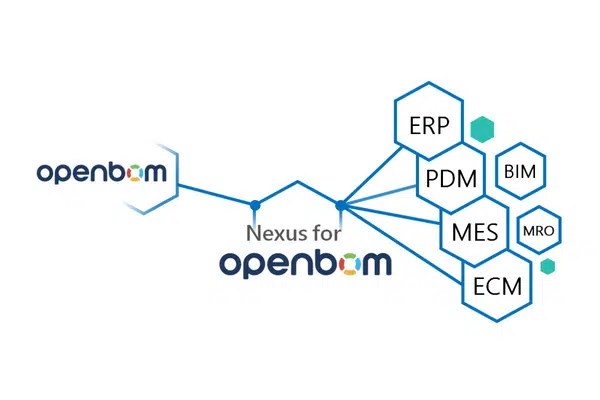
We are excited to share the news about the OpenBOM partnership with vdR Group and providing OpenBOM integrations using the vdR Nexus platform.
What is vdR Nexus?
Nexus helps engineering and manufacturing companies eliminate data and process silos by connecting enterprise applications. This extends the digital thread and drives true digital transformation.
Nexus is an enterprise connectivity solution designed from the ground up to meet the unique needs of companies engaged in engineering and manufacturing. Nexus’ approach to application integrations has dramatically simplified the process, expedites time-to-value, and lowers the overall cost of ownership.
Nexus Application Connectors
Nexus integrates with multiple applications and tools by providing seamless connectivity to transfer data and organize an event-driven integration process.
Nexus Workflows and Transaction Templates
Workflows Nexus is based on a workflow-centric architecture used to orchestrate the exchange and transfer of parts, bills of materials, metadata, relationships, and associated documents, drawings, and renditions. The workflow process incorporates traditional workflow steps or “nodes.” Each node can have its own “if-then-else” logic, programmatic processes, mappings, hooks to native application program interfaces (APIs), messaging, and other options.
To accelerate time-to-value and minimize endpoint customizing, Nexus provides preconfigured transaction templates for common use cases. Templates serve as placeholders to leverage the create, read, update, and delete (CRUD) operations required to support the exchange of data and files between various applications.
Transaction templates can be combined and customized or created from scratch. The diagram below illustrates the document/artifact release transaction process from a PLM application to an ERP application. Note that because the transaction template handles all document transfer logic, only four (4) APIs of the target applications are required in this example.

OpenBOM Architecture To Support vdR Nexus
OpenBOM is a cloud-native SaaS platform, which provides a flexible collaborative environment to manage product information single source of truth and all related information used for design, engineering, manufacturing, maintenance, and distribution. OpenBOM modern data management architecture includes cloud-native data management services and flexible REST API allowing integration with any data sources and applications.
For the purpose of integration with other enterprise applications (eg. CRM, MRP, ERP, etc), vdR Nexus provides a connector for OpenBOM allowing integration of OpenBOM using Nexus connector, workflow engine, and transaction templates.
Conclusion:
OpenBOM is partnering with vdR to expand enterprise connectivity for OpenBOM customers to support data exchange and transactions between the cloud-native OpenBOM platform and other enterprise applications. A combination of cloud-native scalable OpenBOM applications with the Nexus platform can deliver a fully integrated solution to support data handover and connectivity for enterprise connectivity.
Have questions? Please contact OpenBOM support or vdR Group to schedule a demo for OpenBOM with Nexus.
Best, Oleg
Join our newsletter to receive a weekly portion of news, articles, and tips about OpenBOM and our community.