For a long time in manufacturing, CAD files represented everything engineering needed. CAD was the center of the engineering data universe, and PDM systems that managed CAD data were the core of the engineering information hub. But this reality has been changing for many reasons—growing product complexity, organizational complexity, supply chain expansion, and the evolving processes companies use to develop products and deliver services.
PDM is still important, but it is no longer enough for modern engineering work. It performs well at what it was originally designed to do: control CAD files, manage revisions, govern access, and keep design data organized. All of this still matters. However, the scope of engineering has expanded far beyond what traditional PDM can support. Let’s talk about this in more detail.
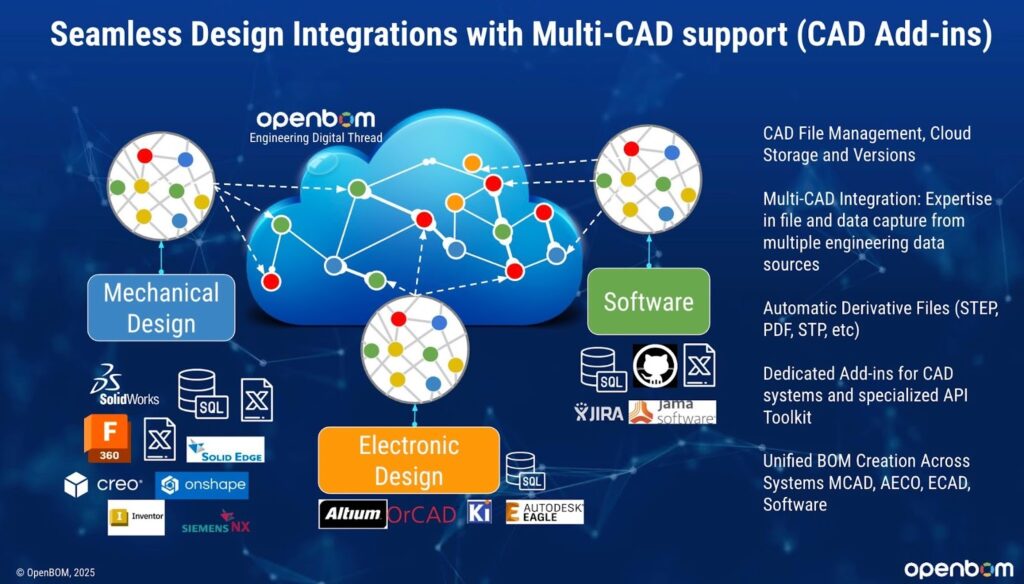
Modern products are no longer only mechanical objects represented by a single CAD model. Most products today blend mechanical design, electronics, firmware, embedded logic, cloud software, materials, suppliers, manufacturing steps, and service requirements. These products are multi-domain by nature. They span MCAD, ECAD, and software, and they include information that is not modeled anywhere in CAD systems.
This broader picture of what a product actually is exposes a simple reality. PDM is necessary to manage CAD, but engineering teams need something more flexible to manage product information as a whole.
CAD Is Not the Product
A MCAD system describes geometry. It gives you shape, fit, tolerances, and a clear visual representation. It does not describe a resistor on the PCB, the firmware version you plan to load at the factory, the adhesive used in assembly, the coating that ensures corrosion resistance, or the long lead time item that procurement must track.
These elements affect the product as much as the geometry. They influence performance, cost, manufacturability, quality, and serviceability. Therefore CAD captures only one part of the product. Because of this, a system that manages only CAD files cannot represent the full product.
This is where the Bill of Materials becomes essential. The BOM structure lists everything needed to build the product. It includes mechanical parts, electronic components, consumables, instructions, firmware, materials, packaging, and many other elements that CAD does not show. The BOM describes the product in a complete and practical way. Design teams often start with CAD, but the engineering process and company business runs on the BOM.
Modern Products Are Multi-Domain
In many companies the engineering team is not a single team. Mechanical engineers use MCAD tools. Electrical engineers use ECAD tools. Software and firmware teams use GitHub, GitLab, or another code management platform. Manufacturing engineers work with ERP or MRP systems. Quality and service teams still use other tools.
Each group manages its own set of data. Each tool is very good at what it was created for, but none of these tools represent the entire product. This creates several isolated systems. A mechanical PDM knows nothing about PCB components. An ECAD library system knows nothing about weldments or bearings. GitHub has no understanding of a capacitor’s lifecycle status.
The product exists across all these systems. There is no single PDM that can unify MCAD, ECAD, embedded code, and manufacturing information. This is why teams frequently return to spreadsheets when they try to combine everything into one place. It is also the reason the BOM becomes the center of the product definition.
The BOM Is Where the Complete Product Lives
The BOM is the structure that merges mechanical items, PCB assemblies, electronic components, software versions, materials, consumables, suppliers, alternates, and routing information. It is the only place where all these elements appear together.
When someone needs to understand the finished product, they do not look for a CAD file. They look for the BOM because it contains the information required to build, purchase, assemble, test, and service the product. Technicians use it in the field. Manufacturing uses it on the shop floor. Procurement uses it to order parts. ERP uses it to plan materials. Service teams use it to identify what is installed and what to replace.
This is why a perfect CAD model does not guarantee a successful product. A correct BOM does. The BOM is the reference point for the entire organization. PDM plays a valuable role for CAD, but the BOM plays the central role for the product.
Why BOM Work Cannot Live Inside CAD or PDM
Most CAD systems can generate a basic BOM (and export it to Excel or similar spreadsheet). That BOM reflects the mechanical structure only or PCB only or software components. It does not include adhesives, coatings, packaging, fasteners that were not modeled, alternates, software, or any manufacturing information. It cannot represent cost, vendors, or lifecycle states. For anything beyond the geometry, teams still rely on separate spreadsheets or external systems.
PDM inherits this limitation because it depends on what CAD supplies. It can manage files and revisions, but it cannot model the multi-domain nature of real products. CAD and PDM show how the mechanical assembly looks. The BOM shows how the complete product is built.
Engineering Data Evolves Together
One useful idea is to treat the BOM as an outline of the product. Engineers may not know everything at the beginning, but they can start listing the parts, materials, components, and activities that will eventually be needed. This outline grows as the work progresses. When the BOM evolves with the design, the team gains visibility early. They can catch gaps, understand dependencies, and consider the implications of mechanical changes on electronics and software, and the other way around.
This evolution cannot happen inside a PDM system because it does not have the flexibility to represent all these domains. A BOM system with a flexible data model can support this process. OpenBOM uses a graph-based data model that allows items to be connected in many ways. This makes it easier to see relationships across MCAD, ECAD, software, and other parts of the lifecycle. It also supports traceability and helps engineers understand the impact of design changes across domains.
OpenBOM captures the data from all data sources (CAD tools, PDM, ALM, Excels, databases, etc) to build a multi-disciplinary BOM structure.
Manufacturing Needs More Than What PDM Provides
Manufacturing teams need a very different view of the product. They need work instructions, routing information, tooling, fixtures, inspection requirements, alternates, substitutes, serialized parts, and many other details that PDM does not store.
Mechanical CAD does not contain this information. ECAD does not contain it either. A PDM system cannot create a manufacturing BOM. This is why mBOM definitions live in spreadsheets, ERP systems, or purpose-built manufacturing tools. They cannot be formed within the boundaries of CAD or PDM.
OpenBOM introduces a multi-view model, sometimes referred to as xBOM. It allows teams to define engineering BOMs, manufacturing BOMs, service BOMs, planning structures, and location-based structures. Each view represents a different perspective, but all of them connect to the same underlying data. This connection is what allows engineering and manufacturing to stay aligned.
Modern Engineering Requires Cloud-Native, Multi-View Systems
Engineering teams are now distributed across locations and companies. They collaborate with design contractors and suppliers. Data comes from many tools, and it changes rapidly. Traditional systems that were built around isolated file vaults are not well suited for this environment.
A modern system must support collaboration, flexibility, and the ability to capture relationships across many data sources. It needs to handle multiple representations of the product. It also needs to be accessible to people who are not CAD users. The system must be able to connect with PDM, ECAD, ERP, and other services.
OpenBOM approaches these requirements with a cloud-native, multi-tenant architecture and a graph data model that can adapt to different stages of the product lifecycle. It integrates with CAD, supports multi-domain BOM structures, connects to procurement data, and provides the foundation for real traceability across the entire product.
When CAD and BOM Do Not Match
Real problems often appear far from CAD. A resistor value that is wrong in the BOM can make an entire PCB unusable. A firmware version that is not aligned with the mechanical revision can create field failures. A missing gasket that was never modeled in CAD can lead to sealing problems. Teams often discover these issues in testing or production, not during CAD review.
These issues reflect a gap in the process. CAD was correct. PDM managed CAD correctly. The product failed because the multi-domain BOM was incomplete or inaccurate. This is why treating PDM as the central engineering system is no longer sufficient.
OpenBOM PDM and PDM Complementation
PDM is still very important. It manages check-in, check-out, revisions, and file control. It protects design work and helps engineers organize mechanical or electronic CAD data. But PDM stops at the file boundary.
OpenBOM Design Projects is the PDM solution native part of OpenBOM. It provides a simple yet powerful way to help customers to manage design files (eg. SolidWorks), but also integrates with other PDM solutions.
OpenBOM continues beyond that point. It manages multi-domain product structures. It supports purchasing, costing, mBOMs, service structures, traceability, and collaboration across teams and companies. It provides the framework to connect engineering and manufacturing and to support the entire lifecycle.
PDM and OpenBOM work together. PDM controls CAD. OpenBOM manages the product.
Conclusion
Engineering has changed. Products now include mechanical, electronic, and software components. Teams work across disciplines, tools, companies, and locations. The information needed to design and build a product is broader and more flexible than what a CAD-centric PDM system can provide.
PDM is still useful and important for managing CAD data, but it cannot manage engineering data as a whole. A modern approach requires a system that can represent the complete product, support multiple BOM views, track cross-domain relationships, and maintain quality and traceability throughout the lifecycle.
This is the role that OpenBOM fills. It provides you with PDM service (OpenBOM Design Projects ) or complements your existing PDM system and allows engineering and manufacturing teams to work with a complete and accurate representation of the product. It provides a practical way to manage the complexity of modern products without forcing everything into a CAD world.
REGISTER FOR FREE to check how OpenBOM can help you.
Best, Oleg
Join our newsletter to receive a weekly portion of news, articles, and tips about OpenBOM and our community.