Introduction
Creating a Bill of Materials (BOM) is both a simple and complex process that stands at the heart of operations for users starting with OpenBOM. Initially developed in the early days of OpenBOM, this process has been identified as needing enhancements to better serve its users. This insight stems from continuous feedback and the evolving needs of our community, especially those transitioning from traditional methods like spreadsheets to more integrated systems.
The Need for Improvement
The connection between BOM creation and new item generation was one of the primary areas identified for enhancement. Traditionally, a BOM is intrinsically linked to an item; however, this wasn’t sufficiently clear to users, particularly those accustomed to spreadsheet-based management. The ambiguity around this association prompted us to rethink and streamline our approach to improve clarity and usability.

Enhancements to the BOM Creation Process
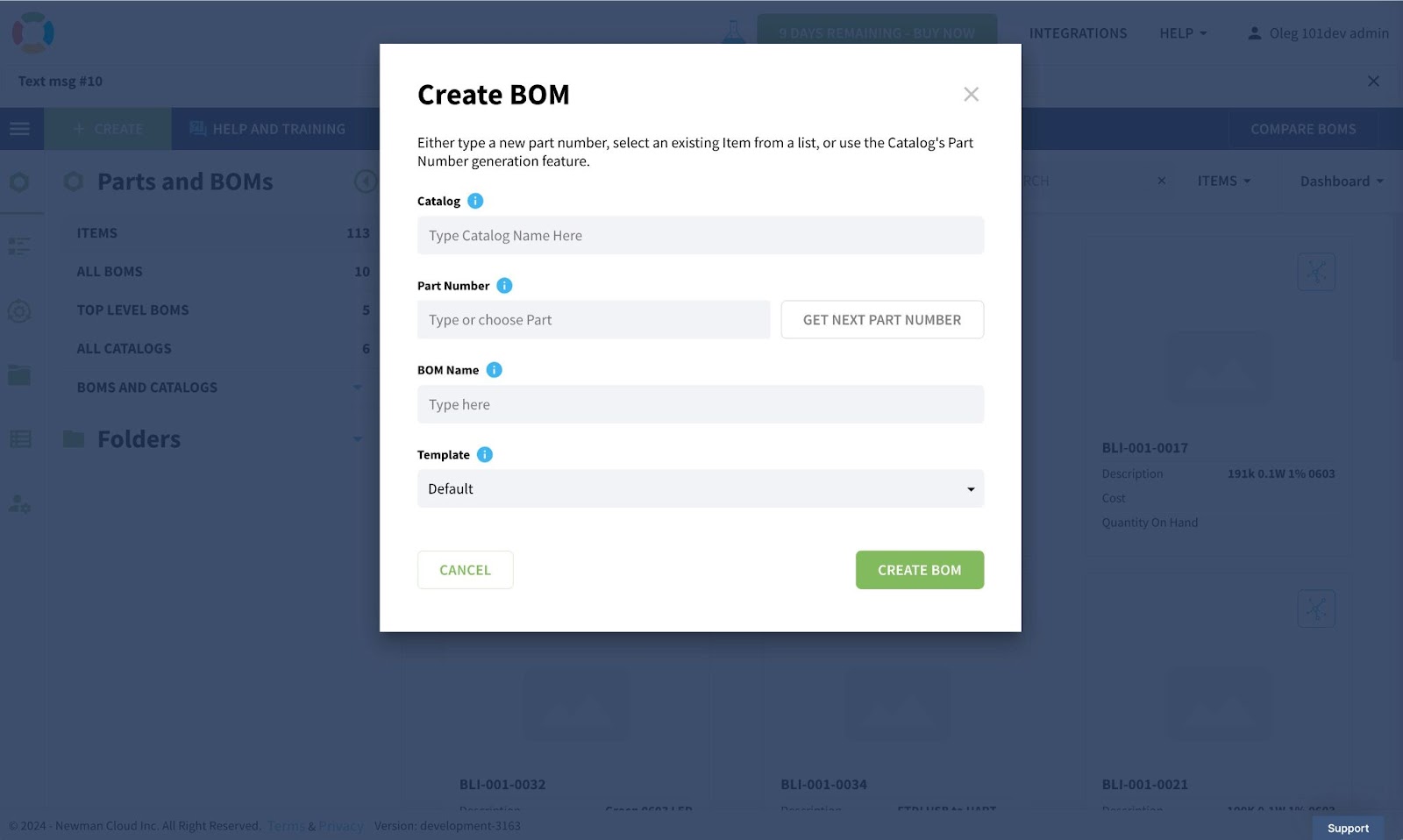
Based on user feedback, several key improvements have been implemented to enhance the BOM creation experience on OpenBOM. These enhancements are designed to make the process more interactive and user-friendly, reducing the learning curve for new users and increasing efficiency for all. The main changes include:
- Simplifying Catalog Selection: We’ve made it easier for users to select a catalog for the top-level item, streamlining the initial steps of BOM creation.
- Automating Part Number Generation: A new feature automatically generates a part number and adds the top-level item to the catalog, eliminating manual entry errors and speeding up the process.
- Preventing Duplicate BOMs: To improve data integrity and management, we’ve introduced checks to prevent the creation of duplicate BOMs with the same part number.
Demo Video
To showcase these improvements, we’ve prepared a video demonstration that walks through the enhanced BOM creation process. This demo highlights the ease of use and new features designed to make BOM management more intuitive and efficient.
Conclusion
At OpenBOM, our commitment to process improvement and user experience is unwavering. Recognizing the foundational role of the Create BOM function, we’ve taken significant steps to refine this process, focusing on data management best practices and standard processes. These improvements are part of our ongoing effort to support the needs of our users, ensuring that OpenBOM remains a valuable tool for efficient and effective BOM management.
We invite you to REGISTER FOR FREE to explore how OpenBOM’s enhanced features and capabilities can benefit your operations.
Best, Oleg
Join our newsletter to receive a weekly portion of news, articles, and tips about OpenBOM and our community.