For years, I have been watching the same pattern repeat itself across engineering and manufacturing teams.
The BOM lives in one system. The discussions about the BOM live somewhere else.
They live in emails with long reply chains. They live in shared spreadsheets attached to calendar invites. They live in Slack threads that scroll away after a few days. They live in screenshots pasted into documents, links to files, and meeting notes that capture a decision but not the reasoning behind it.
At some point, someone updates the BOM. The discussion disappears. The rationale is gone. And the next time a similar question comes up, the team starts the same conversation again.
This gap between product data and product discussion is one of the reasons PLM and PDM systems struggle to support real decision-making. They are very good at storing released information, but they are not very good at capturing how decisions are formed.
Over the past few months, we have been writing about this missing space before the change. We introduced comments. We introduced tasks. We talked about collaborative BOM review as something that needs to exist before ECOs, approvals, and formal releases.
Today, we are taking the next step.
In this article, I want to introduce OpenBOM Review, explain why we built it, and share the first video demo showing comments and tasks working together inside the OpenBOM environment.
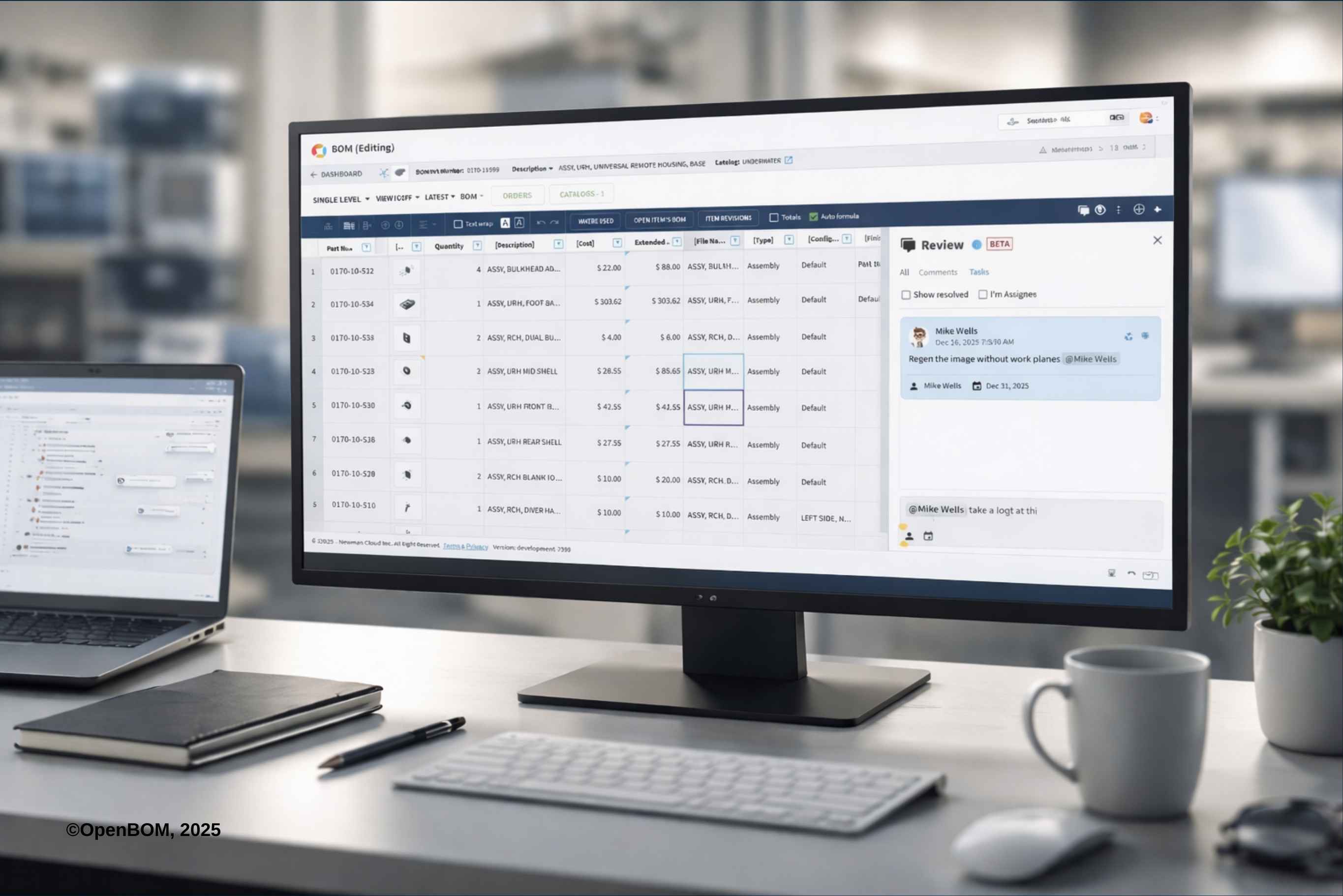
Comments and Tasks Together Form OpenBOM Review
When we first started working on comments and tasks in OpenBOM, we were very intentional about not treating them as isolated features.
A comment by itself is useful, but limited. It captures an opinion, a question, or a concern, but it does not tell you what happens next.
A task by itself is also useful, but incomplete. It captures an action, but often without enough context about why that action exists in the first place.
In real engineering work, these two things are inseparable.
A discussion leads to an action. An action leads to another discussion. Decisions are made somewhere in between.
That is why we treat comments and tasks together as an OpenBOM Review.
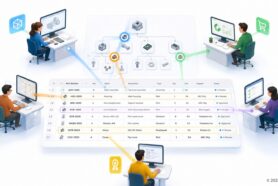
OpenBOM Review is not a separate module and not a parallel workflow. It is a collaborative layer that sits directly on top of BOM data. Comments attach to real items, real structures, and real product information.

Tasks grow out of those comments and remain connected to the same context.

Instead of exporting a BOM to discuss it, the discussion happens on the BOM itself. Instead of copying a line item into an email, the task references the actual object that needs attention.
This might sound like a small shift, but it changes how teams work. It moves collaboration closer to the data, instead of forcing data to follow collaboration tools that were never designed for product structures.
Bringing Conversations Back from Email and Links
The initial goal of OpenBOM Review is deliberately simple.
We want to bring the discussions that are happening today in emails and shared links back into the OpenBOM environment.
Most teams already have collaboration tools. They are not lacking chat applications, project trackers, or messaging platforms. What they are lacking is product context inside those conversations.
When a discussion happens in email, the BOM becomes an attachment. When it happens in Slack, the BOM becomes a screenshot. When it happens in a spreadsheet, the BOM becomes a copy that starts diverging from reality.
Once that happens, traceability is lost. It becomes very hard to answer basic questions later. Why was this component changed? Who raised the concern? What alternatives were considered? Was this a temporary workaround or a final decision?
Traditional PLM systems tried to solve this with rigid workflows and forms. The result was often the opposite of what teams wanted. Instead of enabling discussion, they pushed it outside the system because the process was too heavy.
We took a different approach.
OpenBOM Review does not force decisions into predefined templates. It does not assume that every discussion immediately leads to an ECO. It simply creates a space where conversations can exist next to the data they reference.
This is the missing layer that sits between informal collaboration and formal change management.
Why BOM Review Needs Its Own Space
One of the key ideas behind OpenBOM Review is that not every change is ready to become a change.
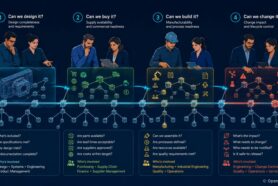
Engineering teams explore options. Manufacturing teams question feasibility. Procurement teams raise concerns about availability or lead time. These conversations are exploratory by nature.
If you force all of that into an ECO process too early, people resist using it. If you keep it outside the system entirely, you lose the history.
BOM Review creates a middle ground.
It allows teams to review, comment, and assign tasks without committing to a formal change workflow too early. At the same time, it keeps everything connected to the product structure, so nothing gets lost.
This is not about replacing ECOs or approvals. It is about preparing better inputs for them.
Watch the First Demo of OpenBOM Review
This brings me to the main reason for this article.
We are sharing the first video demo of OpenBOM Review, showing comments and tasks working together inside OpenBOM. It is a first demo of how we envision BOM Review works today.
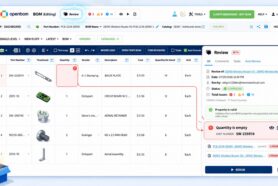
In the demo, you will see how comments can be added directly to BOM items and structures. You will see how tasks can be created from those discussions and tracked without exporting data or switching tools. You will see how to review the activity and tasks dashboard and connect it to the overall BOM activities as it evolves.
The goal of this first demo is not to show everything OpenBOM Review will become. It is to show the foundation we are building on.
As you watch the demo, I encourage you to think about your own workflows. Where do BOM discussions happen today? What gets lost between review and release? What would it change if those conversations lived with the data instead of outside it?
OpenBOM Review Is Not Another Chat Tool
It is important to clarify what OpenBOM Review is not.
It is not a generic chat application. It is not a replacement for Slack or Teams. It is not a project management system.
Those tools are very good at what they do. But they are not designed to understand product structures, multi-level BOMs, or the relationships between parts, assemblies, and suppliers.
OpenBOM Review is intentionally product-aware.
A comment is not just text. It is anchored to a specific item, attribute, revision, or structure. A task is not just an action. It is connected to the data that needs to change or be evaluated.
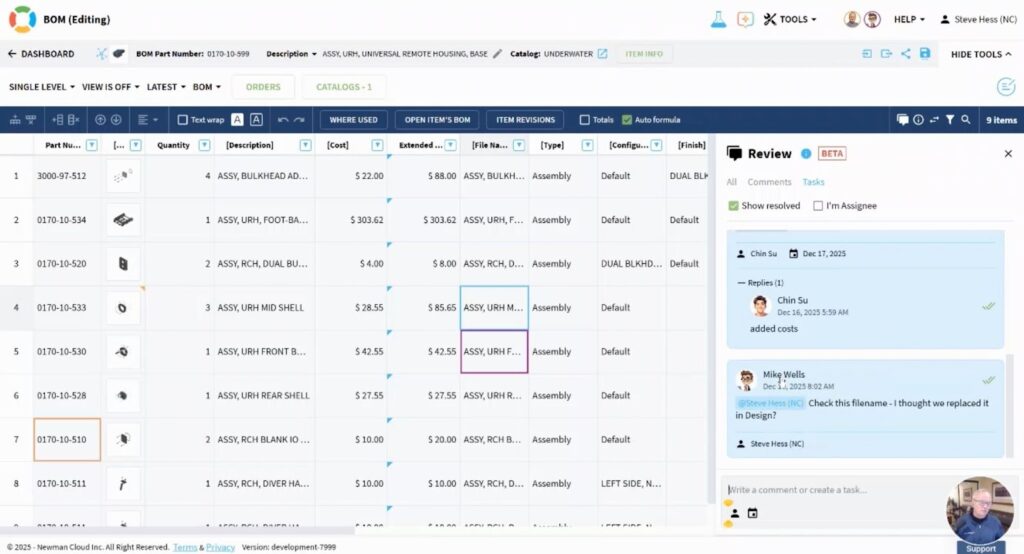
This difference matters when products become complex and teams become distributed.
What Is Coming Next?
The demo you see today is just the beginning.
OpenBOM Review will enter Beta later in December. During this phase, we want to work closely with customers who are actively reviewing BOMs and struggling with fragmented collaboration.
We are looking for design partners and first customers who want to shape how BOM Review evolves. This includes feedback on usability, workflows, and integration points.
One of the most common requests we hear is integration with existing collaboration tools. That is why integrations with tools like Slack, Jira, and project management platforms are part of our roadmap. The goal is not to duplicate those tools, but to connect them in a way that preserves product context.
We are also working toward tighter integration between OpenBOM Review and ECO workflows. Over time, review discussions should be able to flow naturally into formal change processes without re-entering information or losing history.
Looking further ahead, BOM Review is a key building block for AI agents inside OpenBOM. Once discussions, decisions, and tasks are captured in a structured way, it becomes possible for AI to assist with impact analysis, recommendations, and validation.
This is not about replacing human judgment. It is about supporting it with better data.
Why This Matters More Than Ever
Manufacturing organizations are becoming more complex. Products have more variants, more suppliers, and more constraints. At the same time, teams are more distributed than ever.
In this environment, relying on informal communication to make product decisions is risky. But forcing everything into rigid systems too early is equally problematic.
OpenBOM Review is our attempt to address this balance.
It creates a space where teams can think together before they change together.
Conclusion: First Demo, First Feedback
We are excited to share this first demo of OpenBOM Review.
It represents a direction we believe is critical for modern product development. Bringing collaboration closer to data. Capturing decisions as they happen. Reducing the friction between discussion and action.
This is an early step, and feedback matters.
I invite you to watch the demo, reflect on how BOM review works in your organization today, and let us know what resonates and what does not. If you are interested in participating as an early user or design partner, we would love to hear from you.
OpenBOM Review is being built in the open, together with customers, and this first demo is just the beginning.
You can REGISTER FOR FREE to create an instant OpenBOM trial for 14 days and check BOM Review once it becomes available later this week.
Best, Oleg
Join our newsletter to receive a weekly portion of news, articles, and tips about OpenBOM and our community.