

Ambient Biosciences makes temperature-sensitive biomolecules stable at room temperature. Its freeze-free stabilization technology turns liquid reagents such as antibodies, enzymes, and DNA/RNA into products that can be stored and shipped without a cold chain. The company builds both the equipment and the consumables that make the process work, and manufactures them at its facility in Ann Arbor, Michigan.
Tejasvi Chunduri, Director of Engineering and Manufacturing at Ambient Biosciences, leads the work of turning that technology into products the company can build, buy for, and sell repeatedly. As Ambient moved from the lab to the market, that meant replacing local Excel BOMs with structured product data and connecting it to NetSuite without asking a small team to re-enter every engineered component by hand.
Watch the video
Commercialization Starts When the BOM Stops Living on Somebody’s Laptop
A technology that works in the lab is not yet a product a company can manufacture. To sell equipment and consumables, Ambient needed every part, raw material, and assembly behind them defined in a form the whole business could rely on.
As Tejasvi describes it:
“We really started transitioning from the lab to the market. We needed something to get everything organized and to actually have formal BOMs, which are not just on somebody’s Excel sheet locally.”
A BOM in a local spreadsheet works for the person who maintains it. It does not work as the basis for purchasing, inventory, and production in an ERP system. That gap became urgent as Ambient began setting up NetSuite.
New Products Should Start from a Catalog, Not a Blank Spreadsheet
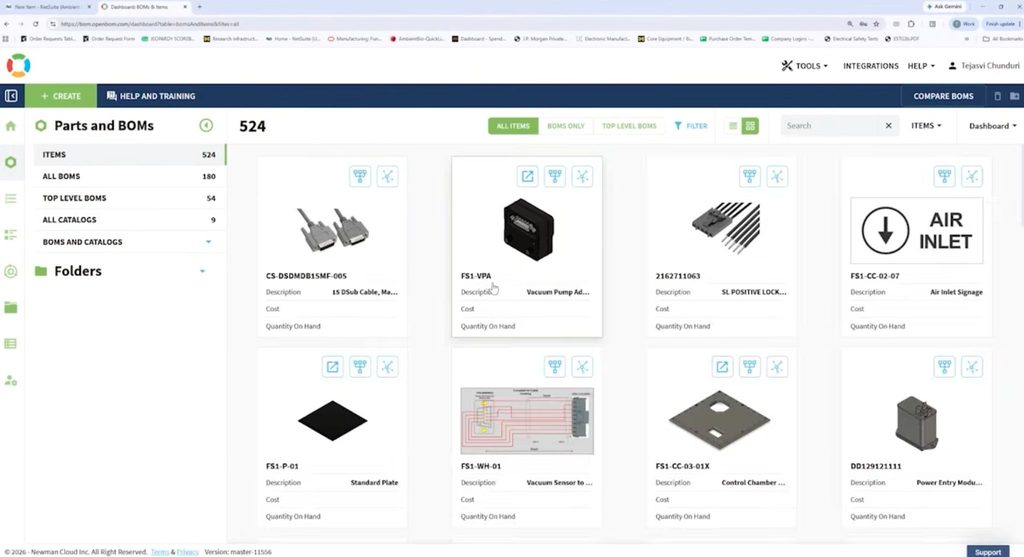
OpenBOM gave Ambient a catalog of raw materials and components that every new product draws from. When the team defines a new BOM or SKU, it pulls existing item records instead of re-creating part numbers, descriptions, and vendor information from scratch.
Tejasvi puts the catalog at the center of what he values most:
“What I like about OpenBOM the most is the automation it offers us and having a catalog system of raw materials that we can draw from to create new BOMs, create new SKUs, and transfer them in a single click to NetSuite. That’s been really beneficial to us.”
Reuse is the point. An item defined once in the catalog is the same item in every BOM that uses it, and the same item when it arrives in NetSuite.
Porting an Engineered System into ERP by Hand Is a Tax a Small Team Cannot Afford
ERP needs every item and every assembly. For a company building its own equipment, that means cables, PCBs, machined plates, enclosures, signage, and purchased components, each with a vendor and a place in a multi-level structure. Entering all of that manually, and keeping it current as designs change, is ongoing work that never ships a product.
Tejasvi is direct about what the alternative would have cost:
“Being able to automate a lot of these workflows instead of having to manually port item by item every single element of our engineered systems onto an ERP system would have been a massive drain of resources.”
With OpenBOM, engineering data flows from CAD into structured items and BOMs, and from there into NetSuite. The team works on the design and the product structure. The transfer is handled by the integration.
An Integration Is Finished Only When It Matches How the Team Works
Every company sets up NetSuite a little differently: item types, fields, vendor records, and how assemblies are represented. Ambient worked directly with the OpenBOM team on a project to tailor the NetSuite integration to its own setup.
“We did a whole project with OpenBOM’s team where they customized their integration with NetSuite for us, and it performs exactly how we wanted it to.”
The result is visible inside NetSuite itself. An assembly item such as the FS1-VPA vacuum pump adapter carries its OpenBOM BOM, with part numbers, quantities, descriptions, and vendors such as JLCPCB and Digi-Key, so the people working in ERP see the same structure engineering defined.

Labor Time Is the Return That Pays for Itself
Asked about the value OpenBOM brings, Tejasvi does not start with features. He starts with people’s time.
“The biggest value that OpenBOM has provided us is really time and efficiency, and labor time especially, because again, we’re a small group of people.”
In a small company, the engineer who would spend days porting items into ERP is the same engineer designing the next instrument or bringing up manufacturing. Removing that work does not just save hours. It returns them to the work that moves products to market.
“With OpenBOM we can just do that very intuitively, straight from CAD, and that is a huge benefit for us. And that pays for itself.”
Data That Moves Once Is What Lets a Small Team Scale
Ambient’s experience shows a simple pattern for companies crossing from development into production. Define raw materials and components once, in a catalog. Build new BOMs and SKUs from that catalog. Move the result from CAD to NetSuite through an integration that fits the company’s own ERP setup, instead of retyping it.
For a small team commercializing a new technology, that is the difference between engineers maintaining data and engineers building products.
If your team is managing BOMs in local spreadsheets and re-entering engineering data into ERP, register for free to OpenBOM and see how a connected CAD, BOM, and NetSuite workflow can work for you.
Learn more about Ambient Biosciences and OpenBOM.
Join our newsletter to receive a weekly portion of news, articles, and tips about OpenBOM and our community.